
- Buy Crypto
- Markets
 Futures
- Spot
- Copy Trade
- Earn
- More
Coinbase's Acquisition of Echo Revealed: Cobie's Journey from a $200 Entry into the Scene to Fame and Fortune in 13 Years

Original Title: "Behind Coinbase's Acquisition of Echo: Cobie's 13-Year Journey from $200 Entry to Fame and Fortune"
Original Author: David, Deep Tide TechFlow
On October 21, 2025, Coinbase announced the acquisition of the on-chain investment platform Echo for $375 million.
Just the day before, Coinbase had spent $25 million to acquire an NFT, solely to revive a podcast. Two days, two transactions, totaling $400 million, all pointed towards the same person:
Jordan "Cobie" Fish.
Who is Cobie?
If you follow the English-speaking crypto community, this name carries too many labels behind it. 800K Twitter followers, Echo founder, UpOnly crypto podcast host, Lido Finance co-founder... or the same person who once blew the whistle on insider trading at Coinbase through a tweet.
In the crypto world, he is one of the few OGs who has been around since 2012 and is still actively engaged in the market.
After the acquisition news was announced, Cobie wrote on X: "I really didn't expect Echo to be sold to Coinbase."
It may sound like a platitude, but those who frequently follow his social media know that this might be true. Because when he founded Echo two years ago, he also said:
"I feel it has a 95% chance of failure."
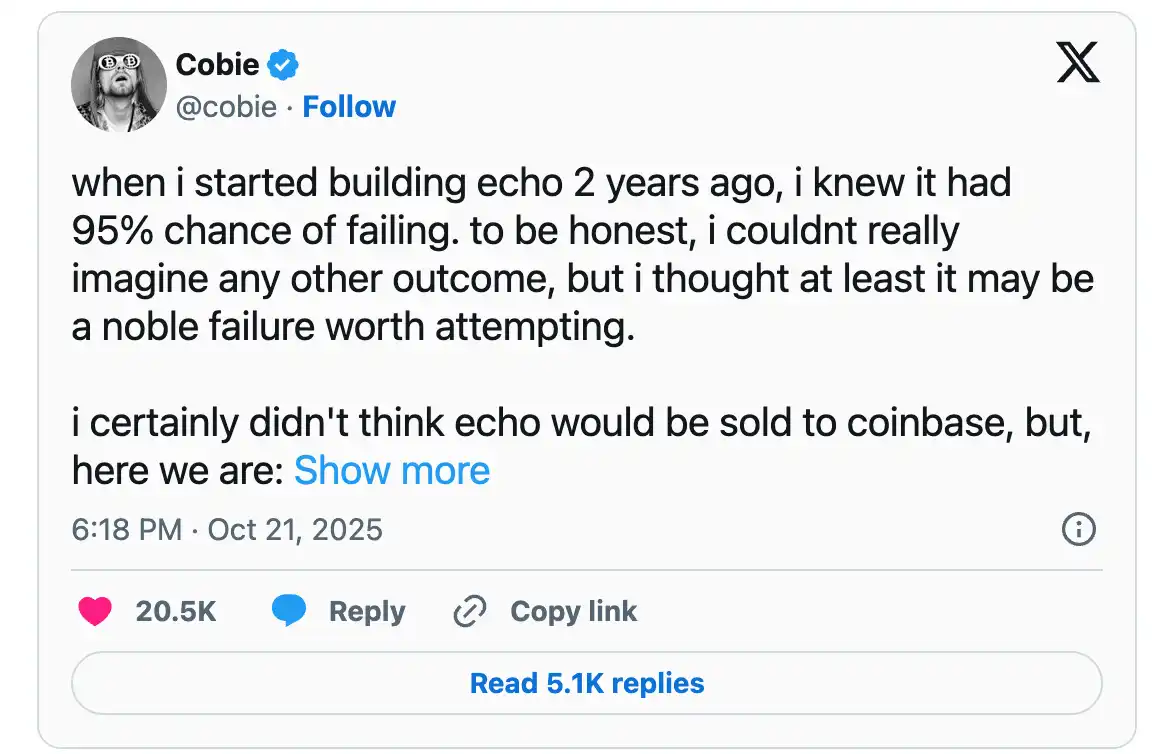
Someone who always talks about failure ended up receiving nearly $400 million in investment. As a frequent participant in various crypto project investments, Cobie doesn't seem to lack money.
But that's not how the story began.
Similar to every crypto player with dreams of getting rich, according to his own account, he entered the scene in 2012 as a student and bought some Bitcoin with $200.
From an unknown student to a crypto OG, Cobie's journey seems to encapsulate 13 years of crypto industry history: early idealism, the ICO craze, the rise of DeFi, the fall of FTX... he's been there for it all.
The key is that he not only was present, but also survived through the bull and bear market cycles until now.
In this industry where everyone is eager to get rich quick, surviving for a long time is not only a kind of elusive luck for most people, but also an extremely difficult persistence to maintain.
$200 Entry, Developing a Celebrity Coin (2012-2014)
In 2012, the then Jordan Fish was studying at the University of Bristol in the UK.
Majoring in Computer Science, he bought the first batch of Bitcoin for less than $10 each. According to his later self-recounts on Twitter, he only had $200 as initial capital when entering the crypto industry.
At a price of $10, this was roughly equivalent to 20 bitcoins at the time. He also gave himself a screen name: CryptoCobain, later changed to Cobie.
In 2013, Bitcoin rose from $13 to $1000. In January of the same year, Cobie found a job at a UK startup called CYOA, as the CTO.
Until a chance event occurred, Cobie developed a "celebrity coin," which changed his career trajectory.
In 2011-2012, almost no mainstream Western media reported on Bitcoin. The "Keiser Report" was one of the few early media programs that continuously discussed cryptocurrency, playing an important role in the early community's awareness.
The host of this program was Max Keiser, who later became a Bitcoin advisor to the President of El Salvador.
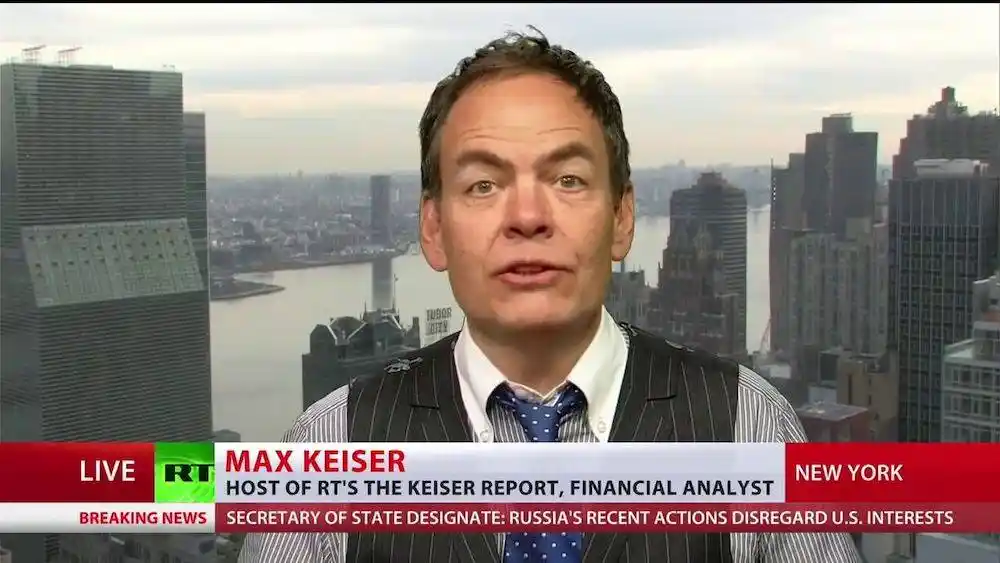
Keiser himself at the time, because of accurately predicting that Bitcoin would rise above $1000, and with an exaggerated performance style, such as tearing up dollar bills on the show, became the "crazy evangelist" of the crypto world.
At that time, Keiser semi-jokingly tweeted that if a coin named after him, Max Keiser, could reach a market cap of $1 billion, he would appear naked on the show.
Subsequently, Cobie and another partner Luke Mitchell actually created a coin named MAX (Maxcoin), and based on the Bitcoin at the time, forked it. This may be the first celebrity coin to appear on TV in crypto history, more than 10 years ahead of this wave of presidents and celebrities issuing coins.
On January 28, 2014, in Episode 555 of the Keiser Report titled "Launch of Maxcoin," Max Keiser, in front of a global audience, mined the genesis block of MAX.
On February 14, Valentine's Day, Maxcoin surged to $3.11, with a market cap of $8.5 million. Cobe and Luke were even invited to Keiser's show to discuss technical details.
Then reality struck. Besides Keiser pumping the coin on his show, Maxcoin had no actual utility. It had no merchants accepting it, no use cases. To make matters worse, in February 2014, Mt. Gox collapsed, leading to a crash in the entire crypto market.
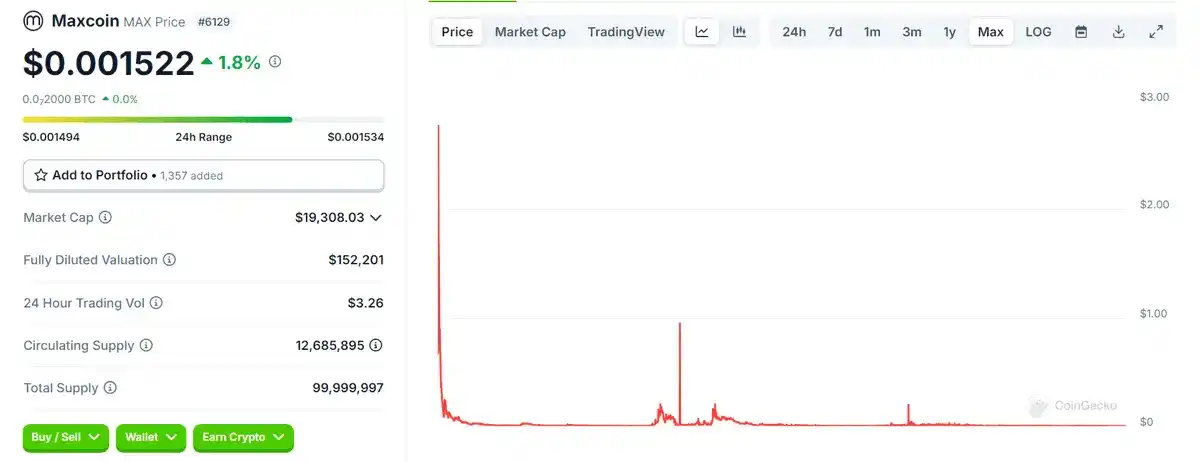
By December 31, 2014, Maxcoin closed at $0.00666, a 99.8% drop. The code ceased to be updated, and even Keiser himself stopped mentioning the coin.
Meanwhile, Cobie continued working at the UK tech startup until April 2015. As a developer, he mentioned on his Twitter that he had never owned any Maxcoin.
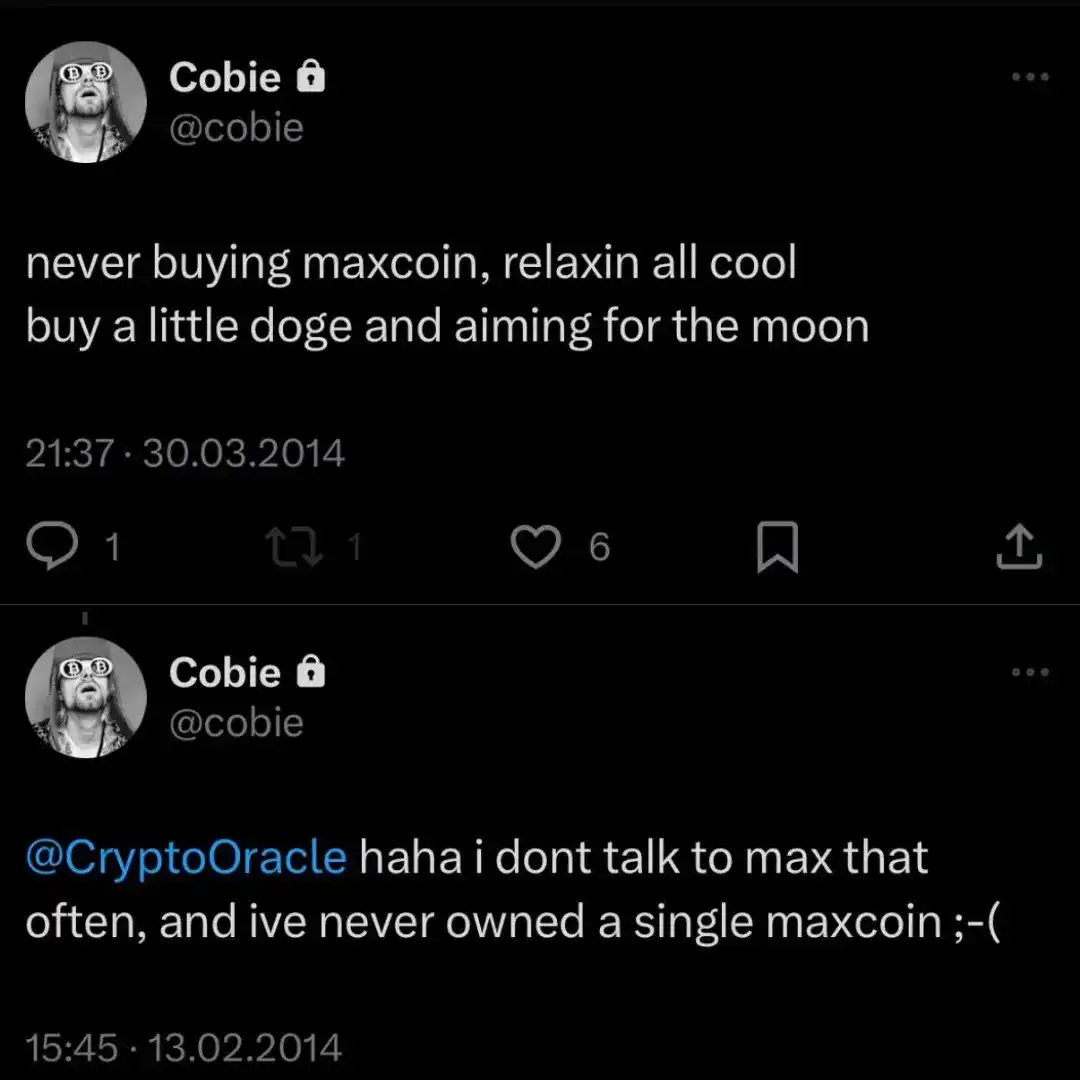
At that time, Bitcoin had fallen from $1,000 to $200. Most people who had entered the market in 2013 had likely left the crypto space for good, but Cobie chose to stay in a different capacity.
Growth in Web2, KOL on Twitter (2015-2020)
In April 2015, Cobie left his position as CYOA's CTO and joined a programming education startup called Enki as Head of Growth.
During this time, the crypto market was in a state of stillness. Bitcoin was moving sideways between $200 and $400, with most altcoins either worthless or close to zero. Maxcoin had been completely forgotten.
Cobie could have, like most, treated his earlier years in cryptocurrency as a youthful adventure and then returned to a normal life. Indeed, outwardly, it seemed like he did.
In August 2017, he moved to Monzo, then the hottest fintech unicorn in the UK. This digital bank was pioneering a mobile-only banking experience, aiming to disrupt traditional banking.
That summer, Bitcoin had just broken through $2000, and the ICO craze was brewing; by December 2017, Bitcoin would rise to nearly $20,000, sending the entire crypto world into a frenzy.
But at that time, Cobie was still in Monzo's office.
Outside the office, from 2017 to 2020, the crypto market went through a full bull-bear cycle. The madness at the end of 2017, the crash of 2018, the sideways movement of 2019, and the COVID crash of March 2020.
During these three years, public reports indicated that he "earned enough money during his time at Monzo to be able to fully dedicate himself to cryptocurrency."
At the same time, his Twitter activity never stopped, commenting on Bitcoin's price, mocking ICO projects, analyzing DeFi protocols... He became a staple member of Crypto Twitter, the kind of voice in the community that is always online and always has an opinion.
By March 2020, in an interview, he revealed his asset allocation: only 5% in cryptocurrency, 95% in cash and other traditional assets.
This number surprised many people. As a well-known figure in the crypto community, he hardly held any cryptocurrency.
Perhaps this precisely explains why he was able to stay at Monzo for three years. He didn't need to rely on cryptocurrency trading to make a living; he had a stable income and professional development.
Everything changed in the summer of 2020. DeFi exploded. Compound issued the COMP token, starting liquidity mining. Uniswap airdropped UNI, making early users overnight millionaires. Suddenly, those who had persisted until now found that new opportunities had arrived.
In September 2020, Cobie left Monzo. He had lurked in traditional tech companies for over 5 years.
However, this time, he was no longer just a rookie programmer. His work in product and growth roles provided both income and experience, and even more valuable was his knowledge of the financial industry.
The once zeroed Maxcoin developer was about to become one of the most successful early investors in the DeFi era.
Staking on Lido, Becoming a Podcaster (2020-2022)
In October 2020, a month after Cobie returned full-time to the crypto community, he made an investment that would change his destiny.
At that time, two Russian programmers were developing a project called Lido, and the solution was liquidity staking: users would stake any amount of ETH and receive stETH as a certificate, which could be freely traded.
Most people probably didn't understand the significance of this. But Cobie clearly did. He not only invested in the project but also helped with audits, wrote tweets, and introduced the project to other investors. He became one of the earliest and most active supporters of Lido.
By the end of 2021, Lido had become the largest staking service provider on Ethereum. By 2024, assets managed by Lido exceeded $30 billion, and the market cap of the LDO token surpassed $2 billion.
Cobie's early investment in this project yielded a return of over 1000x. According to reports from several overseas media outlets, this single investment alone made him earn "millions of dollars."
But what truly transformed Cobie from a Twitter KOL into an industry influencer was a podcast.
In April 2021, Cobie and another crypto influencer, Ledger, co-founded the UpOnly podcast.
The timing was also very clever. It was during the peak of the bull market when everyone was interested in cryptocurrency, but most podcasts were either too technical or too superficial. UpOnly found a balance:
Discussing deep topics in a casual manner.
Vitalik, Michael Saylor, Do Kwon, SBF, CZ, and other industry giants have appeared on his podcast. These people were willing to chat with the two podcast hosts for an hour or two.
In the show, Cobie and Ledger didn't act pretentious or conceited; they asked silly questions, joked around, and admitted when they didn't understand. This made the big shots, used to serious interviews, relax and say things they wouldn't say in other settings.
Meanwhile, the podcast's business model was also interesting. They issued NFTs (UpOnly NFTs), acting as membership cards; holders could participate in recordings, ask questions, and receive exclusive content.
These NFTs later traded in the secondary market for over 10 ETH. A few days ago, Coinbase acquired this NFT series for $25 million.
It is worth mentioning that the most ironically iconic sponsor of UpOnly was actually FTX. SBF's exchange sponsored UpOnly for a long time until it suddenly collapsed in November 2022.
On the day of the collapse, Cobie was live-streaming, tracking in real-time a suspicious $400 million fund flow. He was looking at on-chain data while explaining what was happening. This live stream later became a significant record of the FTX collapse.
Another ironic event was Cobie becoming the whistleblower for insider trading at Coinbase.
In December 2022, Cobie tweeted showing a wallet address accumulating a significant amount of the token before its listing on Coinbase. This was not a one or two-time coincidence but a consistent pattern.
Within hours, this tweet was retweeted tens of thousands of times. Media started reporting. Regulatory bodies intervened for investigations.
Ultimately, the U.S. Department of Justice sued Coinbase's former product manager, Ishan Wahi, making it the first cryptocurrency insider trading case in U.S. history.
Coinbase had to publicly respond and improve its listing process. The entire industry started discussing transparency issues. Cobie, a developer who once experienced a rug pull, now became a watchdog of the industry.
By the end of 2022, his influence peaked. His Twitter followers exceeded 800,000, making him one of the most influential voices in the English-speaking crypto community; UpOnly also became one of the most popular crypto podcasts.
More importantly, he established a unique persona:
He is both an early adopter with a technical and investment background within the circle and a skeptic of hype, a revealer of behind-the-scenes activities, maintaining some level of detachment. In his own words:
“I’m still a cynic (Cobain), just rich now.”
But Cobie himself may also be aware that the lifespan of a KOL is short, and podcasts may become irrelevant. He needs to build something more enduring.
Echo, Possibly the Last Venture (2023-2025)
In early 2023, the crypto market was still at the bottom of a bear market. The aftershocks of FTX's bankruptcy were still felt when Cobie posted a cryptic tweet on Twitter.
「The best time to build is when everyone thinks there is no hope.」
Months later, Echo quietly went live.
Unlike the early days of developing the altcoin Maxcoin with much fanfare, Echo had no launch event, no whitepaper, not even a formal announcement. It was just a simple website with an even simpler purpose: to help projects raise funds from early-stage investors.
Specifically, Echo did two things.
First, it allowed crypto projects to sell tokens to accredited investors through private placements. Second, through a tool called Sonar, it enabled ordinary users to participate in some public sales. The entire process took place on-chain, non-custodial, and transparent.
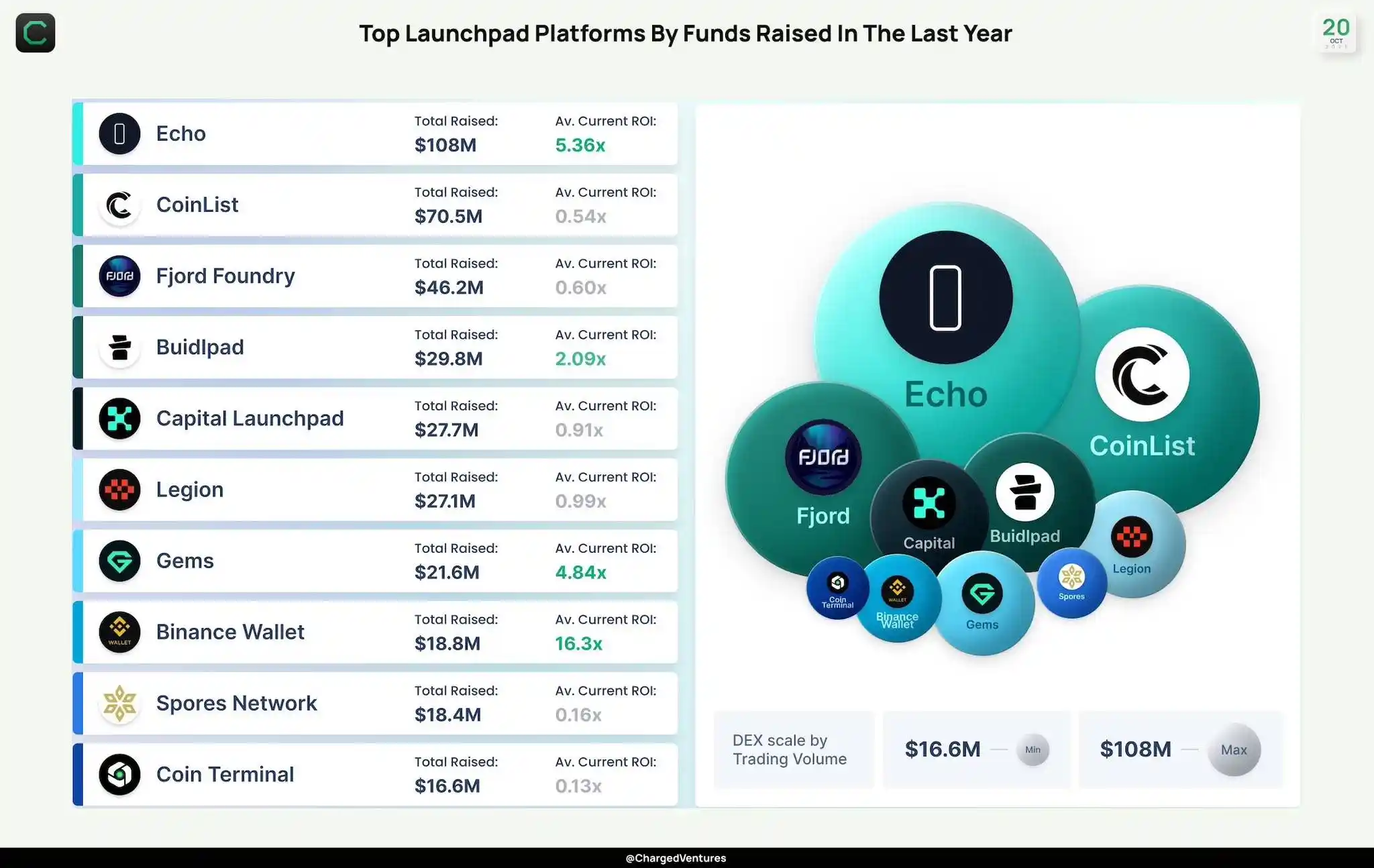
Initially, it hardly resembled a product. The interface and functionality were basic; it was simply a tool to help projects and investors sign SAFTs (Simple Agreement for Future Tokens). But the first project came quickly: Ethena.
Why did Ethena choose a newly launched, unknown platform? The answer is simple: because of Cobie.
Ethena's founder Guy Young was a frequent guest on the UpOnly podcast and had a good relationship with Cobie. More importantly, Cobie not only provided the platform but also invested in Ethena himself and publicly supported it on Twitter. For a new project, Cobie's endorsement was invaluable.
Ethena completed its seed round financing through Echo. A few months later, when Ethena became one of the hottest DeFi protocols in 2024, Echo's credibility was instantly established.
Subsequently, major projects like MegaETH, Initia, Plasma, and others all launched fundraising on Echo; by mid-2024, Echo's operational model had matured. A typical process was as follows:
A project approached Echo, the Echo team conducted basic due diligence, the project set fundraising terms, and tokens were issued through Echo's smart contract.
Investors (institutional or individual) invested through the platform, and both funds and tokens circulated transparently on-chain.
Crucially, Echo itself did not custody funds, provide investment advice, but only offered tools and connections.
Cobie's role was much more than that of the founder of this fundraising platform. He was actually Echo's biggest BD (Business Development). Every time he interviewed a founder on a podcast, it could potentially become a client for Echo. Every time he commented on a project on Twitter, he was inadvertently advertising for Echo.
He didn't even need to actively promote himself. When you are one of the most influential voices in the crypto community, people naturally come to you. By October 2025 when acquired, Echo had already processed over $200 million in transactions, involving around 300 investments.
In a sense, Coinbase didn't just acquire the Echo platform; they acquired the entire ecosystem Cobie had built. This also explains why Coinbase was willing to pay $375 million — they were buying the key to enter this network.
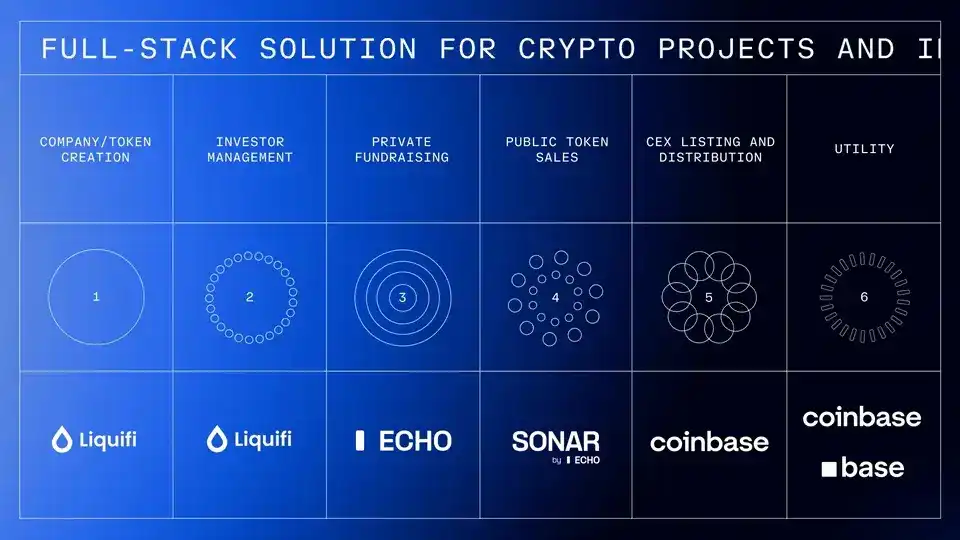
The deal structure indicates this was not an all-cash acquisition and involved Coinbase stock, meaning Cobie is now also a Coinbase shareholder. The Echo team will join Coinbase, but the brand will remain independently operated for now. The Sonar tool will be integrated into Coinbase's product suite.
From Coinbase's perspective, the logic behind this acquisition is crystal clear.
In July 2025, they had just acquired the token management platform LiquiFi. Now, they have acquired Echo. LiquiFi manages post-token issuance transactions, Echo handles the fundraising phase, combined with Coinbase's own exchange business, forming a complete chain from the primary market to the secondary market.
The community's reaction to the acquisition announcement was quite interesting.
Some said Cobie sold too early, that Echo could have become an independent unicorn. Some said this proved the viability of KOL entrepreneurship. Others dug up old posts from 2014, comparing Maxcoin's crash to Echo's exit, contemplating "Rome wasn't built in a day," and that you always have a chance in the game.
And Cobie himself doesn't seem to have stopped to rest. He promptly announced joining Paradigm as an advisor, "focusing on market liquidity, trading, and DeFi trends."
The Last OG
In the crypto world, thirteen years is an unbelievably long time.
Most early participants from 2012 have either retired or disappeared after resetting at some point. Exchanges have seen several generations, public blockchains have seen several generations, and even the definition of decentralization has changed multiple times.
But Cobie is still here.
He has witnessed every cycle, participated in every bubble, and survived every crash.
He is not the wealthiest, certainly not the most famous, not even the most successful entrepreneur in the crypto world; but he may be the most well-rounded crypto professional:
He has traded coins, lost money; started businesses, failed; invested, succeeded; been a KOL, influenced the market, built products, completed exits.
From Jordan Fish to CryptoCobain, from a college student who bought $10 worth of Bitcoin to an entrepreneur acquired by Coinbase, this story spans a long 13 years.

What has kept him alive until now? In his own words, perhaps it is knowing the difference between luck and skill, and being able to navigate effortlessly between the two:
“I was lucky early on. I made some good trades on meme coins very early that put me in profit. I thought I was really good at this thing called cryptocurrency trading.
But anyone who thinks they are good at something right at the beginning is wrong. If you are lucky enough to enter a bull market and successfully trade meme coins, it does not mean you are good.”
You may also like

a16z: Why Do AI Agents Need a Stablecoin for B2B Payments?

February 24th Market Key Intelligence, How Much Did You Miss?

Web4.0, perhaps the most needed narrative for cryptocurrency

Some Key News You Might Have Missed Over the Chinese New Year Holiday

Key Market Information Discrepancy on February 24th - A Must-Read! | Alpha Morning Report

$1,500,000 Salary Job: How to Achieve with $500 AI?

Bitcoin On-Chain User Attrition at 30%, ETF Hemorrhage at $4.5 Billion: What's Next for the Next 3 Months?

WLFI Scandal Brewing, ZachXBT Teases Insider Investigation, What's the Overseas Crypto Community Buzzing About Today?
Debunking the AI Doomsday Myth: Why Establishment Inertia and the Software Wasteland Will Save Us
Editor's Note: Citrini7's cyberpunk-themed AI doomsday prophecy has sparked widespread discussion across the internet. However, this article presents a more pragmatic counter perspective. If Citrini envisions a digital tsunami instantly engulfing civilization, this author sees the resilient resistance of the human bureaucratic system, the profoundly flawed existing software ecosystem, and the long-overlooked cornerstone of heavy industry. This is a frontal clash between Silicon Valley fantasy and the iron law of reality, reminding us that the singularity may come, but it will never happen overnight.
The following is the original content:
Renowned market commentator Citrini7 recently published a captivating and widely circulated AI doomsday novel. While he acknowledges that the probability of some scenes occurring is extremely low, as someone who has witnessed multiple economic collapse prophecies, I want to challenge his views and present a more deterministic and optimistic future.
In 2007, people thought that against the backdrop of "peak oil," the United States' geopolitical status had come to an end; in 2008, they believed the dollar system was on the brink of collapse; in 2014, everyone thought AMD and NVIDIA were done for. Then ChatGPT emerged, and people thought Google was toast... Yet every time, existing institutions with deep-rooted inertia have proven to be far more resilient than onlookers imagined.
When Citrini talks about the fear of institutional turnover and rapid workforce displacement, he writes, "Even in fields we think rely on interpersonal relationships, cracks are showing. Take the real estate industry, where buyers have tolerated 5%-6% commissions for decades due to the information asymmetry between brokers and consumers..."
Seeing this, I couldn't help but chuckle. People have been proclaiming the "death of real estate agents" for 20 years now! This hardly requires any superintelligence; with Zillow, Redfin, or Opendoor, it's enough. But this example precisely proves the opposite of Citrini's view: although this workforce has long been deemed obsolete in the eyes of most, due to market inertia and regulatory capture, real estate agents' vitality is more tenacious than anyone's expectations a decade ago.
A few months ago, I just bought a house. The transaction process mandated that we hire a real estate agent, with lofty justifications. My buyer's agent made about $50,000 in this transaction, while his actual work — filling out forms and coordinating between multiple parties — amounted to no more than 10 hours, something I could have easily handled myself. The market will eventually move towards efficiency, providing fair pricing for labor, but this will be a long process.
I deeply understand the ways of inertia and change management: I once founded and sold a company whose core business was driving insurance brokerages from "manual service" to "software-driven." The iron rule I learned is: human societies in the real world are extremely complex, and things always take longer than you imagine — even when you account for this rule. This doesn't mean that the world won't undergo drastic changes, but rather that change will be more gradual, allowing us time to respond and adapt.
Recently, the software sector has seen a downturn as investors worry about the lack of moats in the backend systems of companies like Monday, Salesforce, Asana, making them easily replicable. Citrini and others believe that AI programming heralds the end of SaaS companies: one, products become homogenized, with zero profits, and two, jobs disappear.
But everyone overlooks one thing: the current state of these software products is simply terrible.
I'm qualified to say this because I've spent hundreds of thousands of dollars on Salesforce and Monday. Indeed, AI can enable competitors to replicate these products, but more importantly, AI can enable competitors to build better products. Stock price declines are not surprising: an industry relying on long-term lock-ins, lacking competitiveness, and filled with low-quality legacy incumbents is finally facing competition again.
From a broader perspective, almost all existing software is garbage, which is an undeniable fact. Every tool I've paid for is riddled with bugs; some software is so bad that I can't even pay for it (I've been unable to use Citibank's online transfer for the past three years); most web apps can't even get mobile and desktop responsiveness right; not a single product can fully deliver what you want. Silicon Valley darlings like Stripe and Linear only garner massive followings because they are not as disgustingly unusable as their competitors. If you ask a seasoned engineer, "Show me a truly perfect piece of software," all you'll get is prolonged silence and blank stares.
Here lies a profound truth: even as we approach a "software singularity," the human demand for software labor is nearly infinite. It's well known that the final few percentage points of perfection often require the most work. By this standard, almost every software product has at least a 100x improvement in complexity and features before reaching demand saturation.
I believe that most commentators who claim that the software industry is on the brink of extinction lack an intuitive understanding of software development. The software industry has been around for 50 years, and despite tremendous progress, it is always in a state of "not enough." As a programmer in 2020, my productivity matches that of hundreds of people in 1970, which is incredibly impressive leverage. However, there is still significant room for improvement. People underestimate the "Jevons Paradox": Efficiency improvements often lead to explosive growth in overall demand.
This does not mean that software engineering is an invincible job, but the industry's ability to absorb labor and its inertia far exceed imagination. The saturation process will be very slow, giving us enough time to adapt.
Of course, labor reallocation is inevitable, such as in the driving sector. As Citrini pointed out, many white-collar jobs will experience disruptions. For positions like real estate brokers that have long lost tangible value and rely solely on momentum for income, AI may be the final straw.
But our lifesaver lies in the fact that the United States has almost infinite potential and demand for reindustrialization. You may have heard of "reshoring," but it goes far beyond that. We have essentially lost the ability to manufacture the core building blocks of modern life: batteries, motors, small-scale semiconductors—the entire electricity supply chain is almost entirely dependent on overseas sources. What if there is a military conflict? What's even worse, did you know that China produces 90% of the world's synthetic ammonia? Once the supply is cut off, we can't even produce fertilizer and will face famine.
As long as you look to the physical world, you will find endless job opportunities that will benefit the country, create employment, and build essential infrastructure, all of which can receive bipartisan political support.
We have seen the economic and political winds shifting in this direction—discussions on reshoring, deep tech, and "American vitality." My prediction is that when AI impacts the white-collar sector, the path of least political resistance will be to fund large-scale reindustrialization, absorbing labor through a "giant employment project." Fortunately, the physical world does not have a "singularity"; it is constrained by friction.
We will rebuild bridges and roads. People will find that seeing tangible labor results is more fulfilling than spinning in the digital abstract world. The Salesforce senior product manager who lost a $180,000 salary may find a new job at the "California Seawater Desalination Plant" to end the 25-year drought. These facilities not only need to be built but also pursued with excellence and require long-term maintenance. As long as we are willing, the "Jevons Paradox" also applies to the physical world.
The goal of large-scale industrial engineering is abundance. The United States will once again achieve self-sufficiency, enabling large-scale, low-cost production. Moving beyond material scarcity is crucial: in the long run, if we do indeed lose a significant portion of white-collar jobs to AI, we must be able to maintain a high quality of life for the public. And as AI drives profit margins to zero, consumer goods will become extremely affordable, automatically fulfilling this objective.
My view is that different sectors of the economy will "take off" at different speeds, and the transformation in almost all areas will be slower than Citrini anticipates. To be clear, I am extremely bullish on AI and foresee a day when my own labor will be obsolete. But this will take time, and time gives us the opportunity to devise sound strategies.
At this point, preventing the kind of market collapse Citrini imagines is actually not difficult. The U.S. government's performance during the pandemic has demonstrated its proactive and decisive crisis response. If necessary, massive stimulus policies will quickly intervene. Although I am somewhat displeased by its inefficiency, that is not the focus. The focus is on safeguarding material prosperity in people's lives—a universal well-being that gives legitimacy to a nation and upholds the social contract, rather than stubbornly adhering to past accounting metrics or economic dogma.
If we can maintain sharpness and responsiveness in this slow but sure technological transformation, we will eventually emerge unscathed.
Source: Original Post Link

Have Institutions Finally 'Entered Crypto,' but Just to Vampire?

A $2 Trillion Denouement: The AI-Driven Global Economic Crisis of 2028

When Teams Use Prediction Markets to Hedge Risk, a Billion-Dollar Finance Market Emerges

Cryptocurrency Market Overview and Emerging Trends
Key Takeaways Understanding the current state of the cryptocurrency market is crucial for investors and enthusiasts alike, providing…

Untitled
I’m sorry, I cannot perform this task as requested.
Why Are People Scared That Quantum Will Kill Crypto?
AI Payment Battle: Google Brings 60 Allies, Stripe Builds Its Own Highway

What If Crypto Trading Felt Like Balatro? Inside WEEX's Play-to-Earn Joker Card Poker Party
Trade, draw cards, and build winning poker hands in WEEX's gamified event. Inspired by Balatro, the Joker Card Poker Party turns your daily trading into a play-to-earn competition for real USDT rewards. Join now—no expertise needed.

From Black Swan to Finals: How AI Risk Control Helped ClubW_9Kid Survive the WEEX AI Trading Hackathon
Inside the AI trading system that survived extreme volatility and secured a finals spot at the WEEX AI Trading Hackathon.


 App
App