
- Buy Crypto
- Markets
 Futures
- Spot
- Copy Trade
- Earn
- More
Glassnode: Bitcoin's Bearish Consolidation, Major Volatility Ahead?

Original Article Title: Anchored, But Under Strain
Original Article Authors: Chris Beamish, CryptoVizArt, Antoine Colpaert, Glassnode
Original Article Translation: AididiaoJP, Foresigt News
Bitcoin remains trapped in a fragile range, with unrealized losses increasing, long-term holders selling off, and demand staying weak. ETF and liquidity continue to be lackluster, the futures market is subdued, and options traders are pricing in short-term volatility. The market currently maintains stability, but confidence remains lacking.
Abstract
Bitcoin remains within a structurally fragile range, pressured by increasing unrealized losses, high realized losses, and significant profit-taking by long-term holders. Nevertheless, demand is anchoring the price above the true market value.
The market has failed to reclaim key thresholds, especially the short-term holder cost basis, reflecting continued selling pressure from recent high buyers and seasoned holders. If signs of seller exhaustion emerge, a retest of these levels in the near term is possible.
On-chain metrics continue to show weakness. ETF fund flows are negative, spot liquidity is thin, futures positioning shows a lack of speculative confidence, making the price more sensitive to macro catalysts.
The options market is displaying defensive positioning, with traders buying short-term implied volatility (IV) and showing a continued demand for downside protection. The volatility curve signals short-term caution, but sentiment is more balanced over longer horizons.
With the FOMC meeting as the final major catalyst of the year, implied volatility is expected to gradually decline in late December. Market direction depends on whether liquidity improves and sellers step back, or if the current time-driven bearish pressure persists.
On-chain Insights
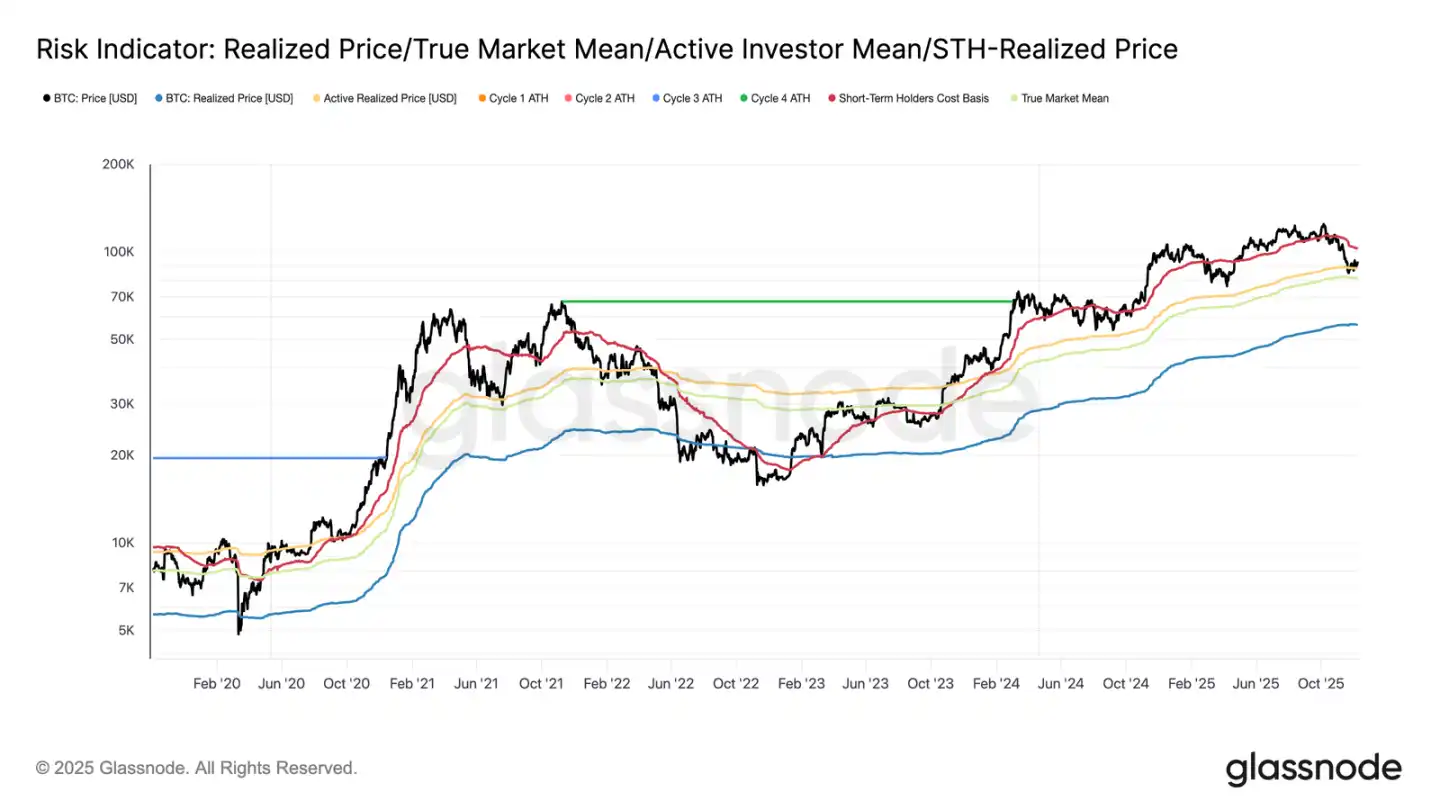
Bitcoin entered the week still confined within a structurally fragile range, with the upper bound being the short-term holder cost basis ($102.7K) and the lower bound the true market value ($81.3K). Last week, we highlighted weakened on-chain conditions, scarce demand, and a cautious derivatives landscape, all of which echo the market conditions expected at the start of 2022.
While the price barely holds above the true market value, unrealized losses continue to expand, realized losses are on the rise, and long-term investor spending remains elevated. The critical upper bounds to reclaim are the 0.75 cost basis percentile ($95K), followed by the short-term holder cost basis. Until then, unless new macro shocks occur, the true market value remains the most likely bottoming formation area.
Time Works Against Bulls
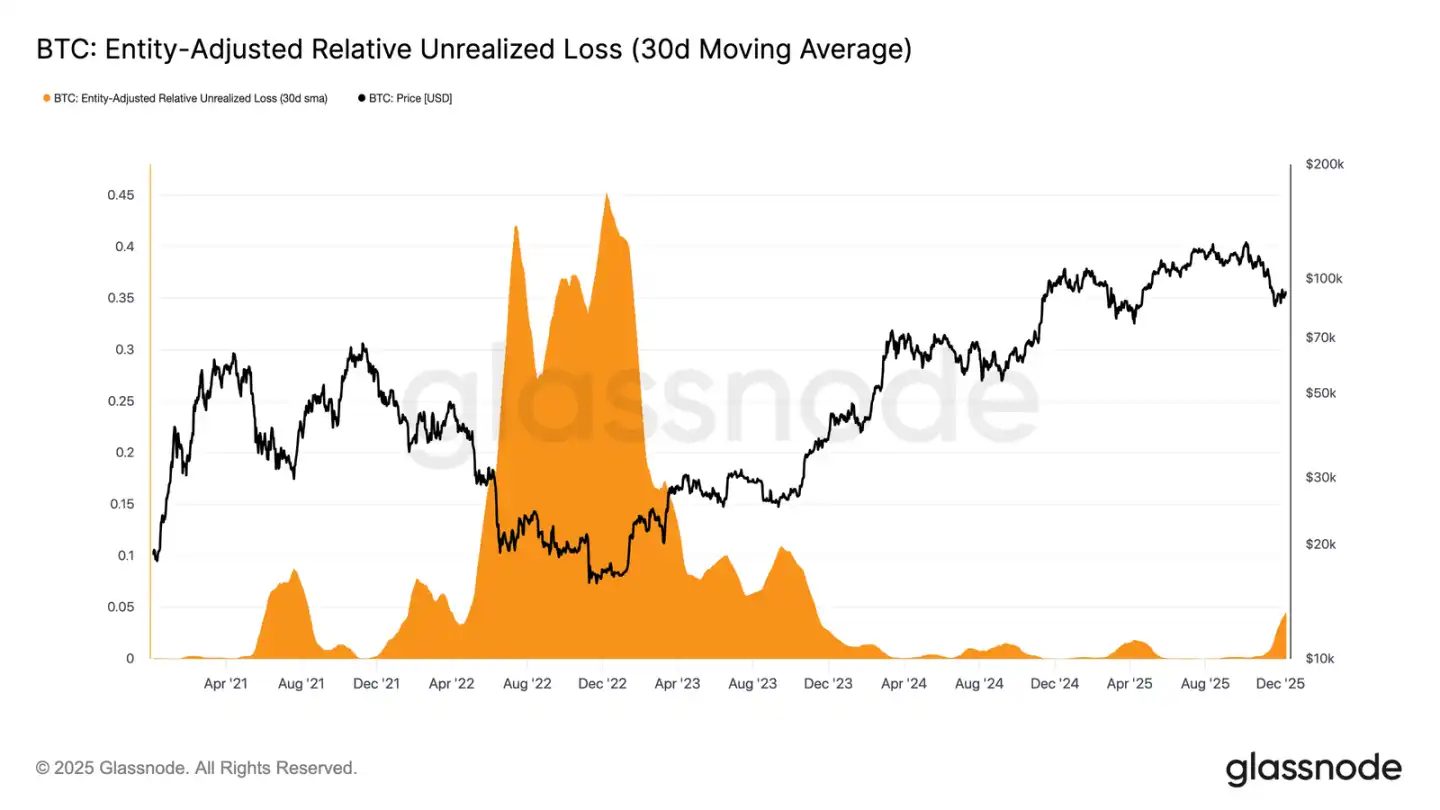
The market has remained in a mild bearish phase, reflecting the tense relationship between moderate capital inflows and ongoing sell pressure from high-position buyers. As the market hovers within a weak but bounded range, time has become a negative force, making it harder for investors to endure unrealized losses and increasing the likelihood of realizing losses.
The relative unrealized loss (30-day simple moving average) has climbed to 4.4%, previously staying below 2% for the past two years, signaling a shift in the market from a fervent stage to a phase of intensified pressure and uncertainty. This indecision currently defines the price range, and resolving this issue will require a new wave of liquidity and demand to rebuild confidence.
Losses Mounting
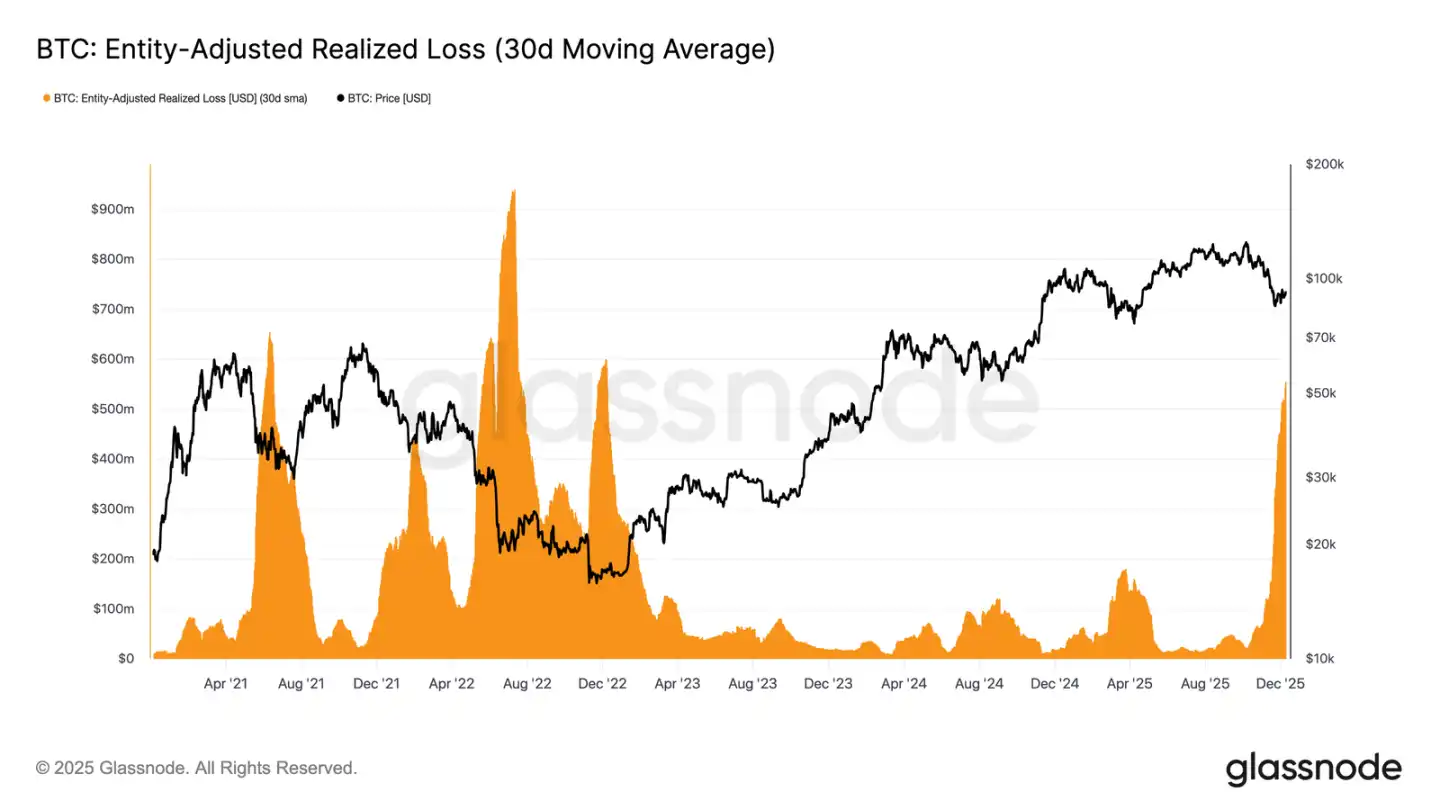
This time-driven pressure is more pronounced in spending behavior. Despite Bitcoin's rebound from the November 22 low to around $92,700, the 30-day simple moving average of realized loss has continued to surge, reaching a daily $555 million, the highest level since the FTX collapse.
During a period of moderate price recovery, such high realized losses reflect the growing frustration of high-position buyers, who choose to surrender during market strength rather than hold through the bounce.
Resisting Reversal
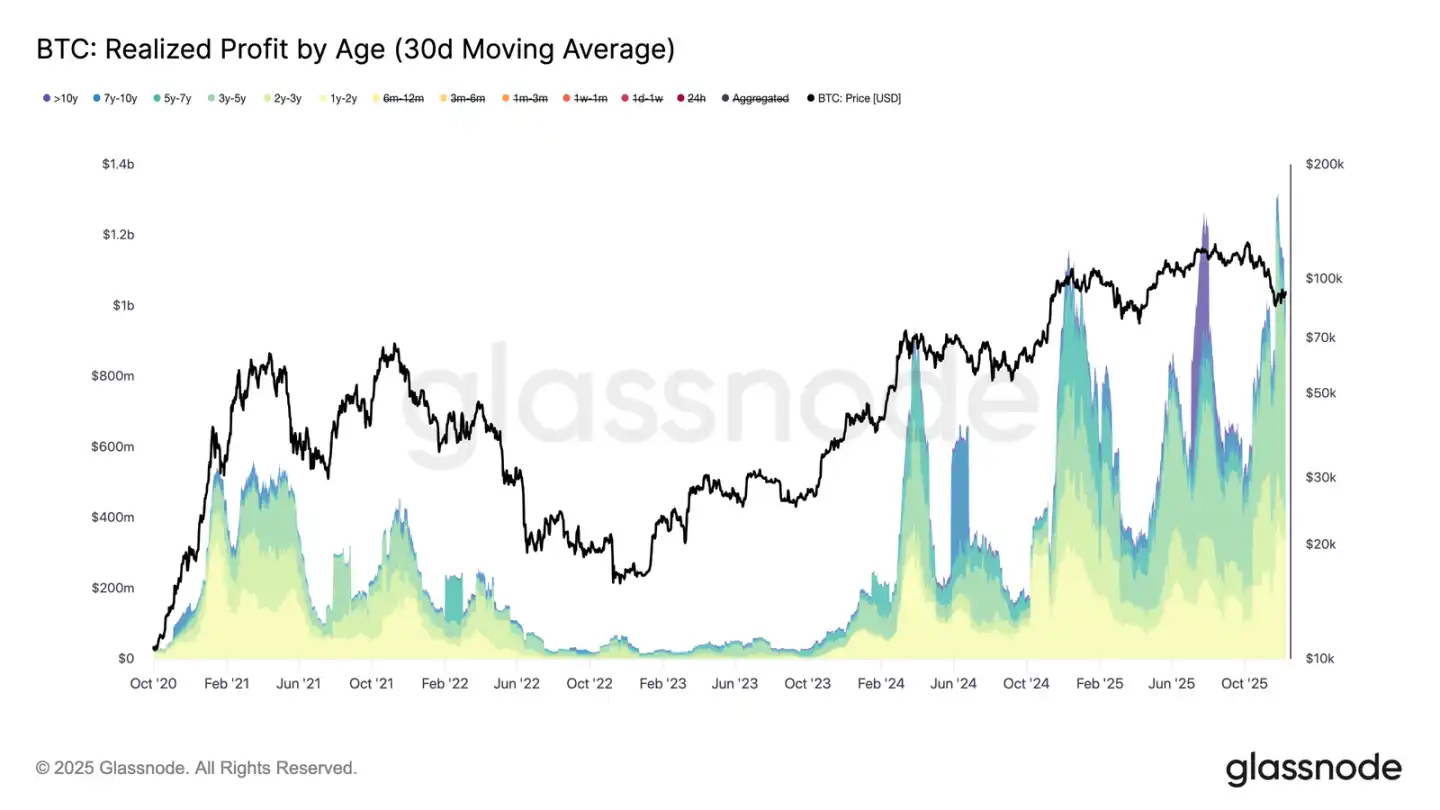
The rising realized losses have further hindered the recovery, especially when they coincide with a sharp increase in realized profits among long-term investors. During the recent rebound, the 30-day simple moving average of realized profits for over 1-year holders exceeded $1 billion per day, peaking at over $1.3 billion at new all-time highs. These dual forces of high-position buyers capitulating and long-term holders taking significant profits explain why the market is still struggling to reclaim the short-term holder cost basis.
However, despite facing such significant sell pressure, the price has stabilized and even slightly risen above the true market value, indicating that persistent and patient demand is absorbing the sell-off. If sellers begin to exhaust in the short term, this potential buying pressure could drive a retest of the 0.75 quantile (around $95,000) and even the short-term holder cost basis.
On-Chain Insights
ETF Conundrum
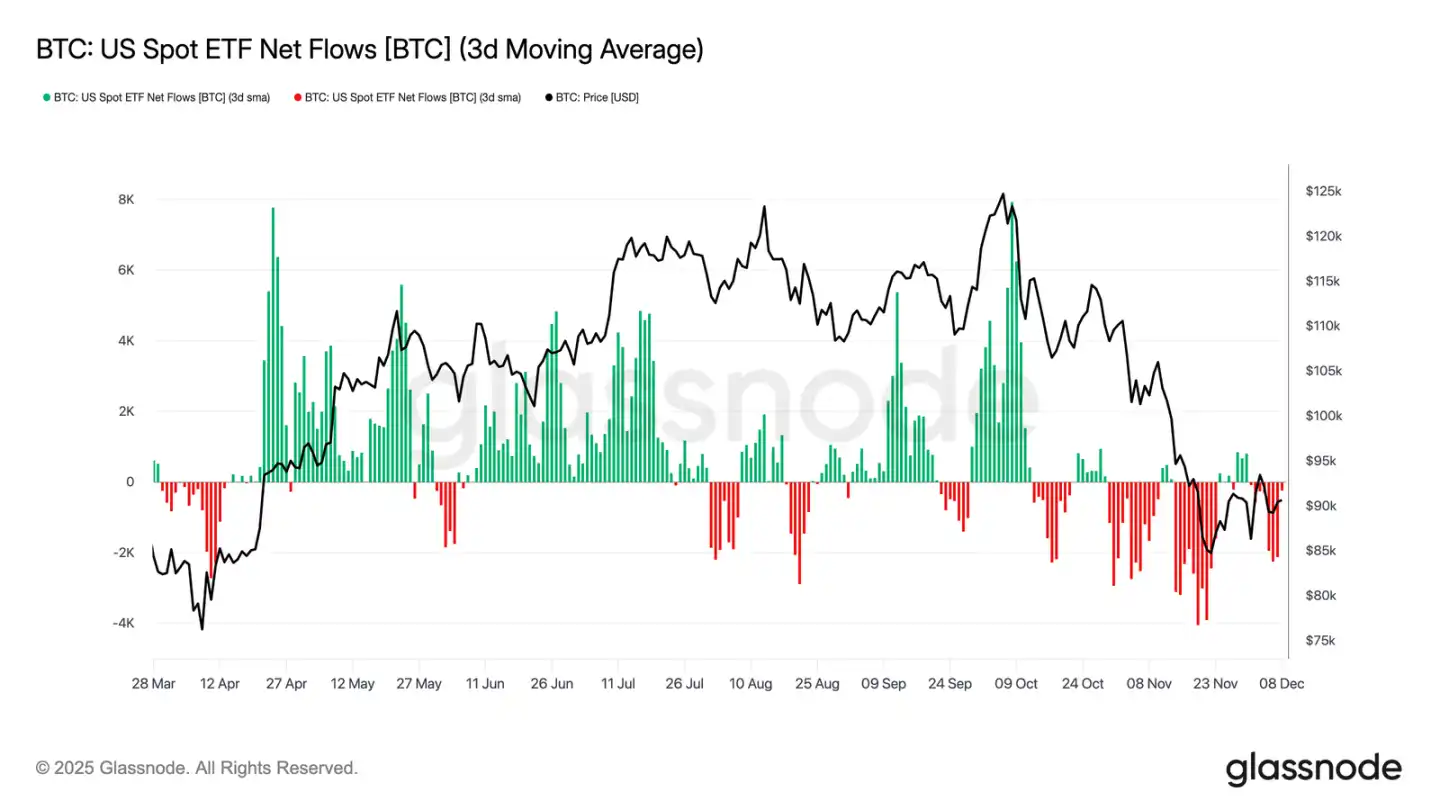
Shifting to the spot market, the U.S. Bitcoin ETF experienced another quiet week, with a three-day average net outflow remaining negative. This continues the cooling trend that began in late November, signaling a stark contrast to the strong inflow mechanism that supported price increases earlier this year. Redemption from several major issuers has remained stable, highlighting that institutional allocators have taken a more risk-averse stance amid a broader market environment instability.
As a result, the cushion of demand in the spot market has thinned, reducing immediate buyer support and making the price more susceptible to macro catalysts and volatility shocks.
Liquidity Still Lacking
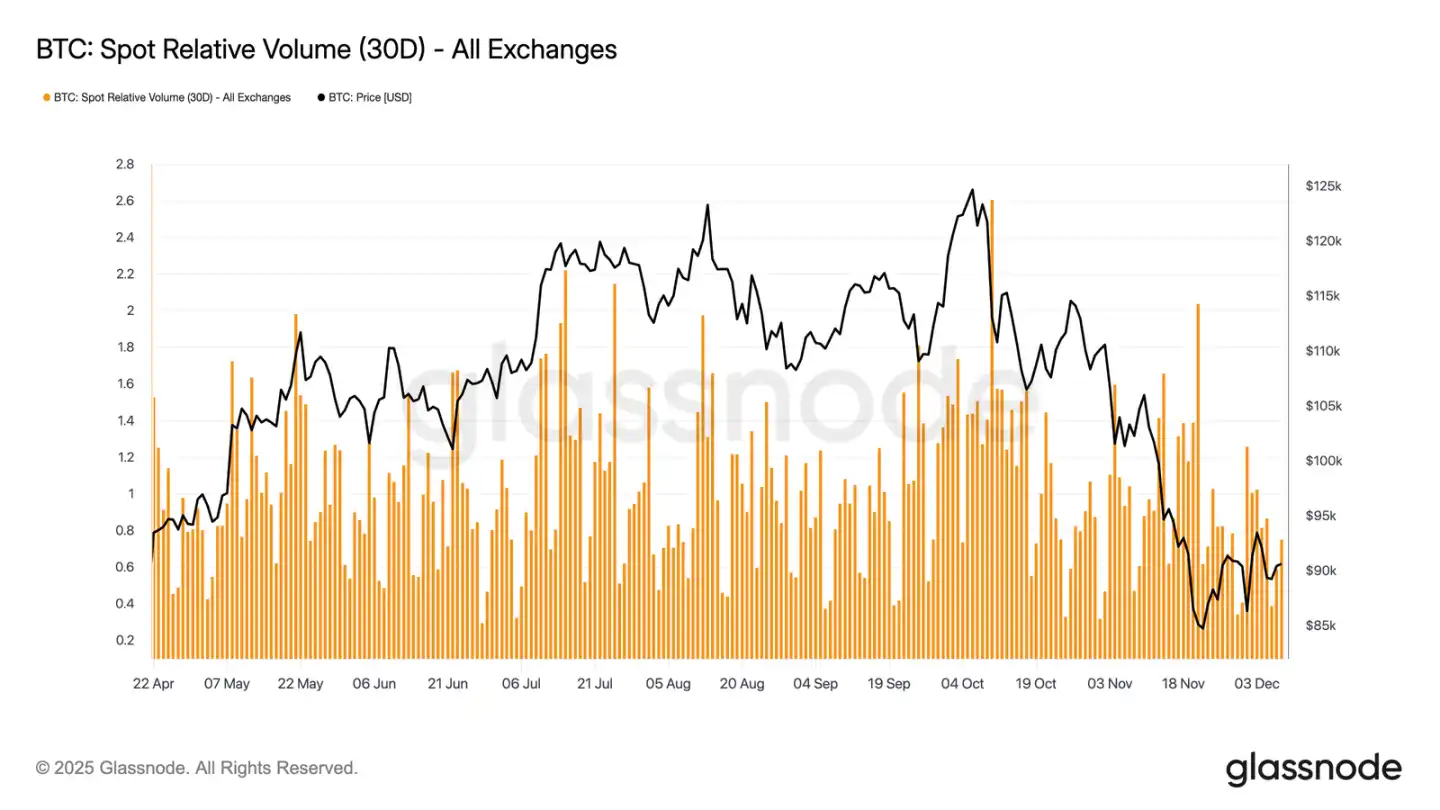
In parallel with the weak ETF flows, Bitcoin's spot relative trading volume continues to hover near the lower end of its 30-day range. Trading activity has been declining from November to December, reflecting price declines and reduced market participation. The contraction in trading volume reflects a more defensive market positioning overall, which can absorb volatility or sustain directional changes with reduced liquidity-driven fund flows.
With the spot market quieting down, attention is now turning to the upcoming FOMC meeting, which could serve as a catalyst to reinvigorate market participation based on its policy tone.
Futures Market Sluggish
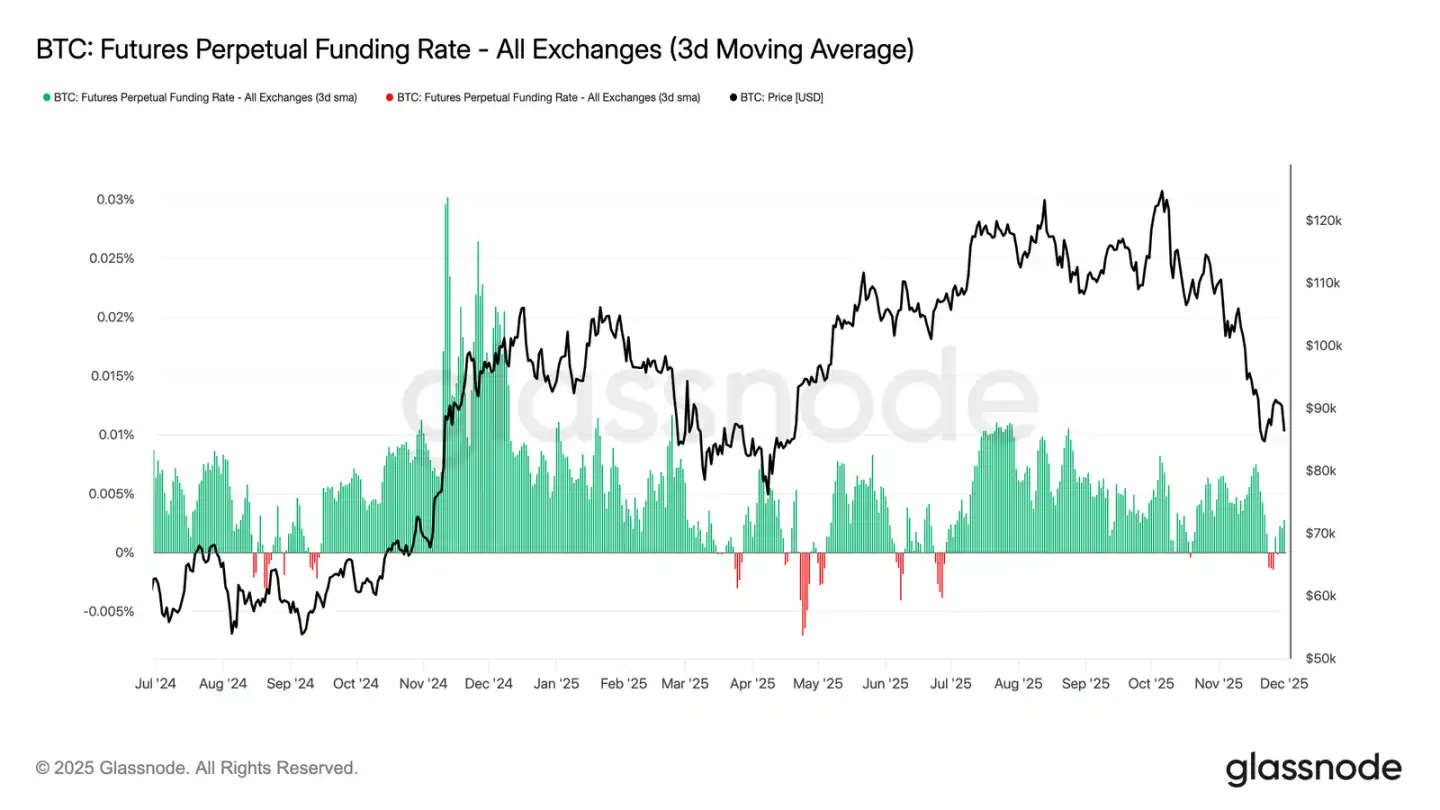
Continuing the theme of low market participation, the futures market also shows limited interest in leverage, with open interest failing to substantially rebuild, and funding rates remaining near neutral levels. These dynamics highlight a derivative environment defined by caution rather than confidence.
In the perpetual contract market, funding rates this week have hovered around zero to slightly negative, underscoring the persistent unwinding of speculative long positions. Traders remain balanced or defensive, exerting directional pressure with minimal leverage.
Due to subdued derivative activity, price discovery is more oriented towards spot fund flows and macro catalysts rather than speculative expansion.
Short-Term Implied Volatility Surges
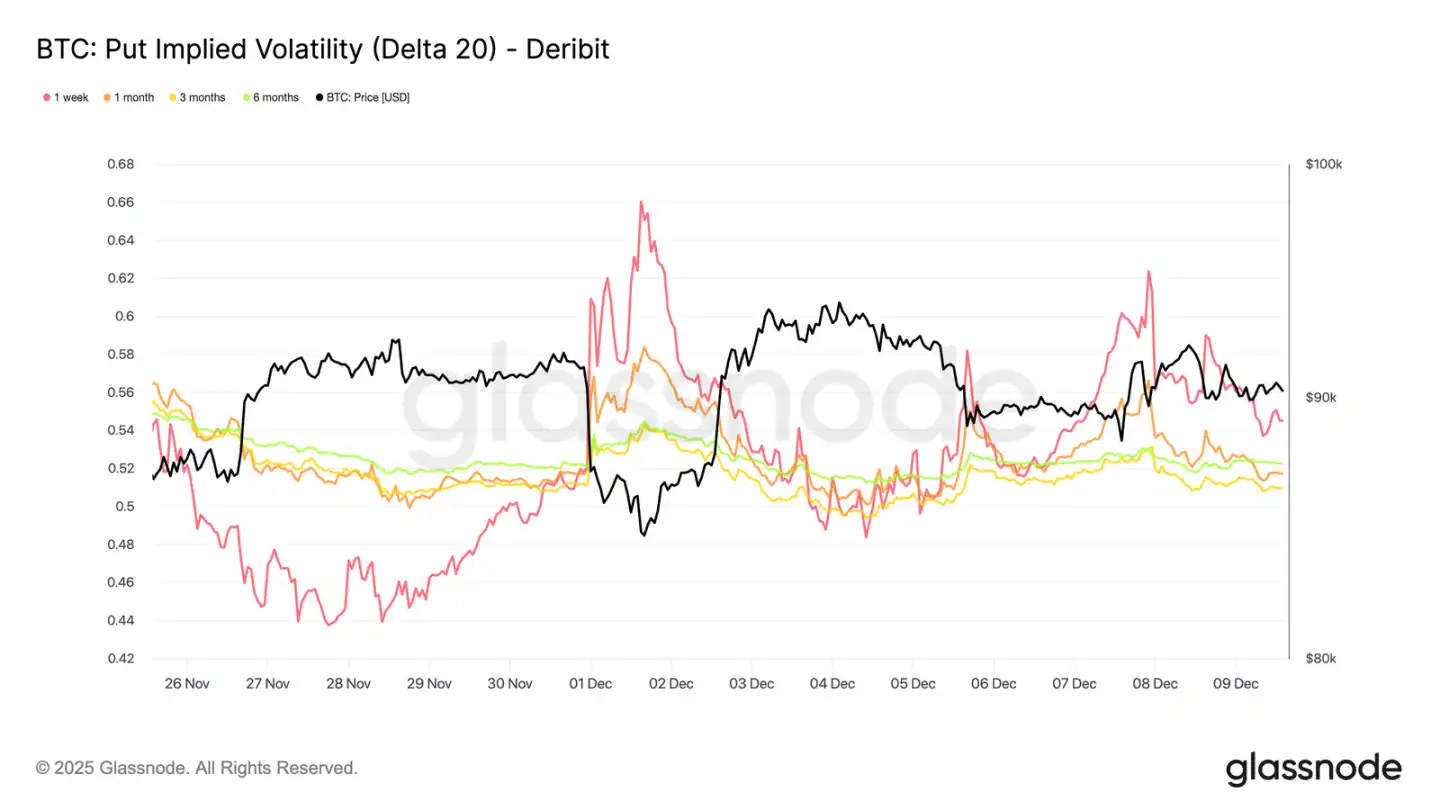
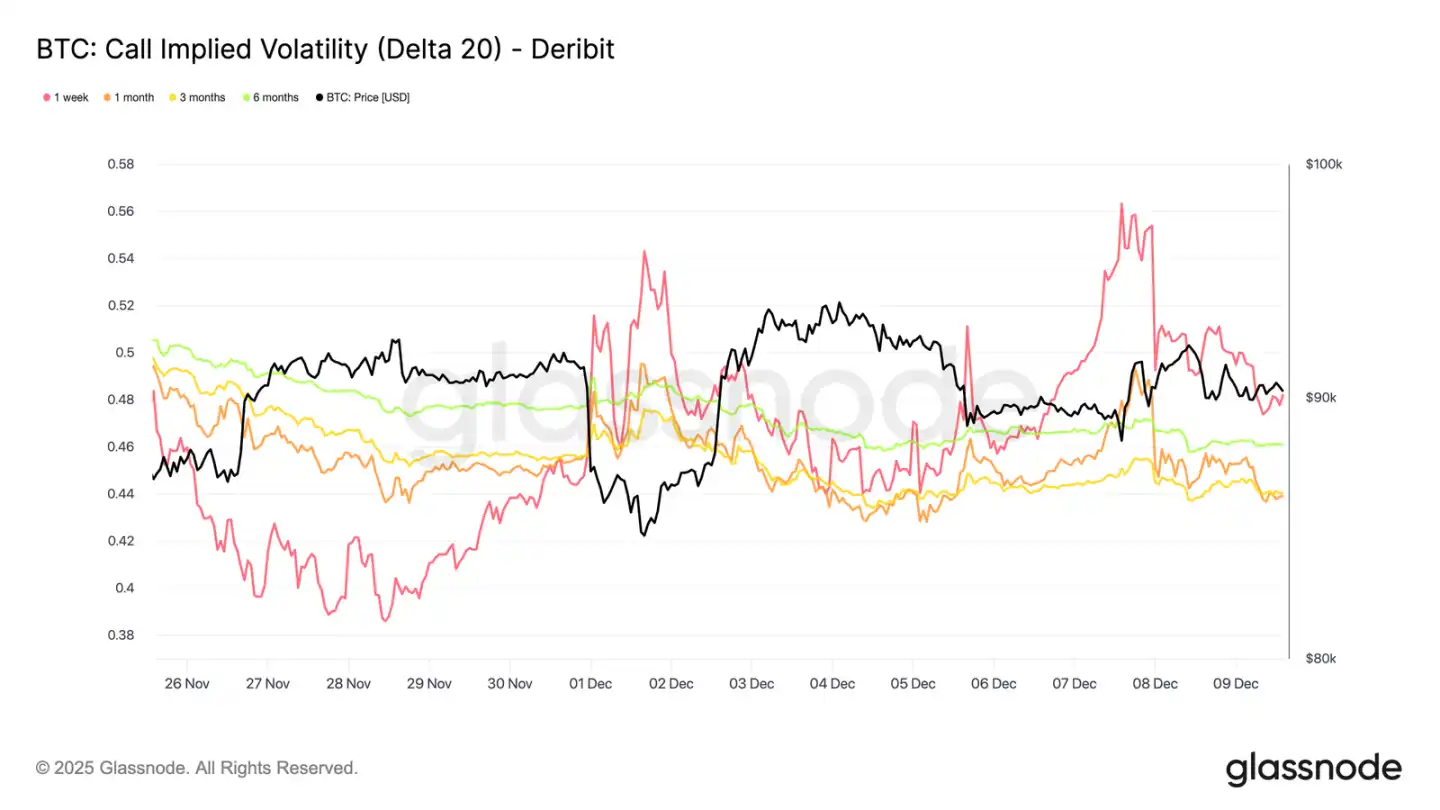
Turning to the options market, Bitcoin's subdued spot activity contrasts sharply with a sudden rise in short-term implied volatility, as traders position for larger price swings. Interpolated implied volatility (estimated IV based on a fixed Delta value rather than relying on listed strike prices) clearly reveals the pricing structure of risk across different tenors.
On the 20-Delta call options, one-week IV has increased by approximately 10 volatility points compared to last week, while longer tenors have remained relatively stable. The same pattern is also evident in the 20-Delta put options, with short-term downside IV rising while longer tenors remain calm.
Overall, traders are accumulating volatility at levels where they expect pressure, preferring to hold convexity rather than sell off before the December 10 FOMC meeting.
Downside Demand Resurgence
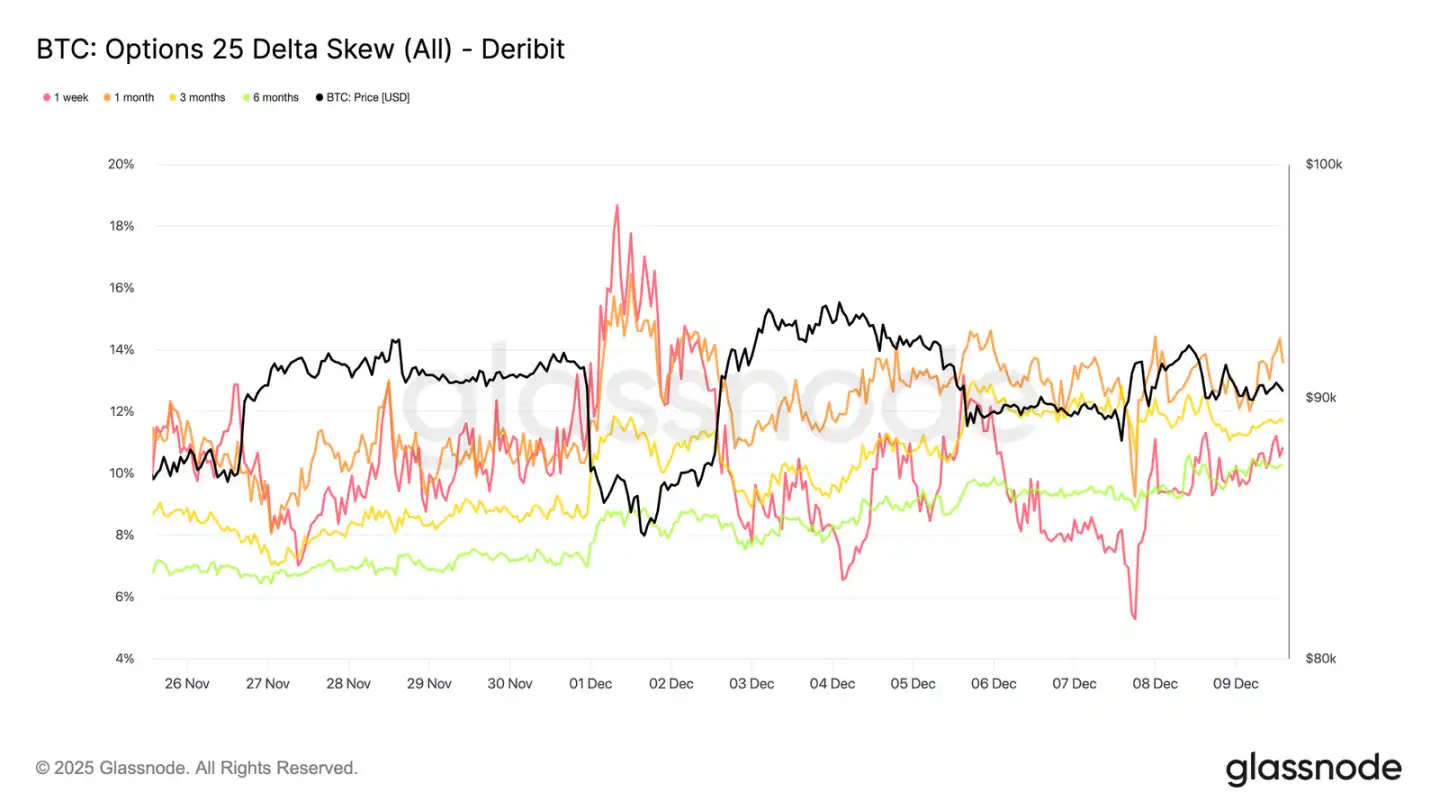
Accompanying the rise in short-term volatility is the resurgence of downside protection premium. The 25-delta skew, measuring the relative cost of puts versus calls at the same Delta value, has climbed to around 11% in a single period, indicating a significant increase in short-term demand for downside insurance ahead of the FOMC meeting.
The skew remains tightly clustered across tenors, ranging from 10.3% to 13.6%. This compression suggests a preference for put protection is prevalent across the entire curve, reflecting a consistent hedging bias rather than isolated short-term pressure.
Volatility Accumulation
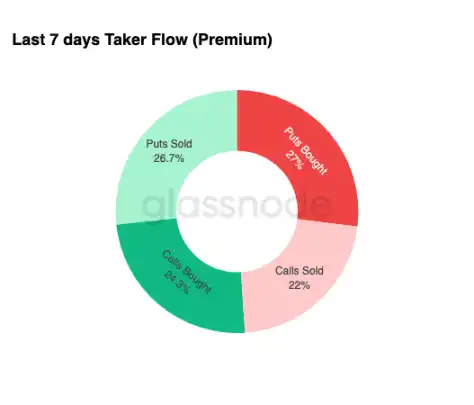
To summarize the options market conditions, weekly fund flow data reinforces a clear pattern: traders are buying volatility rather than selling it. Bought option premium dominates the total notional flow, with puts slightly leading. This does not reflect a directional bias but a state of volatility accumulation. When traders buy options on both ends simultaneously, it signals hedging and seeking convexity behavior rather than emotion-based speculation.
Combined with rising implied volatility and a skew towards the downside, the fund flow condition indicates market participants are preparing for volatility events with a downside bias.
Post-FOMC
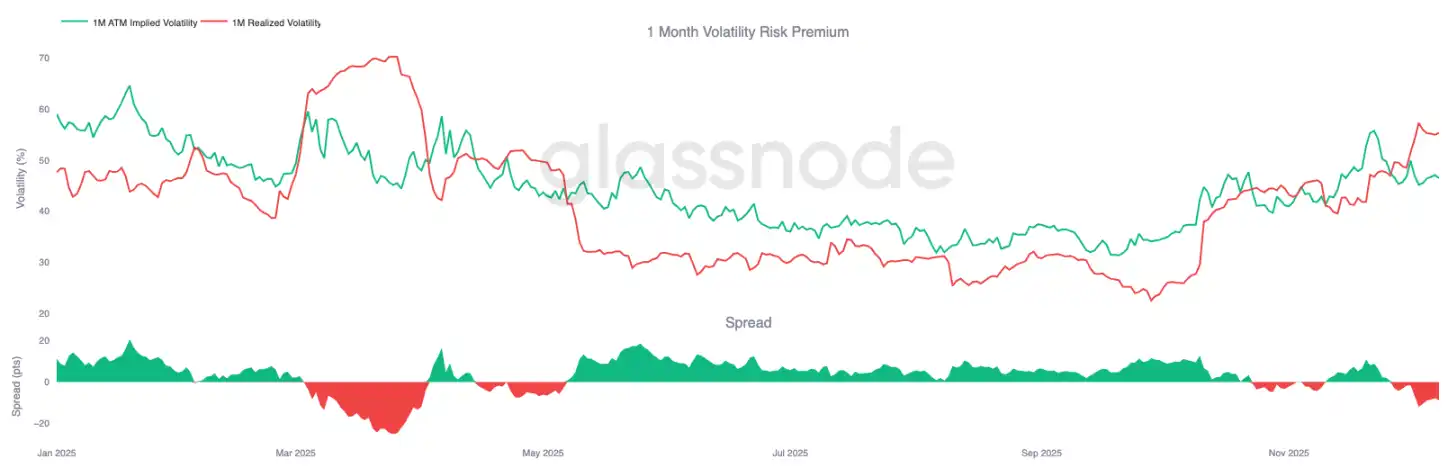
Looking ahead, implied volatility has started to ease off, and historically, once the final major macro event of the year is past, IV tends to further contract. With the December 10 FOMC meeting being the last significant catalyst, the market is transitioning to a low liquidity, mean-reverting environment.
After the announcement, sellers typically re-enter, accelerating IV decay into the year-end. Unless there is a significant shift in hawkish surprises or guidance, the path of least resistance points to lower implied volatility and a flatter volatility term structure, persisting into late December.
Conclusion
Bitcoin continues to trade in a structurally fragile environment, with constantly rising unrealized losses, higher realized losses, and significant profit-taking by long-term holders anchoring price action. Despite facing persistent selling pressure, demand still exhibits enough resilience to keep the price above true market averages, indicating patient buyers are still absorbing the sell-off. If signs of seller exhaustion begin to show, a push towards $95,000 in the short term to unwind short-term holder basis is still a possibility.
The off-chain situation echoes this cautious tone. ETF flows remain negative, spot liquidity is scarce, the futures market lacks speculative participation. The options market has strengthened its defensive posture, with traders accumulating volatility, buying short-term downside protection, and positioning for recent volatility events ahead of the FOMC meeting.
Overall, the market structure indicates a weak but stable range, supported by patient demand but constrained by sustained selling pressure. The short-term path depends on whether liquidity improves and whether sellers will relent, while the long-term outlook depends on whether the market can reclaim key on-chain thresholds and move beyond this time-driven, psychologically challenging phase.
You may also like

Bitcoin's Big Brother Scythe, a Nasdaq Heist Chronicle

ARK Invest: Stablecoins are Constructing the Next-Generation Monetary System

President Trump Asserts Imminent Passing of Crypto Market Structure Bill
Key Takeaways Presidential Confirmation: President Trump states the major crypto market structure bill is on the verge of…

Germany Central Bank Head Advocates for European Crypto Stablecoins Under EU MiCA Framework
Key Takeaways Joachim Nagel, head of the Germany Bundesbank, is advocating for the adoption of euro-based crypto stablecoins…

Polygon Surpasses Ethereum in Daily Fees as Polymarket Bets Rocket
Key Takeaways Polygon has outpaced Ethereum in daily transaction fees, a historic shift driven by activity on Polymarket.…

Bitcoin Price Prediction: BTC Short Squeeze Alert – Is a Significant Rebound on the Horizon?
Key Takeaways Recent data indicates Bitcoin shorts have escalated to unprecedented levels reminiscent of a major market low…

Google’s Gemini AI Predicts the Price of XRP, Solana, and Bitcoin by the End of 2026
Key Takeaways XRP’s Potential: Google’s Gemini AI forecasts XRP could reach $10 by 2026, leveraging Ripple’s payment solutions…

Top Analyst Warns Bitcoin Price Could Plummet to $10,000 Amid Deepening Bear Market
Key Takeaways Bitcoin’s value could potentially drop to $10,000 as part of an imploding bubble, suggests a renowned…

Best Crypto to Buy Now February 10 – XRP, Solana, Dogecoin
Key Takeaways XRP is poised for long-term growth with its recent strategic expansions in institutional-grade payments and tokenization.…

Kyle Samani Criticizes Hyperliquid in Explosive Post-Departure Market Commentary
Key Takeaways: Kyle Samani, after leaving Multicoin Capital, criticized Hyperliquid, a decentralized exchange, labeling it as a systemic…
XRP Price Prediction: A 50M Token Sell-Off Just Shook the Market — Is More Loss Imminent?
Key Takeaways Over 50 million XRP hit the market within a span of less than 12 hours, leading…

Strategy Plans to Equitize Convertible Debt Over 3–6 Years: What It Means for BTC
Key Takeaways Strategy, led by Michael Saylor, is equitizing $6 billion in convertible debt as a long-term strategy…

BlockFills Freezes Withdrawals as Bitcoin Declines, Heightening Counterparty Risk Concerns
Key Takeaways BlockFills, an institutional trading firm, has stopped client withdrawals amid rising market volatility and Bitcoin price…

Leading AI Claude Predicts the Price of XRP, Cardano, and Ethereum by the End of 2026
Key Takeaways Claude AI projects substantial growth for XRP, Cardano, and Ethereum by the end of 2026, with…
Crypto Price Forecast for 16 February – XRP, Ethereum, Cardano
Key Takeaways Technical trends and recent developments suggest potential growth for XRP, Ethereum, and Cardano. XRP is targeting…

Bitcoin Price Prediction: Alarming New Research Warns Millions in BTC at Risk of ‘Quantum Freeze’ – Are You Protected?
Key Takeaways Recent market movements have sparked concerns over a potential bear market for Bitcoin, marked by significant…
XRP Price Forecast: Can XRP Truly Surpass Bitcoin and Ethereum? Analyst Argues the Contest Has Already Begun
Key Takeaways XRP has maintained significant support around the $1.40 level despite a 12% decline over the past…
Best Crypto to Purchase Now February 6 – XRP, Solana, Bitcoin
Key Takeaways XRP’s Strength: Ripple’s focus on challenging traditional systems like SWIFT is driving XRP towards a potential…
Bitcoin's Big Brother Scythe, a Nasdaq Heist Chronicle
ARK Invest: Stablecoins are Constructing the Next-Generation Monetary System
President Trump Asserts Imminent Passing of Crypto Market Structure Bill
Key Takeaways Presidential Confirmation: President Trump states the major crypto market structure bill is on the verge of…
Germany Central Bank Head Advocates for European Crypto Stablecoins Under EU MiCA Framework
Key Takeaways Joachim Nagel, head of the Germany Bundesbank, is advocating for the adoption of euro-based crypto stablecoins…
Polygon Surpasses Ethereum in Daily Fees as Polymarket Bets Rocket
Key Takeaways Polygon has outpaced Ethereum in daily transaction fees, a historic shift driven by activity on Polymarket.…
Bitcoin Price Prediction: BTC Short Squeeze Alert – Is a Significant Rebound on the Horizon?
Key Takeaways Recent data indicates Bitcoin shorts have escalated to unprecedented levels reminiscent of a major market low…


 App
App