
- Buy Crypto
- Markets
 Futures
- Spot
- Copy Trade
- Earn
- More
Hundreds of Dollars Turned into 260,000, Independent Miner Frequently "Hits the Jackpot," Is Mining the New Gold Rush?

Original Article Title: Solo Bitcoin Miners Are Winning More Blocks Lately—What Gives?
Original Article Author: Mat Di Salvo, Decrypt
Original Article Translation: Lila, BlockBeats
Last week, another solo Bitcoin miner successfully mined a block and received a reward of 3.125 bitcoins (including transaction fees), worth nearly $260,000. This is just one of several recent instances where independent miners have struck it rich.
So, was this miner just lucky? Is solo mining becoming more common? Can an average person with a basic mining rig challenge the large mining farms with their relatively modest hashing power?
The answers vary. While recently there has indeed been an increase in the number of blocks mined by "solo miners" (here referring to individual enthusiasts or some low-profile small mining groups), the growth has been modest and is unlikely to skyrocket.
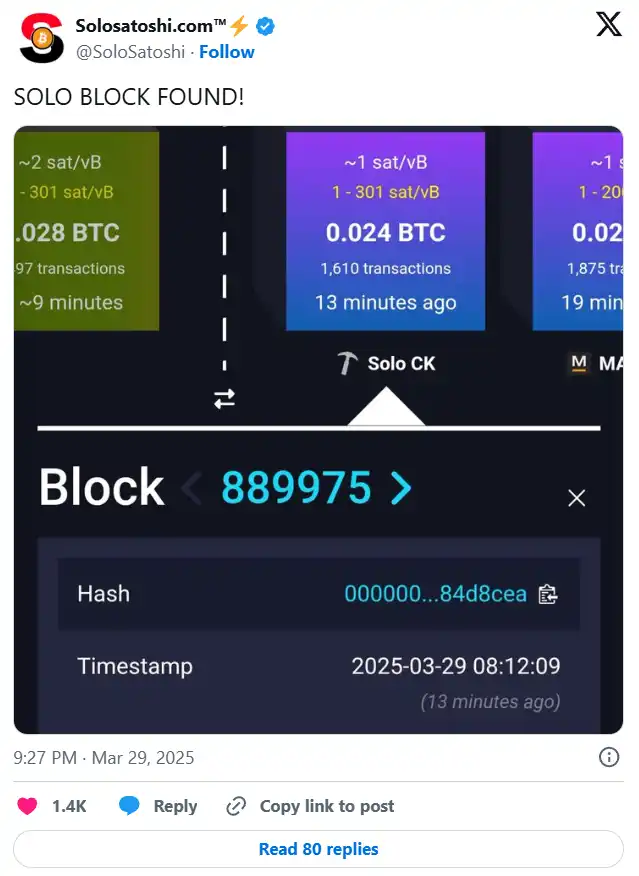
Scott Norris, CEO of the independent mining firm Optiminer, bluntly states that solo mining still feels like "buying a lottery ticket."
According to data, in 2022, there were 7 successful block mines through Solo CKPool (a service platform that allows anonymous users to mine without running a full node); this number increased to 12 in 2023 and reached 16 in 2024.
It is worth noting that Solo CKPool is not a traditional mining pool. Despite the name including "Pool," it only provides an entry point. Once a miner finds a block, they can take away the vast majority of the reward themselves. However, this does not mean that blocks mined through Solo CKPool are mined by a single individual sitting in their bedroom using very low hashing power. There is a significant misconception about this on some platforms, with some people even promoting this view vigorously without data to support it.
The current mining pool industry is still dominated by a few giants, such as Foundry, AntPool, and F2Pool. Miners typically join these large pools, share hashing power, and distribute rewards proportionally. Miners accessing Solo CKPool can keep almost all of the rewards for themselves.
As the Bitcoin network continues to grow, the search for the computing power and resources needed to find a block has become increasingly competitive. As a result, most mining activities are now industrialized operations run by publicly traded companies on a global scale. Some Bitcoin core supporters believe this is detrimental to Bitcoin's decentralization.
Today, some hobbyist mining devices like Bitaxe and FutureBit Apollo, priced between $200 and $500, are gaining popularity among Bitcoin extremists. In January of this year, a FutureBit Apollo successfully mined a block — albeit under the condition that a nonprofit organization donated hashing power to it. An anonymous miner known as Econoalchemist wrote on X at the time that the organization's goal was to "break the proprietary mining empire and make Bitcoin and free tech available to all."
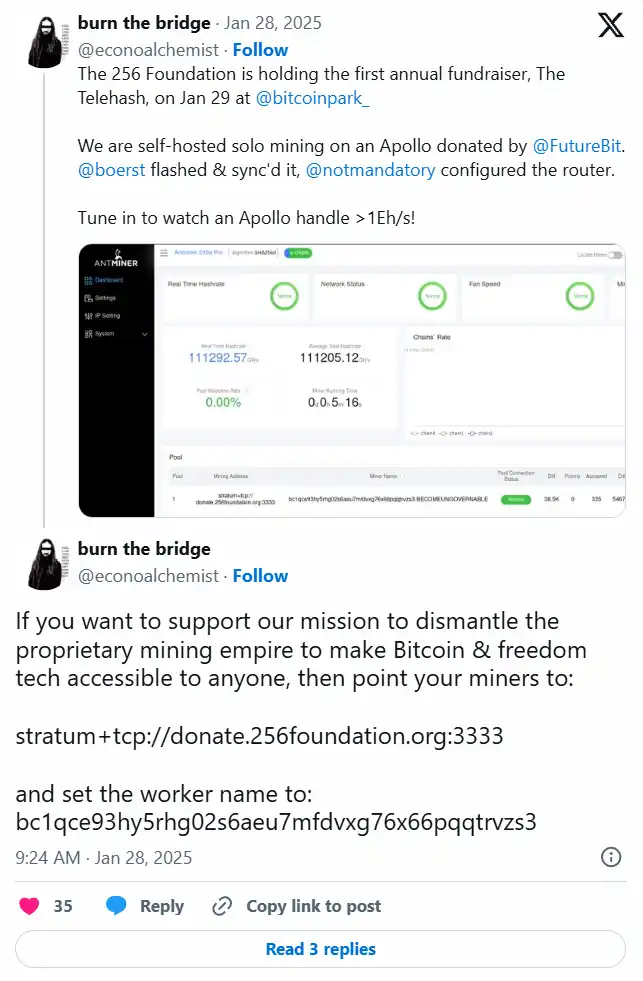
While the probability of success is extremely low, it may be that the increasing number of "amateur miners" is driving a significant increase in individual mining success rates. Econoalchemist pointed out that the trend of independent miners' success has become more pronounced in recent years. "Every so often (and more and more frequently), a small device like Bitaxe quietly running in a corner of someone's home suddenly hits a block," he said.
Norris from Optiminer added that it could also be the case that some large institutions mine blocks with their own computing power without joining large mining pools — appearing "independent" in form but not in reality.
Even Solo Satoshi, a company based in Houston, Texas, that sells mining devices like Bitaxe Gamma, states on its website that the probability of mining a block with a $180 device with a hash rate of 1.2 TH/s is only 0.00068390% per day.
But Matt Howard mentioned that engaging in solo mining is not necessarily about making money. "The main goal is to promote decentralization. Finding a block and getting Bitcoin is just a bonus," he said. "For Bitcoin extremists, mining must be decentralized."
You may also like

Stop Talking About Gold, Bitcoin Is Not a Safe Haven Asset

Aave Founder: What Is the Secret of the DeFi Lending Market?

The Trader's Playbook: 7 Market Cycle Lessons From LALIGA’s 90 Minutes
What do LALIGA matches teach about crypto markets? Learn how consolidation, breakouts, and late-cycle volatility shape disciplined trading decisions.
How Smart Money Tracker Survived Live AI Trading at WEEX AI Hackathon
Discover how WEEX AI Trading Hackathon tested strategies with real capital—no simulations. See how Smart Money Tracker survived flash crashes and leveraged 18x in live markets.

80% Win Rate to 40% Drawdown: An AI Trader's Brutal Recalibration at WEEX AI Wars
Dive into the technical blueprint of an AI trading system built on LLaMA reasoning and multi-agent execution. See how Quantum Quaser uses confidence thresholds & volatility filters at WEEX AI Wars, and learn the key to unlocking 95% win rate trades.
AI Trading Strategy Explained: How a Beginner Tiana Reached the WEEX AI Trading Hackathon Finals
Can AI trading really outperform human emotion? In this exclusive WEEX Hackathon finalist interview, discover how behavioral signal strategies, SOL trend setups, and disciplined AI execution secured a spot in the finals.
When AI Takes Over the 'Shopping Journey,' How Much Time Does PayPal Have Left?

Bloomberg: Aid Turkey Freeze $1 Billion Assets, Tether Remakes Compliance Boundary

Polymarket vs. Kalshi: The Full Meme War Timeline

Consensus Check: What Consensus Was Born at the 2026 First Conference?

Resigned in Less Than a Year of Taking Office, Why Did Yet Another Key Figure at the Ethereum Foundation Depart?

Russian-Ukrainian War Prediction Market Analysis Report

Ethereum Foundation Executive Director Resigns, Coinbase Rating Downgrade: What's the Overseas Crypto Community Talking About Today?

Who's at the CFTC Table? A Rebalancing of American Fintech Discourse

AI Trading vs Human Crypto Traders: $10,000 Live Trading Battle Results in Munich, Germany (WEEX Hackathon 2026)
Discover how AI trading outperformed human traders in WEEX's live Munich showdown. Learn 3 key strategies from the battle and why AI is changing crypto trading.

Elon Musk's X Money vs. Crypto's Synthetic Dollars: Who Wins the Future of Money?
How do Synthetic Dollars work? This guide explains their strategies, benefits over traditional stablecoins like USDT, and risks every crypto trader must know.

The Israeli military is hunting a mole on Polymarket

Q4 $667M Net Loss: Coinbase Earnings Report Foreshadows Challenging 2026 for Crypto Industry?
Stop Talking About Gold, Bitcoin Is Not a Safe Haven Asset
Aave Founder: What Is the Secret of the DeFi Lending Market?
The Trader's Playbook: 7 Market Cycle Lessons From LALIGA’s 90 Minutes
What do LALIGA matches teach about crypto markets? Learn how consolidation, breakouts, and late-cycle volatility shape disciplined trading decisions.
How Smart Money Tracker Survived Live AI Trading at WEEX AI Hackathon
Discover how WEEX AI Trading Hackathon tested strategies with real capital—no simulations. See how Smart Money Tracker survived flash crashes and leveraged 18x in live markets.
80% Win Rate to 40% Drawdown: An AI Trader's Brutal Recalibration at WEEX AI Wars
Dive into the technical blueprint of an AI trading system built on LLaMA reasoning and multi-agent execution. See how Quantum Quaser uses confidence thresholds & volatility filters at WEEX AI Wars, and learn the key to unlocking 95% win rate trades.
AI Trading Strategy Explained: How a Beginner Tiana Reached the WEEX AI Trading Hackathon Finals
Can AI trading really outperform human emotion? In this exclusive WEEX Hackathon finalist interview, discover how behavioral signal strategies, SOL trend setups, and disciplined AI execution secured a spot in the finals.


 App
App