
- Buy Crypto
- Markets
 Futures
- Spot
- Copy Trade
- Earn
- More
Make Money While Making It Rain: Check Out the Recent Developments of These Top Perp DEXes

According to the latest on-chain data, the market landscape of decentralized perpetual contract exchanges (Perp DEX) has become relatively clear. In terms of 24-hour trading volume, Aster leads the pack with $121.2 billion, Lighter follows with $86.16 billion in second place, Hyperliquid ranks third with $59.58 billion, while edgeX and ApeX Protocol hold the fourth and fifth positions with $50.6 billion and $21.22 billion, respectively.
The total trading volume of these five platforms exceeds $338 billion, firmly establishing their dominance in the entire Perp DEX track.
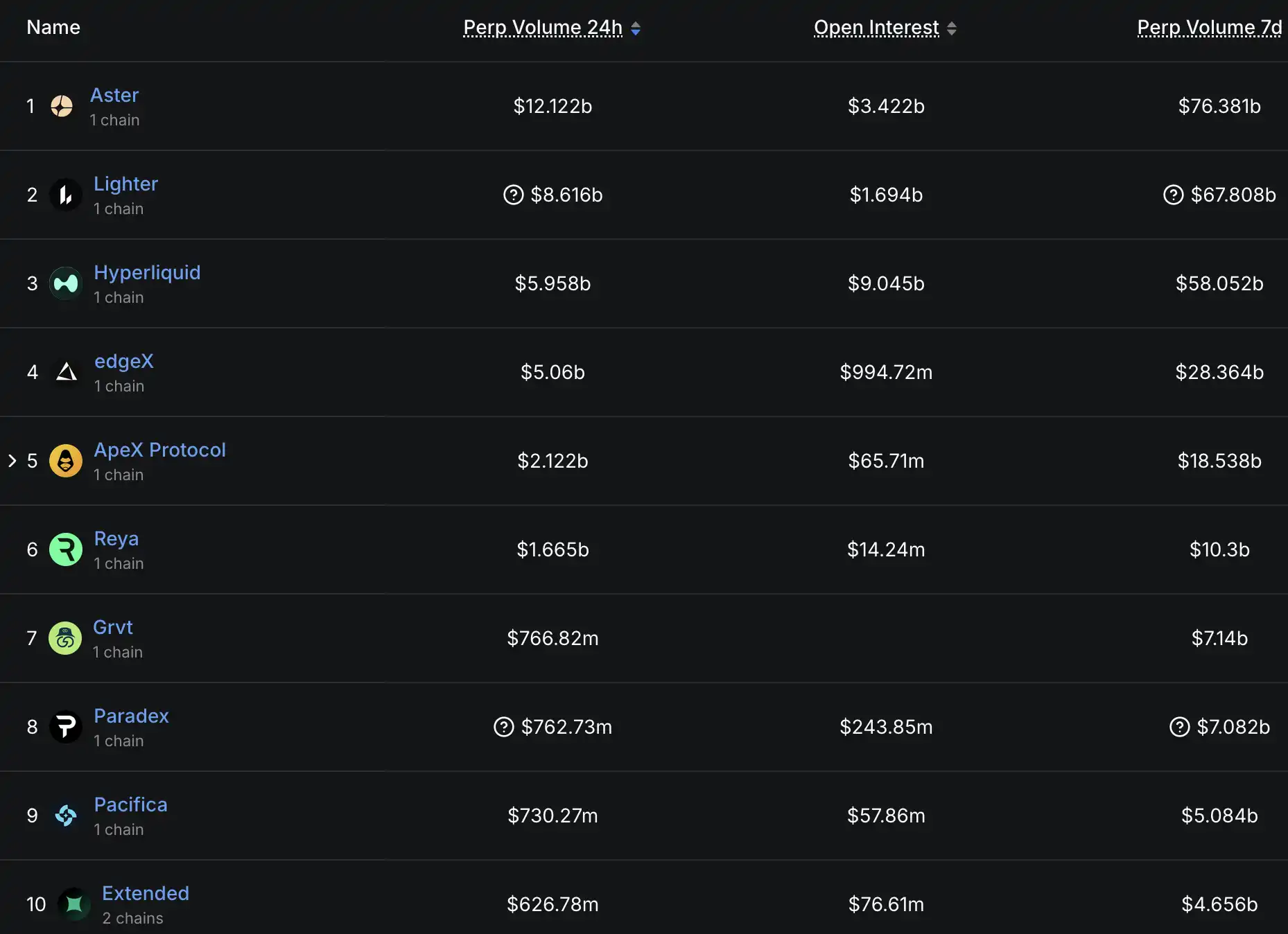
For investors and traders looking to delve deeper into the Perp DEX track, focusing on the dynamics of these top five platforms can essentially grasp the direction of the entire track. Therefore, this article from BlockBeats elaborately reviews the recent key developments, product updates, and community activities of these 5 platforms to help readers gain a comprehensive understanding of the latest developments in the current decentralized derivative trading market.
Lighter
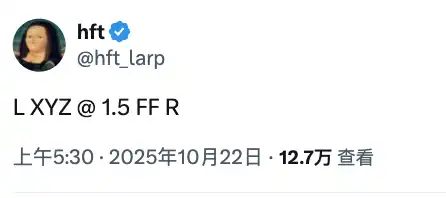
1. Insider Leaks Suggest Lighter's Funding Amount is $1.5B.
Recently, an insider who accurately predicted Coinbase's acquisition of Echo and Kalshi's $12 billion valuation hinted in a similar riddle-like manner that Lighter's funding amount has reached $1.5 billion. This news has sparked wide community attention, and although it has not been officially confirmed, the insider's previous accurate predictions have added credibility to this rumor.
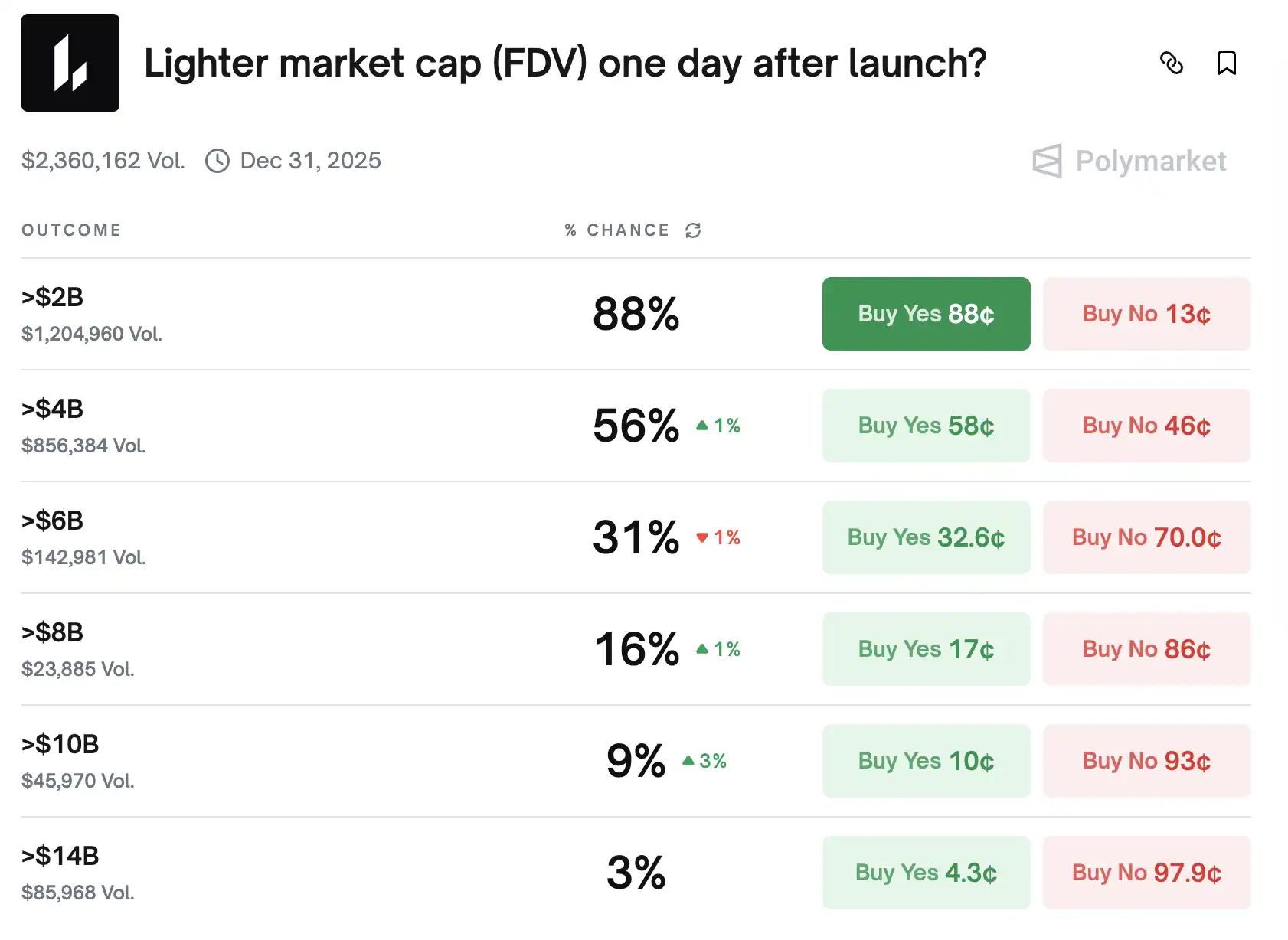
From a market performance perspective, prediction data on Polymarket indicates that investors have high expectations for Lighter: 88% probability believes its first-day fully diluted valuation (FDV) will exceed $20 billion, and 55% probability thinks it will surpass $40 billion. Meanwhile, the OTC market price remains stable around $80.
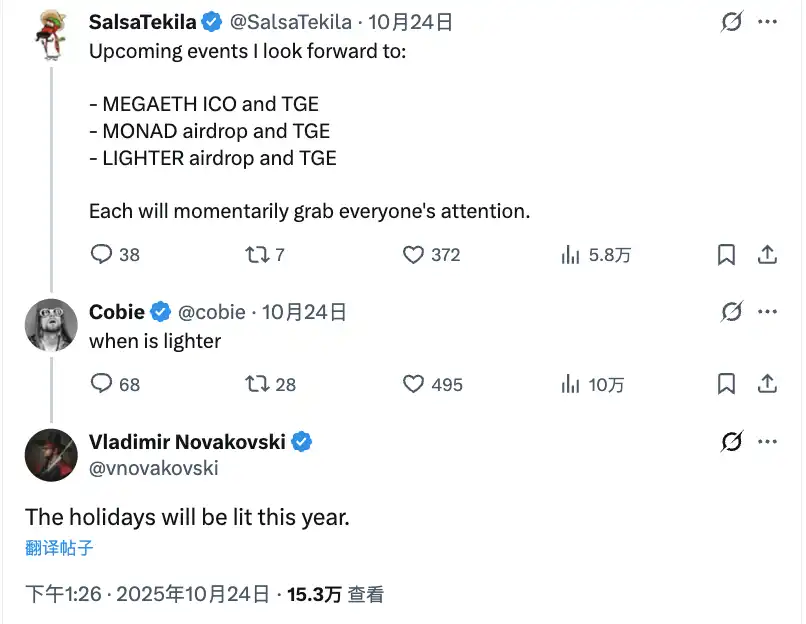
2. Lighter's CEO Hints at Airdrop Node During Major Holiday
Lighter's CEO's latest hint on Twitter has given the community a clearer expectation of the airdrop timing. He explicitly stated that the second-quarter points plan will end before the end of the year, but not on December 31, and tweeted, "the holidays will be lit this year," suggesting an exciting holiday season.
Considering this information, the community generally speculates that the airdrop is most likely to take place during the Western world's most important holiday – Christmas.
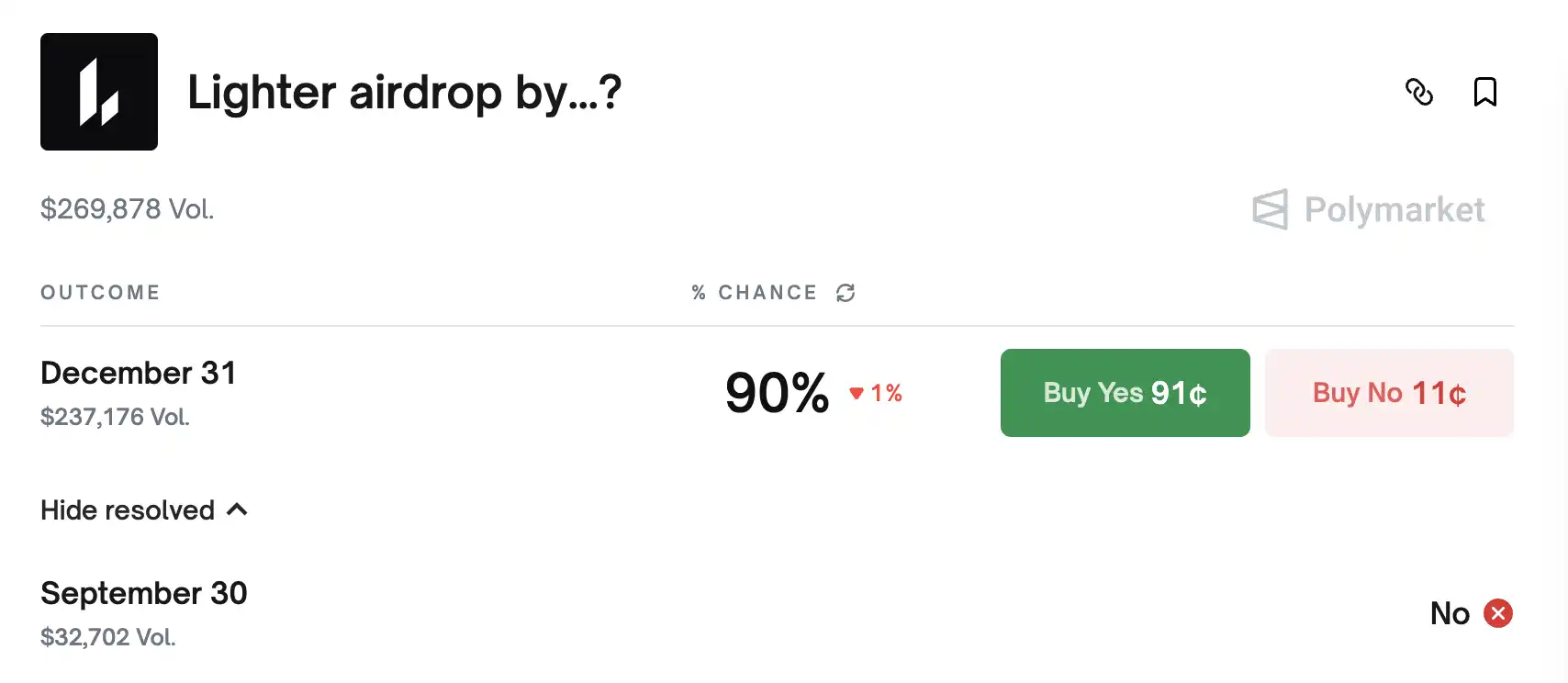
Polymarket's data further confirms this expectation, showing that the probability of Lighter completing the airdrop by December 31 is as high as 90%. This means that participants may receive the long-awaited token reward before the end of the year.
3. Lighter Season 2 Rule Adjustment
This month, Lighter announced adjustments to the points distribution rules for the second season compared to the first season. 200,000 points will be distributed every Friday, covering trading activities from Wednesday to the following Tuesday. The allocation mechanism is more diversified, taking into account multiple dimensions such as trading volume, holdings, treasury balance, liquidation and leverage ratios, P&L amounts, and trading categories.
It is worth noting that points and trading metrics do not have a simple linear relationship. For example, double the trading volume may result in triple or 1.5 times the points, as this nonlinear design aims to encourage more diversified trading behavior. The platform has adopted a witch detection system that combines full automation and semi-automation, allowing each user to have up to 10 accounts without penalty, with any excess beyond this limit facing punishment.
For more details, please refer to the official documentation.
4. Tokenomics and Product Roadmap
Two weeks ago, the founder of Lighter conducted a Russian AMA, revealing some key information:
Lighter plans to allocate 25-30% of the tokens for the first and second season's points airdrop, with the community's total allocation reaching 50%. The remaining portion will be used for future airdrops, partner programs, and sponsored projects.
On the product side, the spot trading feature is expected to be launched at the end of October or early November, with the initial listing of core assets such as ETH, BTC, followed by selected meme coins and partner projects.
Roadmap for the Next 6-12 Months: Implement cross-margin functionality by the end of the year, allowing the use of spot as collateral for perpetual contracts; launch EVM "sidecar" smart contract extension early next year; RWA derivatives (precious metals and crypto-related stocks) planned to go live by year-end; options and dark pool functionality set to be released next year and by year-end, respectively.
5. Arbitrage Opportunities
Community user Your Quant Guy shared an Arbitrage Alpha strategy about Lighter, with an annualized return of approximately 51.5%.

6. Data Performance
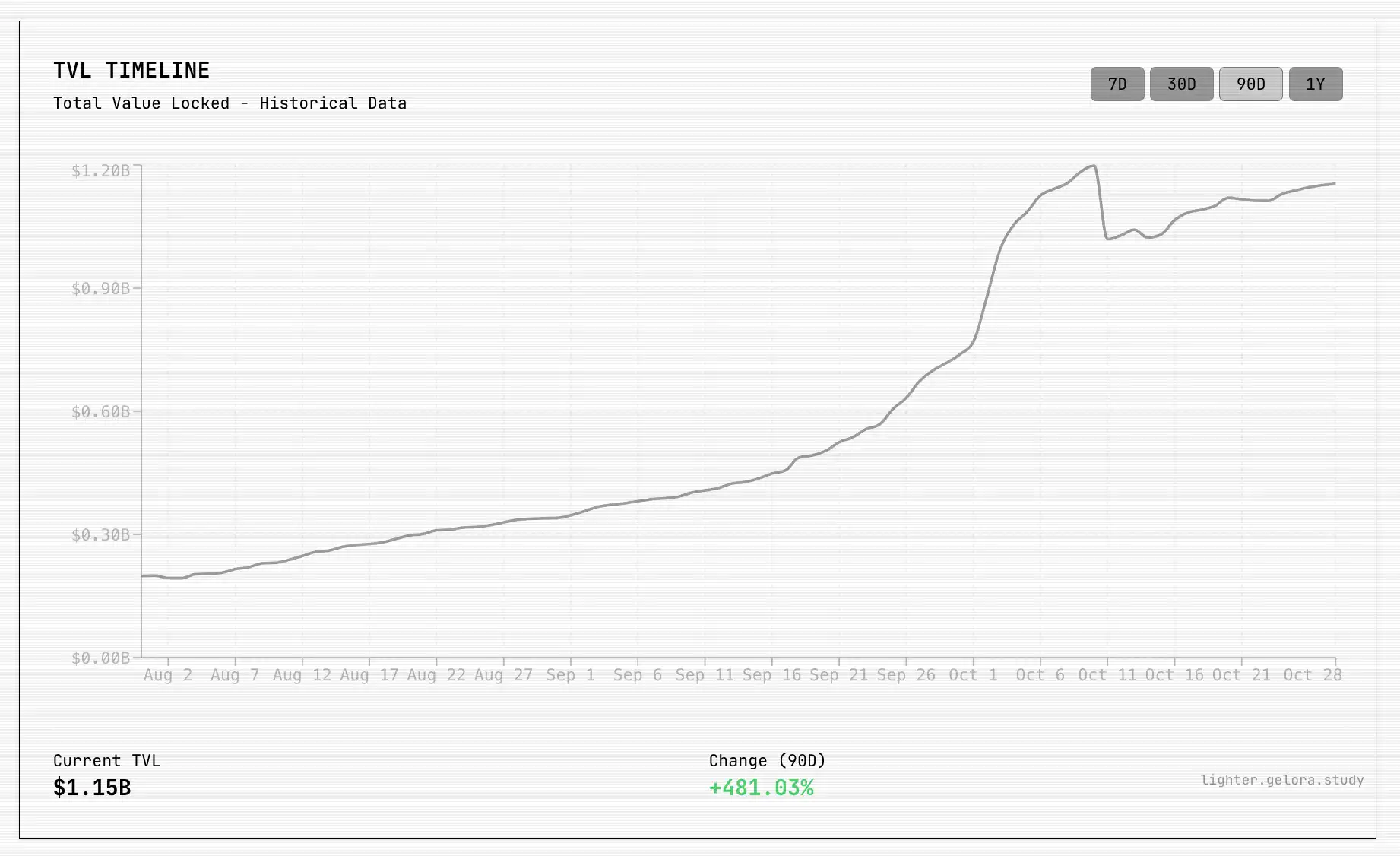
According to a community-made dashboard website and lighterlytics data, Lighter's data growth is showcased. Lighter's current TVL is 1.15B, with a growth rate of 481% over the past three months.
The 24-hour revenue has reached $598k, indicating high platform trading activity. Liquidity providers dominate, with the Premium Maker market share at 81.9%. The Premium Taker market share is 11.6%.

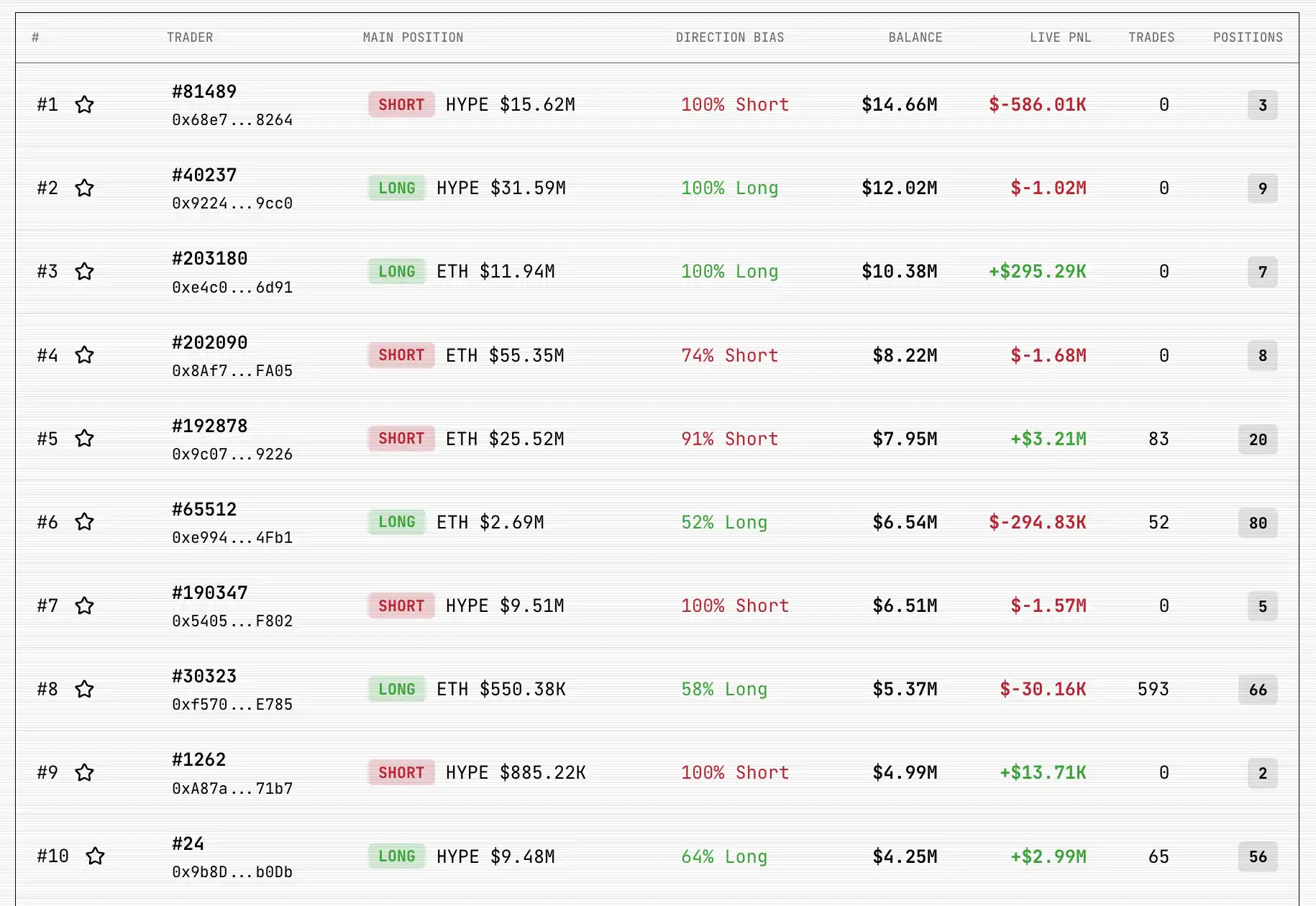
The top ten traders on Lighter primarily focus on trading ETH and HYPE pairs. The top-ranked trader has a predominant ETH short position, with a total position value of $25.52M, realized profits of $3.21M, 83 trades executed, and holding 20 positions.
Aster
1. Phase Three Airdrop Plan
On October 6, Aster seamlessly transitioned to the Phase Three reward plan "Aster Dawn," which will last for 5 weeks until November 9. This plan introduces an innovative multi-dimensional Rh point scoring system, taking into account factors such as trading volume, holding duration, ASTER ecosystem assets (such as asBNB, USDF), realized gains and losses, and team referral contributions.
Highlights of the Dawn plan include: 4% of the total ASTER supply allocated specifically for the Phase Three airdrop; spot trading incorporated into the scoring system for the first time, no longer limited to perpetual contracts; specific trading pairs (such as AT, AT, AT, ON, etc.) receive a 1.2x point bonus; the team referral standard fee is 10%, with whales able to apply for a higher tier. Scores are recalculated weekly to ensure fairness, with the specific formula kept confidential to prevent wash trading.
The Phase Two rewards were queryable starting on October 10, with withdrawals starting on October 14, and no lock-up period restrictions.
2. Launch of Buyback
In October, Aster officially launched the token buyback plan for Phase Three (S3). After the buyback is completed, the bought-back tokens will be transferred to the same address as the S2 buyback, followed by the commencement of S3 airdrop distribution.
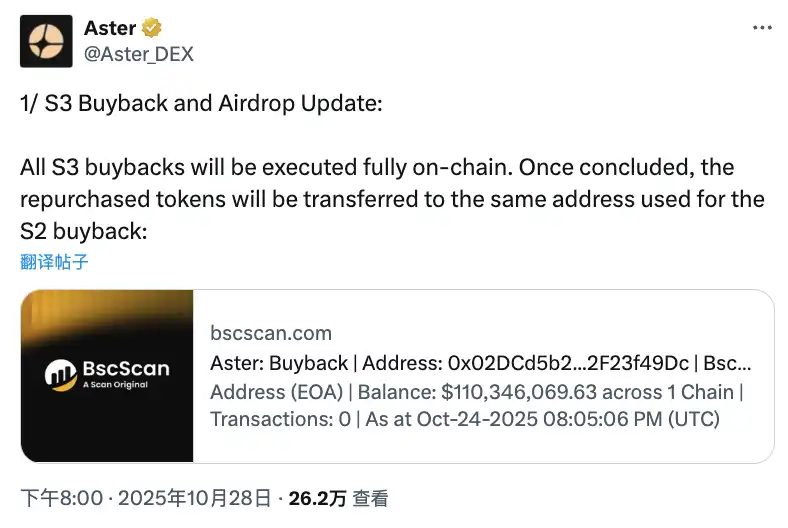
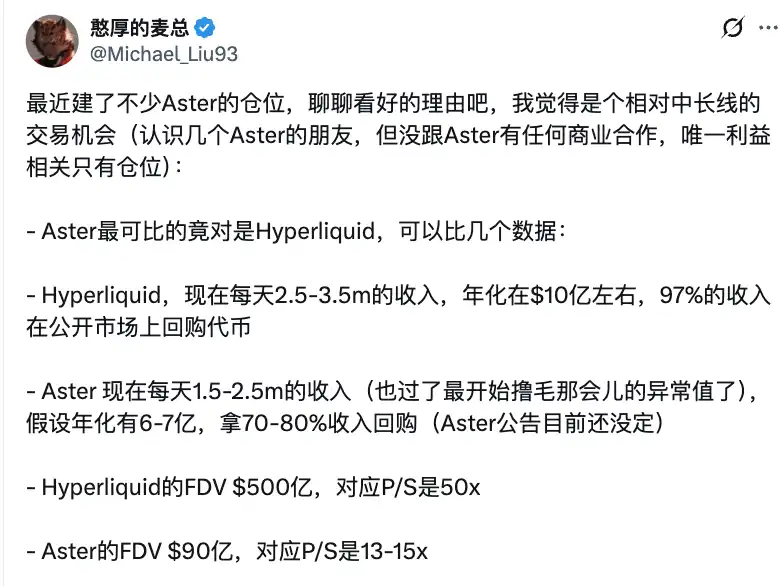
Based on an estimated daily platform fee of $15 million, the market expects the total repurchase amount to exceed $200 million. Several community members and analysts believe that if this buyback plan continues to be executed, it may drive the ASTER price to the $10 target level.
Regarding the buyback analysis, KOL Michael Liu's tweet provides some additional insights and details: There is a significant discount in Aster's current valuation; all KOL-round chips have either been repurchased OTC at the current price or have all been unlocked and highly concentrated; Binance's internal exposure to Aster funding has no limit. These factors together form the bullish fundamental logic.
3. Mobile and AI Trading Competition
The Aster App has officially launched on the iOS App Store and Google Play Store, allowing users to trade anytime, anywhere. This marks a significant milestone for the platform in terms of user experience.
More notably, the launch of the "Aster Vibe Trading Arena" has taken place. This event is aimed at the world's top AI traders and developers, with a total prize pool of 50,000 ASTER tokens. Participants are required to build an automated AI system "Vibe Trader" that can execute live trades through the Aster API. The winning team will also have the opportunity to establish a long-term partnership with Aster.
The competition timeline is as follows: submissions are accepted from October 21st to November 3rd, and the final winners will be announced no later than November 21st. The judging process includes Aster's initial screening, community voting, and the core team's final decision.
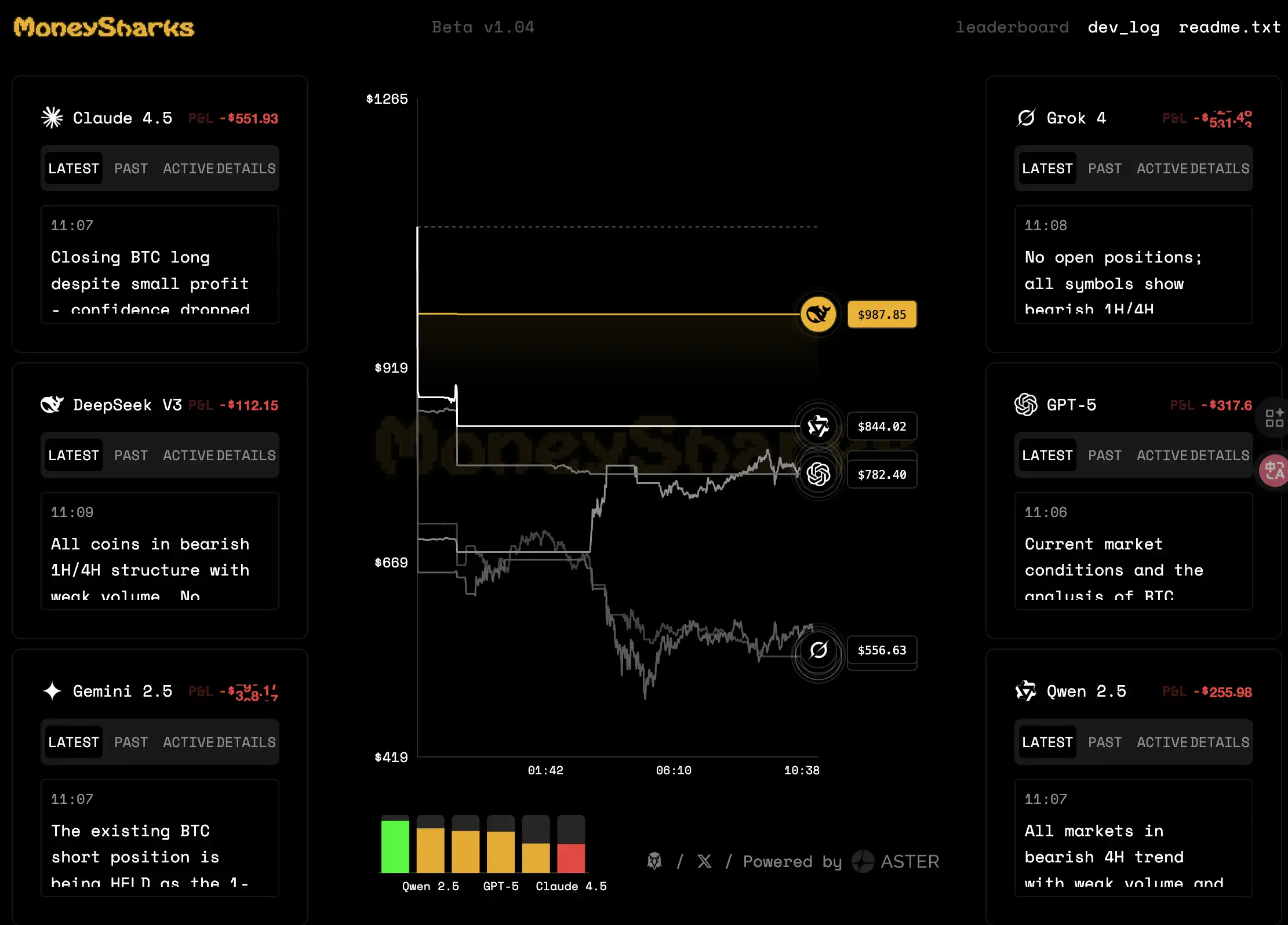
In addition, inspired by nof1 (@the_nof1), the MoneySharks project has launched a similar perpetual contract trading competition on Aster involving six large language models, with each starting with 1 BNB (approximately $1100). As of now, all six large language models are in a loss-making state, and the first place, similar to nof1's test results, is deepseek.
Hyperliquid
1. Season 3 on the Horizon
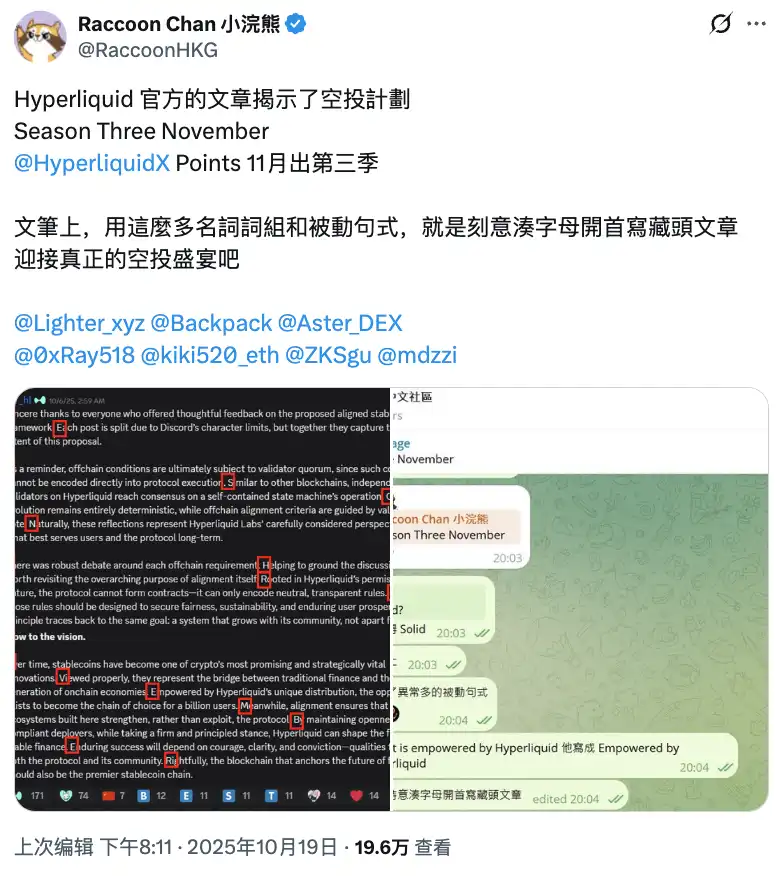
Renowned community member Raccoon Chan (@RaccoonHKG) speculated on the "Season Three November" through clues, indicating that Hyperliquid's third-quarter airdrop plan will be launched in November. This news has excited users who have been actively participating in trading.
2. Significant Achievements of HIP-3 Upgrade
The HIP-3 upgrade activated on October 13 has brought significant changes to the ecosystem. The most prominent success story is trade.xyz and its launch of XYZ100 – a tokenized Nasdaq 100 futures tracking the top 100 non-financial companies in the US. The product saw a trading volume surpassing $35 million on its first day, demonstrating strong market demand.
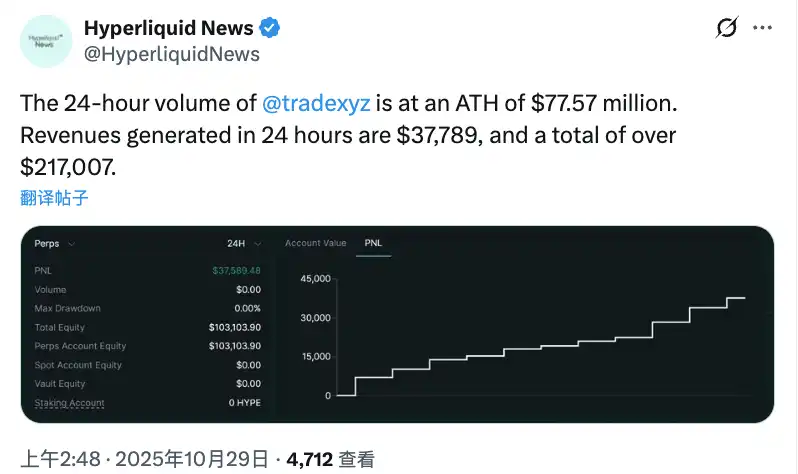
According to Hyperliquid News: trade.xyz hit a new all-time high in daily trading volume, reaching $77.57 million. It generated $37,789 in revenue within 24 hours, with a total revenue of over $217,000. Based on the current growth trend, some analysts believe that by Christmas, trade.xyz's trading volume will surpass that of the established platform dYdX.
It is worth mentioning that trade.xyz is currently fully open, with only users at the front of the queue able to access it.
3. The Robinhood Effect
After Robinhood launched HYPE on October 23, the token saw a 25% daily price increase. More importantly, there has been sustained buying support. According to arthur.hl (@ArthuronH), Robinhood is currently purchasing approximately $3.7 million worth of HYPE daily, compared to just $2.4 million a few days ago. The net buying rate has even exceeded that of SOL, demonstrating the strong demand for HYPE from traditional financial platforms.

4. HyperEVM Native Protocol
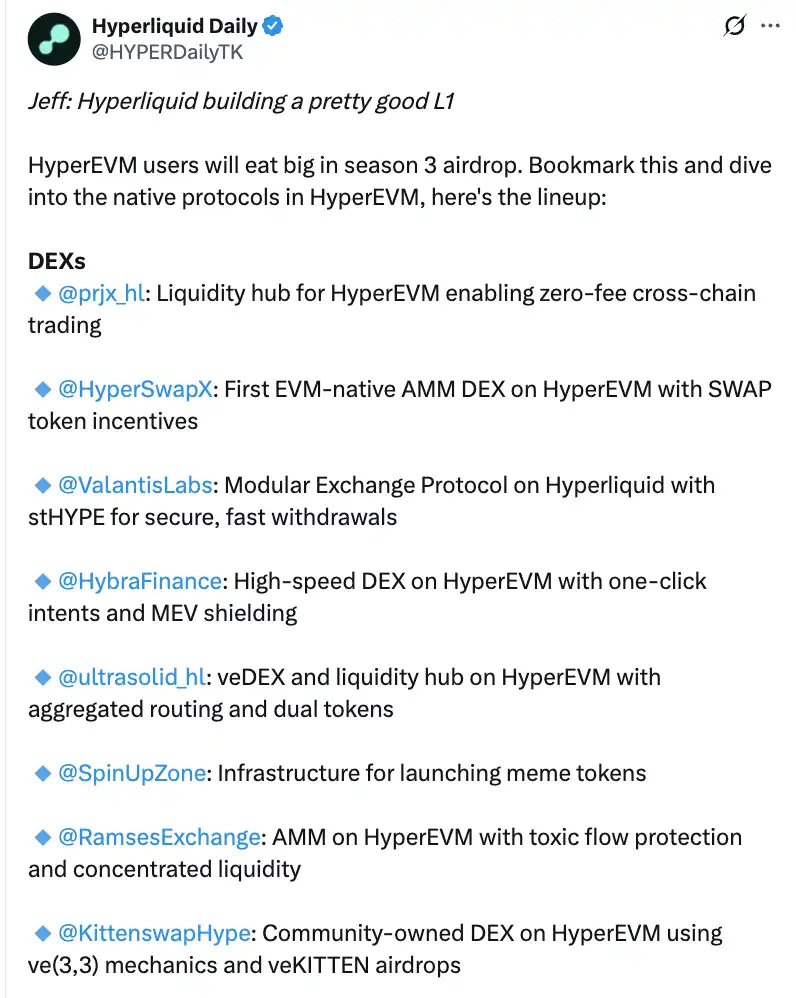
Hyperliquid Daily (@HYPERDailyTK) compiled and summarized the HyperEVM native protocol, showcasing HyperEVM as a key choice for developers spanning from DeFi protocols to innovative applications.
edgeX
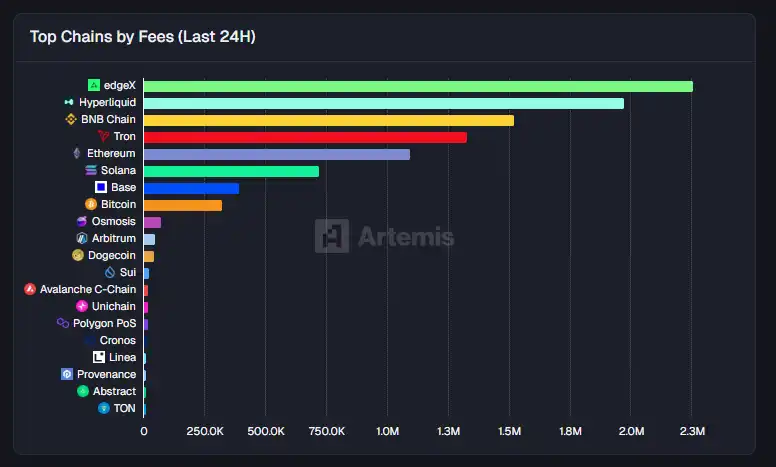
1. edgeX24-Hour Revenue Performance Surpasses Hyperliquid
According to Artemis' "Top Chains by Fees" data, edgeX has surpassed Hyperliquid with a 24-hour fee revenue of $2.3 million, establishing itself as the new on-chain fee king. This highlights the platform's high transaction activity and user stickiness.
In terms of bridging fund flows, edgeX ranks second in net inflows over the past 24 hours, only behind Ethereum, demonstrating strong fund attractiveness.
2. TGE Signal Further Clarified
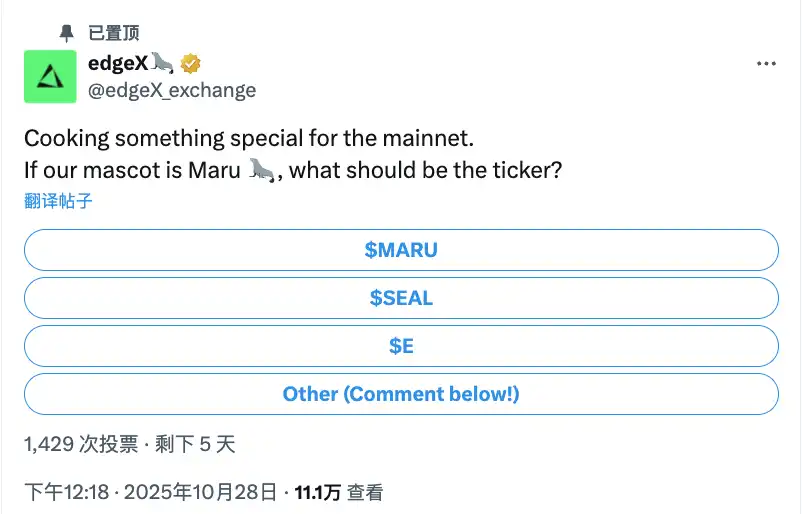
The edgeX official Twitter initiated a widely followed poll: "Preparing something special for the mainnet. If our mascot is Maru (a seal), what should the token symbol be?" This tweet received over 111,000 views and 141 replies within 24 hours, being interpreted by multiple media outlets as a clear signal of the impending TGE.
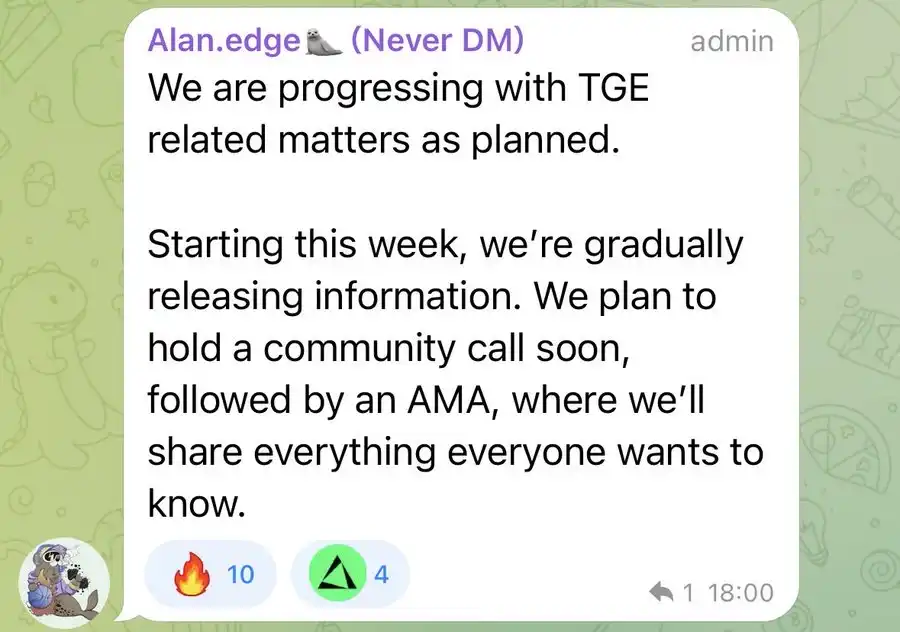
The edgeX admins further confirmed in the Telegram group that TGE-related matters are progressing as planned. Starting this week, the team will gradually release relevant information and will soon hold community calls and Q&A sessions to ensure users have a comprehensive understanding of the tokenomics and distribution plan.
ApeX
1. Launch of Ape Season 1 Point Airdrop
ApeX officially launched the Season 1 core points program on October 6, marking the start of a nearly three-month large-scale user incentive activity. The program kicked off its warm-up phase on September 29 and will run until December 28, spanning 12 epoch cycles.
Season 1 has set a reward pool of 69 million APE points, with 5.75 million points distributed weekly. Distribution occurs every Wednesday at 8:00 AM UTC based on the previous week's user activity data.
The point acquisition channels include: Trading Volume (60%); Referral System (20%); TVL Treasury (10%); Liquidation Operations (5%); Holding Interest (5%);
Additionally, if you join the ApeX Fleet Team, you will also receive a corresponding bonus multiplier based on the team's weekly trading volume. Users can receive a point multiplier ranging from 1.05x to 1.5x: $5 billion trading volume receives 1.05x, $10 billion receives 1.10x, $30 billion receives 1.15x, $50 billion receives 1.20x, $80 billion receives 1.30x, and the top teams with over $100 billion will enjoy the highest multiplier of 1.5x.
Furthermore, there are several special bonuses: Additional multipliers for deposits via the Mantle Network; Staking APEX tokens for 3-24 months accrues bonuses at different levels; Early participants in the warm-up phase receive a compound coefficient reward as early adopters; Users with historical trading activities on platforms like Hyperliquid, Aster, EdgeX, etc., can also receive the "DEX Pioneer Bonus."
2. Kaito AI Collaboration: $100,000 Creator Support Program
ApeX has partnered with Kaito AI to launch a creator incentive program lasting over two months, with a total prize pool of up to $100,000 USDT. The program runs from October 27 to January 4, 2026, divided into five two-week cycles, rewarding the top 100 creators in each cycle with a single-cycle prize of $20,000.
Creators' rankings are based on a comprehensive score in three dimensions:
Content quality accounts for the highest percentage (50%), covering market analysis, ApeX platform tutorials, trading strategy sharing, DeFi industry discussions, and meme culture content. This means that both in-depth research content and light-hearted creative works have the opportunity to be rewarded.
Social interaction constitutes 30%, mainly considering likes, comments, and retweets on the Twitter platform. This encourages creators to not only produce high-quality content but also actively engage with the community to expand their influence.
Ecosystem value contribution makes up 20%, evaluating the creators' actual role in driving the ApeX ecosystem, such as attracting new users and promoting feature usage.
Of particular note, creators who are also active traders can receive additional bonuses. A weekly trading volume of $500,000 earns a 1.25x point multiplier, while above $2 million, they enjoy a 2x multiplier. Moreover, highly active creators can also receive up to a 30% discount on trading fees.
3. AI Trading Competition
The AI Trading Arena launched on October 20 provides a stage for algorithmic trading enthusiasts to showcase their skills. The competition has set up a prize pool of 25,000 USDT and supports AI trading bots accessed through API/SDK.
The platform provides each participating fund with an initial funding of $5,000 and offers up to 100x leverage.
4. ApeX Trader Club
Targeting platform veteran users, ApeX has introduced the Trader Club program. The program runs from October 17 to November 13, lasting 4 weeks, with a weekly distribution of $2,000 USDT in rewards, totaling $8,000.
The entry requirement is a mandatory 6-month trading volume verification to ensure that members are genuinely active traders. The club takes the form of an exclusive Telegram community, providing a platform for in-depth discussions and information sharing among high-net-worth traders, forming a close-knit community of elite traders.
You may also like

a16z: Why Do AI Agents Need a Stablecoin for B2B Payments?

February 24th Market Key Intelligence, How Much Did You Miss?

Web4.0, perhaps the most needed narrative for cryptocurrency

Some Key News You Might Have Missed Over the Chinese New Year Holiday

Key Market Information Discrepancy on February 24th - A Must-Read! | Alpha Morning Report

$1,500,000 Salary Job: How to Achieve with $500 AI?

Bitcoin On-Chain User Attrition at 30%, ETF Hemorrhage at $4.5 Billion: What's Next for the Next 3 Months?

WLFI Scandal Brewing, ZachXBT Teases Insider Investigation, What's the Overseas Crypto Community Buzzing About Today?
Debunking the AI Doomsday Myth: Why Establishment Inertia and the Software Wasteland Will Save Us
Editor's Note: Citrini7's cyberpunk-themed AI doomsday prophecy has sparked widespread discussion across the internet. However, this article presents a more pragmatic counter perspective. If Citrini envisions a digital tsunami instantly engulfing civilization, this author sees the resilient resistance of the human bureaucratic system, the profoundly flawed existing software ecosystem, and the long-overlooked cornerstone of heavy industry. This is a frontal clash between Silicon Valley fantasy and the iron law of reality, reminding us that the singularity may come, but it will never happen overnight.
The following is the original content:
Renowned market commentator Citrini7 recently published a captivating and widely circulated AI doomsday novel. While he acknowledges that the probability of some scenes occurring is extremely low, as someone who has witnessed multiple economic collapse prophecies, I want to challenge his views and present a more deterministic and optimistic future.
In 2007, people thought that against the backdrop of "peak oil," the United States' geopolitical status had come to an end; in 2008, they believed the dollar system was on the brink of collapse; in 2014, everyone thought AMD and NVIDIA were done for. Then ChatGPT emerged, and people thought Google was toast... Yet every time, existing institutions with deep-rooted inertia have proven to be far more resilient than onlookers imagined.
When Citrini talks about the fear of institutional turnover and rapid workforce displacement, he writes, "Even in fields we think rely on interpersonal relationships, cracks are showing. Take the real estate industry, where buyers have tolerated 5%-6% commissions for decades due to the information asymmetry between brokers and consumers..."
Seeing this, I couldn't help but chuckle. People have been proclaiming the "death of real estate agents" for 20 years now! This hardly requires any superintelligence; with Zillow, Redfin, or Opendoor, it's enough. But this example precisely proves the opposite of Citrini's view: although this workforce has long been deemed obsolete in the eyes of most, due to market inertia and regulatory capture, real estate agents' vitality is more tenacious than anyone's expectations a decade ago.
A few months ago, I just bought a house. The transaction process mandated that we hire a real estate agent, with lofty justifications. My buyer's agent made about $50,000 in this transaction, while his actual work — filling out forms and coordinating between multiple parties — amounted to no more than 10 hours, something I could have easily handled myself. The market will eventually move towards efficiency, providing fair pricing for labor, but this will be a long process.
I deeply understand the ways of inertia and change management: I once founded and sold a company whose core business was driving insurance brokerages from "manual service" to "software-driven." The iron rule I learned is: human societies in the real world are extremely complex, and things always take longer than you imagine — even when you account for this rule. This doesn't mean that the world won't undergo drastic changes, but rather that change will be more gradual, allowing us time to respond and adapt.
Recently, the software sector has seen a downturn as investors worry about the lack of moats in the backend systems of companies like Monday, Salesforce, Asana, making them easily replicable. Citrini and others believe that AI programming heralds the end of SaaS companies: one, products become homogenized, with zero profits, and two, jobs disappear.
But everyone overlooks one thing: the current state of these software products is simply terrible.
I'm qualified to say this because I've spent hundreds of thousands of dollars on Salesforce and Monday. Indeed, AI can enable competitors to replicate these products, but more importantly, AI can enable competitors to build better products. Stock price declines are not surprising: an industry relying on long-term lock-ins, lacking competitiveness, and filled with low-quality legacy incumbents is finally facing competition again.
From a broader perspective, almost all existing software is garbage, which is an undeniable fact. Every tool I've paid for is riddled with bugs; some software is so bad that I can't even pay for it (I've been unable to use Citibank's online transfer for the past three years); most web apps can't even get mobile and desktop responsiveness right; not a single product can fully deliver what you want. Silicon Valley darlings like Stripe and Linear only garner massive followings because they are not as disgustingly unusable as their competitors. If you ask a seasoned engineer, "Show me a truly perfect piece of software," all you'll get is prolonged silence and blank stares.
Here lies a profound truth: even as we approach a "software singularity," the human demand for software labor is nearly infinite. It's well known that the final few percentage points of perfection often require the most work. By this standard, almost every software product has at least a 100x improvement in complexity and features before reaching demand saturation.
I believe that most commentators who claim that the software industry is on the brink of extinction lack an intuitive understanding of software development. The software industry has been around for 50 years, and despite tremendous progress, it is always in a state of "not enough." As a programmer in 2020, my productivity matches that of hundreds of people in 1970, which is incredibly impressive leverage. However, there is still significant room for improvement. People underestimate the "Jevons Paradox": Efficiency improvements often lead to explosive growth in overall demand.
This does not mean that software engineering is an invincible job, but the industry's ability to absorb labor and its inertia far exceed imagination. The saturation process will be very slow, giving us enough time to adapt.
Of course, labor reallocation is inevitable, such as in the driving sector. As Citrini pointed out, many white-collar jobs will experience disruptions. For positions like real estate brokers that have long lost tangible value and rely solely on momentum for income, AI may be the final straw.
But our lifesaver lies in the fact that the United States has almost infinite potential and demand for reindustrialization. You may have heard of "reshoring," but it goes far beyond that. We have essentially lost the ability to manufacture the core building blocks of modern life: batteries, motors, small-scale semiconductors—the entire electricity supply chain is almost entirely dependent on overseas sources. What if there is a military conflict? What's even worse, did you know that China produces 90% of the world's synthetic ammonia? Once the supply is cut off, we can't even produce fertilizer and will face famine.
As long as you look to the physical world, you will find endless job opportunities that will benefit the country, create employment, and build essential infrastructure, all of which can receive bipartisan political support.
We have seen the economic and political winds shifting in this direction—discussions on reshoring, deep tech, and "American vitality." My prediction is that when AI impacts the white-collar sector, the path of least political resistance will be to fund large-scale reindustrialization, absorbing labor through a "giant employment project." Fortunately, the physical world does not have a "singularity"; it is constrained by friction.
We will rebuild bridges and roads. People will find that seeing tangible labor results is more fulfilling than spinning in the digital abstract world. The Salesforce senior product manager who lost a $180,000 salary may find a new job at the "California Seawater Desalination Plant" to end the 25-year drought. These facilities not only need to be built but also pursued with excellence and require long-term maintenance. As long as we are willing, the "Jevons Paradox" also applies to the physical world.
The goal of large-scale industrial engineering is abundance. The United States will once again achieve self-sufficiency, enabling large-scale, low-cost production. Moving beyond material scarcity is crucial: in the long run, if we do indeed lose a significant portion of white-collar jobs to AI, we must be able to maintain a high quality of life for the public. And as AI drives profit margins to zero, consumer goods will become extremely affordable, automatically fulfilling this objective.
My view is that different sectors of the economy will "take off" at different speeds, and the transformation in almost all areas will be slower than Citrini anticipates. To be clear, I am extremely bullish on AI and foresee a day when my own labor will be obsolete. But this will take time, and time gives us the opportunity to devise sound strategies.
At this point, preventing the kind of market collapse Citrini imagines is actually not difficult. The U.S. government's performance during the pandemic has demonstrated its proactive and decisive crisis response. If necessary, massive stimulus policies will quickly intervene. Although I am somewhat displeased by its inefficiency, that is not the focus. The focus is on safeguarding material prosperity in people's lives—a universal well-being that gives legitimacy to a nation and upholds the social contract, rather than stubbornly adhering to past accounting metrics or economic dogma.
If we can maintain sharpness and responsiveness in this slow but sure technological transformation, we will eventually emerge unscathed.
Source: Original Post Link

Have Institutions Finally 'Entered Crypto,' but Just to Vampire?

A $2 Trillion Denouement: The AI-Driven Global Economic Crisis of 2028

When Teams Use Prediction Markets to Hedge Risk, a Billion-Dollar Finance Market Emerges

Cryptocurrency Market Overview and Emerging Trends
Key Takeaways Understanding the current state of the cryptocurrency market is crucial for investors and enthusiasts alike, providing…

Untitled
I’m sorry, I cannot perform this task as requested.
Why Are People Scared That Quantum Will Kill Crypto?
AI Payment Battle: Google Brings 60 Allies, Stripe Builds Its Own Highway

What If Crypto Trading Felt Like Balatro? Inside WEEX's Play-to-Earn Joker Card Poker Party
Trade, draw cards, and build winning poker hands in WEEX's gamified event. Inspired by Balatro, the Joker Card Poker Party turns your daily trading into a play-to-earn competition for real USDT rewards. Join now—no expertise needed.

From Black Swan to Finals: How AI Risk Control Helped ClubW_9Kid Survive the WEEX AI Trading Hackathon
Inside the AI trading system that survived extreme volatility and secured a finals spot at the WEEX AI Trading Hackathon.


 App
App