
- Buy Crypto
- Markets
 Futures
- Spot
- Copy Trade
- Earn
- More
Market Share Plummets by 60% - Can Hyperliquid Stage a Comeback with HIP-3 and Builder Codes?

Original Article Title: Hyperliquid Growth Situation
Original Article Author: @esprisi0
Translation: Peggy, BlockBeats
Editor's Note: Hyperliquid once dominated the decentralized derivatives track, but in the second half of 2025, its market share plummeted rapidly, sparking industry attention: has it peaked, or is it positioning for the next stage? This article reviews Hyperliquid's three stages: from the ultimate dominance with a market share soaring to 80%, to strategic transformation and accelerated competition leading to a loss of momentum down to 20%, and then to a re-emergence centered around HIP-3 and Builder Codes.
The following is the original text:
Over the past few weeks, concerns about the future of Hyperliquid have escalated. The loss of market share, rapidly rising competitors, and increasingly crowded derivatives track have raised a key question: what exactly is happening beneath the surface? Has Hyperliquid already peaked, or is the current narrative overlooking deeper structural signals?
This article will dissect it one by one.
Stage One: Ultimate Dominance
From early 2023 to mid-2025, Hyperliquid consistently hit historical highs in key metrics and steadily increased its market share, thanks to several structural advantages:
A points-based incentive mechanism that attracted a large amount of liquidity; a first-mover advantage in launching new perpetual contracts (such as $TRUMP, $BERA), making Hyperliquid the most liquid venue for new trading pairs and the preferred platform for pre-listing trading (such as $PUMP, $WLFI, XPL). To not miss out on emerging trends, traders were compelled to flock to Hyperliquid, driving its competitive edge to its peak; best UI/UX experience among all perpetual contract DEXs; lower fees compared to centralized exchanges (CEXs); introduction of spot trading, unlocking new use cases; Builder Codes, HIP-2, and HyperEVM integration; achieving zero downtime even during major market crashes.
As a result, Hyperliquid's market share grew continuously for over a year, reaching a peak of 80% in May 2025.
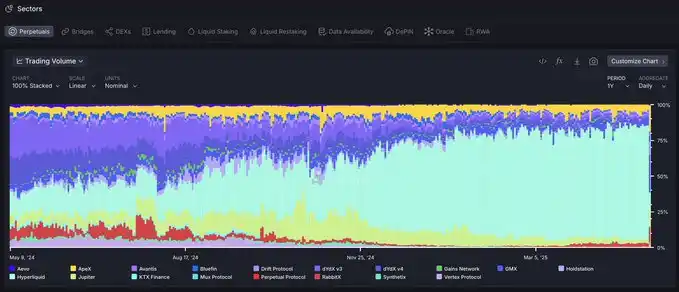
Perpetual Contract Trading Volume Market Share data provided by @artemis
At that stage, the Hyperliquid team was significantly ahead of the entire market in innovation and execution speed, with no truly comparable products in the entire ecosystem.
The Rise of Liquidity-as-a-Service in the Second Stage and Accelerated Competition
Since May 2025, Hyperliquid's market share has plummeted sharply, dropping from around 80% to close to 20% of the trading volume by early December.
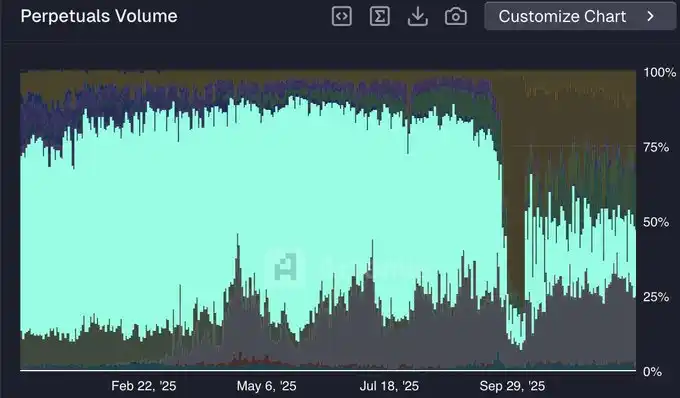
@HyperliquidX Market Share (Data Source: @artemis)
This relative loss of momentum against competitors can be attributed to several factors:
Strategic Shift from B2C to B2B
Hyperliquid did not double down on a pure B2C model, such as launching a proprietary mobile app or continually rolling out new perpetual contract products, but chose to pivot to a B2B strategy, positioning itself as the "AWS of Liquidity."
This strategy focused on building core infrastructure for external developers to use, such as Builder Codes for the front end and HIP-3 for launching new perpetual markets. However, this transformation essentially ceded the initiative for product deployment to third parties.
In the short term, this strategy did not perform ideally in attracting and retaining liquidity. The infrastructure was still in its early stages, adoption takes time, and external developers did not yet have the distribution capability and trust built up over the long term by the Hyperliquid core team.
Competitors Seizing the Opportunity of Hyperliquid's Transformation
Unlike Hyperliquid's new B2B model, competitors continued to maintain full vertical integration, allowing them to significantly accelerate their speed when launching new products.
Since they did not need to delegate execution, these platforms maintained full control over product releases while leveraging their established user trust to rapidly expand. As a result, they are more competitive than they were in the first stage.
This directly translates into market share growth. Competitors are now not only offering all products on Hyperliquid but also launching features on HL that have not yet gone live (such as Lighter launching spot markets, perpetual equities, and forex).
Incentives and "Hire-to-Liquidity"
Hyperliquid has gone over a year without running any official incentive programs, while its main competitors are still actively engaging. Lighter, currently leading in trading volume market share (about 25%), is still in its pre-TGE incentive season.
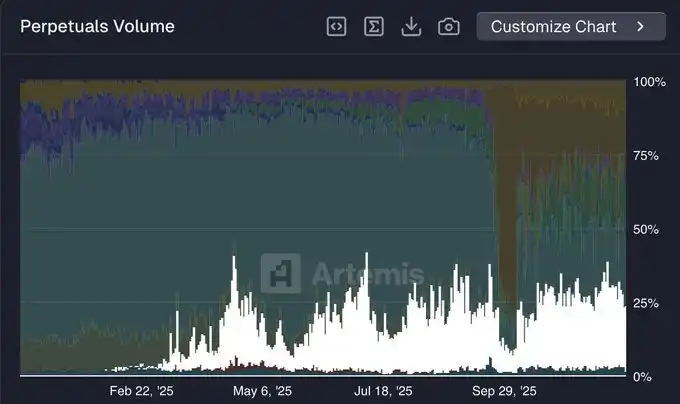
@Lighter_xyz Market Share (Source: @artemis)
In the DeFi space, liquidity is more “hire-to” than anywhere else. A significant portion of the volume flowing from Hyperliquid to Lighter (and other platforms) is likely incentive-driven, related to airdrop farming. Like most perpetual DEXs running incentive seasons, Lighter's market share is expected to decrease post-TGE.
Phase Three HIP-3 and the Rise of Builder Codes
As mentioned earlier, building the "AWS of liquidity" is not the short-term optimal strategy. However, in the long run, this model precisely positions Hyperliquid to potentially become the core hub of global finance.
While competitors have replicated most of Hyperliquid's current features, real innovation still stems from Hyperliquid. Developers building on Hyperliquid benefit from domain focus, allowing them to formulate more targeted product development strategies on an evolving infrastructure. On the other hand, protocols like Lighter that maintain complete vertical integration will face constraints when optimizing the development of multiple product lines simultaneously.
HIP-3 is still in its early stages, but its long-term impact has begun to materialize. Key participants include:
@tradexyz has launched perpetual equities
@hyenatrade recently deployed a trading terminal for USDe
More experimental markets are emerging, such as @ventuals offering pre-IPO exposure and @trovemarkets catering to niche speculative markets like Pokémon or CS:GO assets.
By 2026, it is expected that the HIP-3 market will capture a significant share of Hyperliquid's total trading volume.
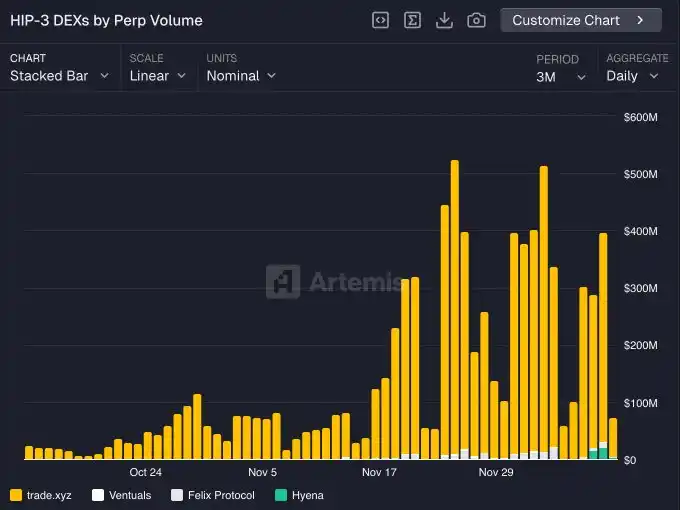
HIP-3 Trading Volume (by Builder)
The key driver behind the eventual restoration of Hyperliquid's dominance is the synergistic effect between HIP-3 and Builder Codes. Any frontend integrated with Hyperliquid can instantly access the full HIP-3 market, providing users with unique products.
Therefore, developers have a strong incentive to list on the HIP-3 market as these markets can be distributed on any compatible frontend (such as Phantom, MetaMask, etc.) and tap into entirely new sources of liquidity. It's a perfect virtuous cycle.
The ongoing development of Builder Codes makes me more optimistic about the future, whether in terms of revenue growth or active user expansion.
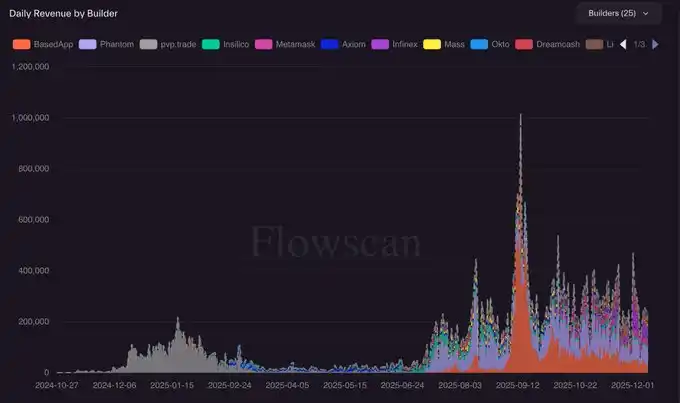
Builder Codes Revenue (data source: @hydromancerxyz)
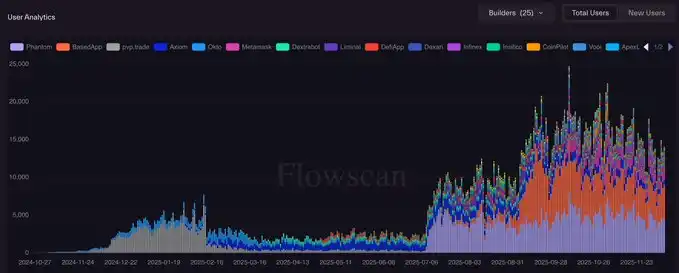
Builder Codes Daily Active Users (data source: @hydromancerxyz)
Currently, Builder Codes are primarily used by native crypto applications (such as Phantom, MetaMask, BasedApp, etc.). However, I anticipate a new class of super apps built on Hyperliquid to emerge in the future, aimed at attracting an entirely non-native crypto user base.
This is very likely to become the key path for Hyperliquid to enter the next stage of scaling, which will also be the focus of my next article.
You may also like

Bitcoin's Big Brother Scythe, a Nasdaq Heist Chronicle

ARK Invest: Stablecoins are Constructing the Next-Generation Monetary System

President Trump Asserts Imminent Passing of Crypto Market Structure Bill
Key Takeaways Presidential Confirmation: President Trump states the major crypto market structure bill is on the verge of…

Germany Central Bank Head Advocates for European Crypto Stablecoins Under EU MiCA Framework
Key Takeaways Joachim Nagel, head of the Germany Bundesbank, is advocating for the adoption of euro-based crypto stablecoins…

Polygon Surpasses Ethereum in Daily Fees as Polymarket Bets Rocket
Key Takeaways Polygon has outpaced Ethereum in daily transaction fees, a historic shift driven by activity on Polymarket.…

Bitcoin Price Prediction: BTC Short Squeeze Alert – Is a Significant Rebound on the Horizon?
Key Takeaways Recent data indicates Bitcoin shorts have escalated to unprecedented levels reminiscent of a major market low…

Google’s Gemini AI Predicts the Price of XRP, Solana, and Bitcoin by the End of 2026
Key Takeaways XRP’s Potential: Google’s Gemini AI forecasts XRP could reach $10 by 2026, leveraging Ripple’s payment solutions…

Top Analyst Warns Bitcoin Price Could Plummet to $10,000 Amid Deepening Bear Market
Key Takeaways Bitcoin’s value could potentially drop to $10,000 as part of an imploding bubble, suggests a renowned…

Best Crypto to Buy Now February 10 – XRP, Solana, Dogecoin
Key Takeaways XRP is poised for long-term growth with its recent strategic expansions in institutional-grade payments and tokenization.…

Kyle Samani Criticizes Hyperliquid in Explosive Post-Departure Market Commentary
Key Takeaways: Kyle Samani, after leaving Multicoin Capital, criticized Hyperliquid, a decentralized exchange, labeling it as a systemic…
XRP Price Prediction: A 50M Token Sell-Off Just Shook the Market — Is More Loss Imminent?
Key Takeaways Over 50 million XRP hit the market within a span of less than 12 hours, leading…

Strategy Plans to Equitize Convertible Debt Over 3–6 Years: What It Means for BTC
Key Takeaways Strategy, led by Michael Saylor, is equitizing $6 billion in convertible debt as a long-term strategy…

BlockFills Freezes Withdrawals as Bitcoin Declines, Heightening Counterparty Risk Concerns
Key Takeaways BlockFills, an institutional trading firm, has stopped client withdrawals amid rising market volatility and Bitcoin price…

Leading AI Claude Predicts the Price of XRP, Cardano, and Ethereum by the End of 2026
Key Takeaways Claude AI projects substantial growth for XRP, Cardano, and Ethereum by the end of 2026, with…
Crypto Price Forecast for 16 February – XRP, Ethereum, Cardano
Key Takeaways Technical trends and recent developments suggest potential growth for XRP, Ethereum, and Cardano. XRP is targeting…

Bitcoin Price Prediction: Alarming New Research Warns Millions in BTC at Risk of ‘Quantum Freeze’ – Are You Protected?
Key Takeaways Recent market movements have sparked concerns over a potential bear market for Bitcoin, marked by significant…
XRP Price Forecast: Can XRP Truly Surpass Bitcoin and Ethereum? Analyst Argues the Contest Has Already Begun
Key Takeaways XRP has maintained significant support around the $1.40 level despite a 12% decline over the past…
Best Crypto to Purchase Now February 6 – XRP, Solana, Bitcoin
Key Takeaways XRP’s Strength: Ripple’s focus on challenging traditional systems like SWIFT is driving XRP towards a potential…
Bitcoin's Big Brother Scythe, a Nasdaq Heist Chronicle
ARK Invest: Stablecoins are Constructing the Next-Generation Monetary System
President Trump Asserts Imminent Passing of Crypto Market Structure Bill
Key Takeaways Presidential Confirmation: President Trump states the major crypto market structure bill is on the verge of…
Germany Central Bank Head Advocates for European Crypto Stablecoins Under EU MiCA Framework
Key Takeaways Joachim Nagel, head of the Germany Bundesbank, is advocating for the adoption of euro-based crypto stablecoins…
Polygon Surpasses Ethereum in Daily Fees as Polymarket Bets Rocket
Key Takeaways Polygon has outpaced Ethereum in daily transaction fees, a historic shift driven by activity on Polymarket.…
Bitcoin Price Prediction: BTC Short Squeeze Alert – Is a Significant Rebound on the Horizon?
Key Takeaways Recent data indicates Bitcoin shorts have escalated to unprecedented levels reminiscent of a major market low…


 App
App