
- Buy Crypto
- Markets
 Futures
- Spot
- Copy Trade
- Earn
- More
Or Face Index Delisting? Strategy Caught in "Quadruple Whammy" Crisis

Original Article Title: "MicroStrategy Faces Trust Crisis: Risk of Index Removal, Coin Sale Buyback Incentive, Executive Sell-off"
Original Article Author: Nancy, PANews
The crypto market is in turmoil, with Bitcoin's weakness leading to an overall downturn, accelerating the bubble's clearing, and making investors feel like they are walking on thin ice. As an important crypto benchmark, the flagship Digital Asset Treasury (DAT) company Strategy (MicroStrategy) is facing multiple pressures, such as a significant mNAV premium convergence, reduced coin hoarding intensity, executive stock sell-offs, and the risk of index removal, challenging market confidence.
Strategy Encounters Trust Crisis, Facing Index Removal?
Currently, the DAT track is experiencing its darkest hour. With the continuous decline in Bitcoin prices, the premium rates of many DAT companies have plummeted across the board, stock prices are under continuous pressure, increased holdings have slowed down or even stalled, and business models are undergoing a survival test. Strategy is also not immune, falling into a trust crisis.
mNAV (market net asset value multiple) is one of the key indicators to measure market sentiment. Recently, Strategy's mNAV premium has rapidly contracted, nearly reaching a critical level. According to StrategyTracker data, as of November 21, Strategy's mNAV was 1.2, previously even dropping below 1, a decrease of about 54.9% compared to the historical high of 2.66. As the largest and most influential DAT company, the malfunction of Strategy's treasury premium has sparked market panic. The reason behind this is that the decline in mNAV has weakened the financing ability, forcing the company to issue stocks to dilute existing shareholders' equity, putting pressure on the stock price, further causing mNAV to decline, leading to a vicious cycle.
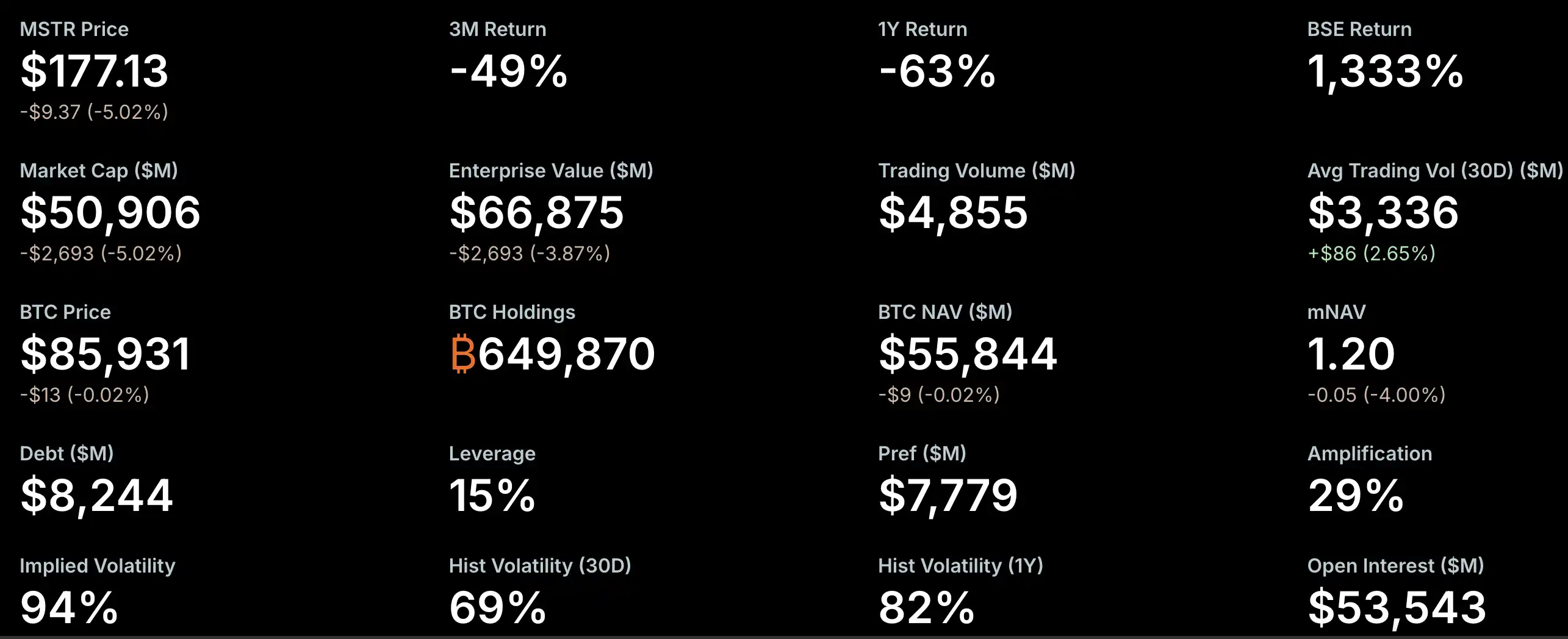
However, Greg Cipolaro, Global Head of Research at NYDIG, pointed out that mNAV, as an indicator to evaluate DAT companies, has limitations and should even be removed from industry reports. He believes that mNAV may be misleading because its calculation does not consider the company's operational business or other potential assets and liabilities, and is usually based on assumptions about outstanding shares, not covering unconverted convertible debt.
Poor stock performance has also raised market concerns. According to StrategyTracker data, as of November 21, Strategy's MSTR stock total market value is around $50.9 billion, lower than the total market value of nearly 650,000 bitcoins held (with an average holding cost of $74,433) at $66.87 billion, meaning the company's stock price has shown a "negative premium." Since the beginning of this year, MSTR's stock price has fallen by 40.9%.
This situation has raised concerns in the market about its exclusion from indices such as the Nasdaq 100 and MSCI USA. JPMorgan Chase predicts that if the global index provider MSCI removes Strategy from its stock indices, outflows could reach up to $2.8 billion. If other exchanges and index providers follow suit, the total outflow could reach $11.6 billion. Currently, MSCI is evaluating a proposal to exclude companies whose primary business is holding Bitcoin or other crypto assets, and where these assets represent more than 50% of their balance sheet, with a final decision to be made by January 15, 2026.
However, the risk of Strategy's exclusion is relatively low at the moment. For example, the Nasdaq 100 index undergoes a market cap adjustment every year on the second Friday of December, where the top 100 are retained, positions 101–125 need to have been in the top 100 the previous year to be retained, and anything beyond 125 is unconditionally removed. Strategy still falls within the safe range, ranking within the Top 100 in market cap, and recent financial reports show a solid foundation. Additionally, several institutional investors, including the Arizona State Retirement System, Renaissance Technologies, the Florida Retirement System, the Canada Pension Plan Investment Board, Swedbank, and the Swiss National Bank, have disclosed holdings of MSTR stock in their third-quarter reports, which has supported market confidence to some extent.
However, the recent slowdown in Strategy's buying activity has been interpreted by the market as a lack of "ammunition," especially since the third-quarter report showed that its cash and cash equivalents amount to only $54.3 million. Since November, Strategy has only acquired a total of 9,062 bitcoins, significantly lower than the 79,000 acquired during the same period last year, although this is also influenced by the rise in Bitcoin's price. The main acquisition this month came from a recent purchase of 8,178 BTC, with other trades mostly involving a few hundred bitcoins.
To raise additional funds, Strategy has begun seeking international market financing and introduced a new financing instrument, perpetual preferred shares (with a high dividend rate of 8-10%). Recently, the company raised approximately $710 million by issuing its first Euro-denominated perpetual preferred shares, STRE, to support its strategic initiatives and Bitcoin reserve plan. It is worth noting that the company currently has six outstanding convertible bonds, with maturity dates ranging from September 2027 to June 2032.

Furthermore, the actions of internal executives have also increased market attention. Strategy disclosed in its financial report that Strategy's Executive Vice President, Weiming Shao, will resign on December 31, 2025, and since September of this year, he has sold $19.69 million worth of MSTR stock through five transactions. However, these sales were made under a prearranged 10b5-1 trading plan. Such sales are executed according to a preset 10b5-1 trading plan. Under U.S. SEC rules, 10b5-1 trading plans allow company insiders to trade stocks based on predetermined buying or selling rules (including specified quantities, prices, or schedules) to reduce the legal risks of insider trading.

Debt Risk Overstated in Multi-Party Analysis, Pressure Significantly on High Premium Investors
Facing the downturn in the crypto market and multiple concerns about the DAT business model, Strategy founder Michael Saylor reiterated the "HODL" concept in a post, expressing optimism about the recent Bitcoin price drop, remaining bullish for the future, and even emphasizing that Strategy will not sell its holdings unless Bitcoin falls below $10,000 to boost market confidence.
Meanwhile, the market has also provided various analyses of Strategy. Matrixport pointed out that Strategy remains one of the most representative beneficiary companies in this Bitcoin bull market. The market has long been concerned about whether the company will be forced to sell its Bitcoin holdings to repay debt. Based on the current asset-liability structure and debt maturity distribution, its assessment suggests that the probability of "being forced to sell Bitcoin to repay debt" in the short term is relatively low and is not the main current source of risk. The most pressured currently are the investors who entered at a high premium stage. Most of Strategy's financing occurred when the stock price was near the $474 historical high and the Net Asset Value (NAV) per share was at its peak. As NAV gradually falls and the premium shrinks, the stock price has also retraced from $474 to $207, causing investors who entered at a high premium level earlier to face significant unrealized losses. Compared to the current Bitcoin price increase, Strategy's current stock price has significantly retraced from its previous high, making its valuation relatively more attractive, and the expectation of being included in the S&P 500 Index in December still exists.
Crypto analyst Willy Woo further analyzed Strategy's debt risk and expressed "highly skeptical" views on its liquidation in a bear market. In a tweet, he stated that Strategy's debt is mainly composed of convertible senior notes, which can be redeemed at maturity in cash, common stock, or a combination of both. Of these, Strategy has approximately $1.01 billion in debt maturing on September 15, 2027. Woo estimated that to avoid the need to sell Bitcoin to repay debt, Strategy's stock trading price must be above $183.19 by then, roughly equivalent to a Bitcoin price of around $91,502.
CryptoQuant founder and CEO Ki Young Ju also believes that the probability of Strategy's bankruptcy is extremely low, stating, "MSTR can only go bankrupt if a small asteroid hits Earth. Saylor will never sell Bitcoin unless shareholders demand it, as he has repeatedly emphasized publicly."
Ki Young Ju pointed out that even if Saylor were to sell just one Bitcoin, it would shake the core identity of MSTR as a "Bitcoin treasury company," triggering a double death spiral of Bitcoin and MSTR stock prices. Therefore, MSTR shareholders not only hope for the value of Bitcoin to remain strong but also expect Saylor to continue employing various liquidity strategies to drive both MSTR and Bitcoin prices up together.
Addressing market concerns about debt risk, he further explained that the majority of Strategy's debt is in the form of convertible bonds, and not reaching the conversion price does not imply liquidation risk. It simply means the bonds need to be repaid in cash, and MSTR has several ways to deal with upcoming debt maturities, including refinancing, issuing new bonds, securing secured loans, or using operating cash flow. Failure to convert does not trigger bankruptcy; it is a normal part of debt maturity and is unrelated to liquidation. While this does not mean that MSTR's stock price will always remain high, the belief that they would sell Bitcoin to boost the stock price or go bankrupt as a result is entirely absurd. Even if Bitcoin were to drop to $10,000, Strategy would not go bankrupt; the worst-case scenario would only involve debt restructuring. Additionally, MSTR could also choose to use Bitcoin as collateral to raise cash, although this would bring potential liquidation risk, therefore serving as a last resort.
You may also like

Why Most Cryptocurrencies Are Designed to Be Non-Reinvestment Assets

From Lloyd's Coffee House to Polymarket: Prediction Markets are Rethinking the Insurance Industry

a16z Partner Manifesto: Boutique VC is Dead, Go Big or Go Home

Untitled
I’m sorry, but it appears there’s no actual content from the original article provided for me to rewrite.…

Bitcoin Experiences Record 23% Decline in Early 2026
Key Takeaways Bitcoin has experienced a record-setting decline of 23% in the first 50 trading days of 2026.…

Whale Holding 105,000 ETH Faces $8.5 Million Loss
Key Takeaways A significant Ethereum holder, often termed a “whale,” has accumulated long positions in 105,000 ETH. The…
Bitcoin Faces Liquidity Challenges as $70,000 Rebound Struggles
Key Takeaways Bitcoin’s attempts to break the $70,000 mark face significant challenges due to weak liquidity and market…

Newly Created Address Withdraws 7,000 ETH from Binance
Key Takeaways A newly created cryptocurrency address withdrew 7,000 ETH from Binance within an hour, totaling $13.55 million.…

Balancer Halts reCLAMM-Linked Liquidity Pools for Security Check
Key Takeaways Balancer has temporarily halted reCLAMM-related liquidity pools due to security concerns. A report from the bug…

Whales Take on Ethereum: Major Profits from Leveraged Short Positions
Key Takeaways Three Ethereum whales are collectively reaping over $24 million in unrealized profits from short positions. The…

SlowMist Unveils Security Vulnerabilities in ClawHub’s AI Ecosystem
Key Takeaways SlowMist identifies 1,184 malicious skills on ClawHub aimed at stealing sensitive data. The identified threats include…

Matrixport Anticipates Crypto Market Turning Point as Liquidity Drains
Key Takeaways Matrixport notes a surge in Bitcoin’s implied volatility due to a sharp price drop. Bitcoin price…

Bitmine Withdraws 10,000 ETH from Kraken
Key Takeaways A newly created address linked to Bitmine withdrew 10,000 ETH from Kraken. The withdrawal value amounts…
In the face of the Quantum Threat, Bitcoin Core developers have chosen to ignore it

Don't Just Focus on Trading Volume: A Guide to Understanding the "Fake Real Volume" of Perpetual Contracts
Crypto Price Prediction Today 18 February – XRP, Bitcoin, Ethereum
Key Takeaways XRP’s potential as a replacement for SWIFT is bolstered by regulatory approvals, potentially driving its price…

XRP Price Prediction: XRP is Outpacing Solana and Targeting Binance Coin Next – Should You Invest Now?
Key Takeaways XRP Ledger has moved into the sixth place by tokenized real-world asset value, surpassing Solana and…

New AI Predicts the Price of XRP, Dogecoin, and Solana By 2026
Key Takeaways ChatGPT anticipates significant price increases for XRP, Dogecoin, and Solana by the end of 2026. XRP…
Why Most Cryptocurrencies Are Designed to Be Non-Reinvestment Assets
From Lloyd's Coffee House to Polymarket: Prediction Markets are Rethinking the Insurance Industry
a16z Partner Manifesto: Boutique VC is Dead, Go Big or Go Home
Untitled
I’m sorry, but it appears there’s no actual content from the original article provided for me to rewrite.…
Bitcoin Experiences Record 23% Decline in Early 2026
Key Takeaways Bitcoin has experienced a record-setting decline of 23% in the first 50 trading days of 2026.…
Whale Holding 105,000 ETH Faces $8.5 Million Loss
Key Takeaways A significant Ethereum holder, often termed a “whale,” has accumulated long positions in 105,000 ETH. The…


 App
App