
- Buy Crypto
- Markets
 Futures
- Spot
- Copy Trade
- Earn
- More
Silent War Between JPMorgan and the White House: Is Bitcoin and MSTR the Target?

Original Title: Trump's Gambit: The Quiet War Between the White House and JPMorgan
Original Source: Maryland HODL
Original Translation: Golden Finance
A monetary power struggle is unfolding in plain sight — but almost no one realizes the stakes. Here is my personal speculation.
Over the past few months, a new pattern has emerged in the realms of politics, markets, and media. Disparate news headlines suddenly connect, market anomalies no longer seem so random, and institutional behavior exhibits unusually aggressive traits. Beneath the surface, a deeper transformation seems to be at play.
This is not a normal monetary cycle.
It is not a traditional partisan squabble.
This is not mere "market volatility."
What we are witnessing now is a direct confrontation between two competing monetary systems:
The Old Order... centered around JPMorgan, Wall Street, and the Fed.
And the New Order... centered around sovereign debt, stablecoins, and a Bitcoin-based digital architecture.
This conflict is no longer theoretical but real and escalating. For the first time in decades, it is coming out into the open.
Below is an attempt to the real battlefield... the battlefield that most analysts cannot see because they are still applying a frame of reference from 1970-2010 to a world that is breaking free from its own constraints.
I. JPMorgan Steps Out of the Shadows
Most people think of JPMorgan as a bank. This is incorrect.
JPMorgan is the operational arm of the global financial apparatus... the entity closest to the core mechanism of the Fed, influencing global dollar settlement, and acting as a primary executor of the traditional monetary system.
So when Trump released content about the Epstein network and explicitly named JPMorgan (rather than looking at individuals in isolation), this was not rhetorical exaggeration. He drew a deeply entrenched institutional entity into this public relations storm.
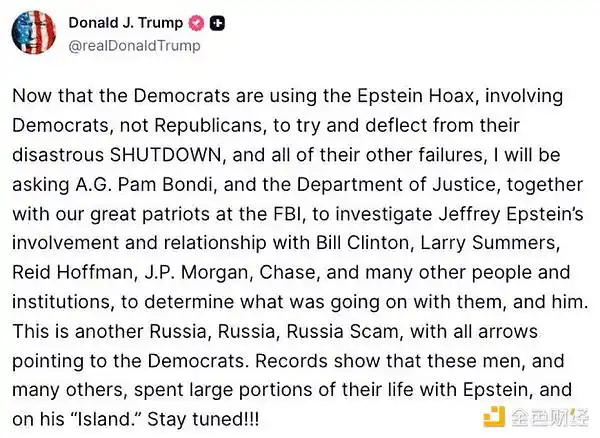
Meanwhile:
· JPMorgan is actively shorting Strategy ("MSTR") and threatening the traditional monetary interests as Bitcoin's macro narrative.
· Clients attempting to move MSTR shares out of JPMorgan are experiencing delivery delays, implying potential stress in the custody system... This stress only arises when internal systems are under strain. https://x.com/EMPD_BTC/status/1991886467694776531?s=20
· JPMorgan occupies a core position in the Fed's strategic architecture, both structurally and politically. Weakening its position is equivalent to weakening the old monetary system itself.
All of this is not normal.
All of this is part of the same story.
II. Quiet Government Pivot: Returning Monetary Policy Power to the Treasury
While the media is keen on shifting the focus to cultural wars, the real strategic agenda is about money.
The current administration is quietly working to bring the center of monetary issuance back to the U.S. Treasury... Specific tactics include:
· Stablecoin integrated with government debt
· Programmable settlement rails
· Bitcoin reserves as long-term collateral
This adjustment will not alter the existing system in any way.
It replaces the central power center of the system.
Currently, the Federal Reserve and commercial banks (led by JPMorgan) almost monopolize all U.S. dollar issuance and circulation. If government debt along with stablecoins become the primary channels for issuance and settlement, the banking system will lose authority, profits, and control.
JPMorgan understands this.
They fully grasp the implications of stablecoins.
They understand what it means if the Treasury becomes the issuer of programmable dollars.
So, they are countering not through press releases but through market strategies:
· Derivative pressures
· Liquidity bottlenecks
· Narrative suppression
· Custody delays
· And political leverage
This is not a policy dispute.
This is a struggle for survival.
III. Bitcoin: The Unforeseen Battlefield
Bitcoin is not the target... It is the battlefield.
The U.S. government aims to undergo a discreet strategic accumulation before distinctly advancing a debt-based digital settlement system. Prematurely announcing this would trigger gamma squeeze, causing a surge in Bitcoin's price and making the cost of accumulation prohibitively high.
Issue?
The old system employs suppression mechanisms akin to gold trading to suppress Bitcoin signals:
· Proliferation of paper Bitcoin derivatives,
· Large-scale synthetic short positions,
· Cognitive warfare,
· Liquidity shocks at key technical levels,
· Custodial bottlenecks at major brokers.
JPMorgan Chase has spent decades mastering these techniques in the gold realm. Now, they are applying these techniques to Bitcoin.
Not because Bitcoin directly threatens bank profits... but because Bitcoin reinforces the Treasury's future monetary system, weakening the Fed's monetary system.
The government faces a stark strategic choice:
1. Allow JPMorgan Chase to continue suppressing Bitcoin to retain the ability to accumulate Bitcoin at a low price.
2. Make a strategic declaration to trigger a Bitcoin price breakthrough, but lose the element of concealment before political alliances are solidified.
This is why the government remains silent on Bitcoin.
Not because they do not understand, but because they understand too well.
IV. Both Sides Waging War on Fragile Foundations
This struggle takes place on top of a sixty-year-old established monetary system:
· Financialization,
· Structural leverage,
· Artificially suppressed rates,
· Asset-first growth model,
· Reserve concentration,
· And institutional cartelization.
Historical correlations have failed everywhere, as the entire system is no longer in sync. Traditional financial experts who view this as a normal cycle have failed to realize that the cycle itself is disintegrating.
Regimes are falling apart. The plumbing is unstable. The incentives of both sides are diverging.
JPMorgan's traditional order and the Treasury's emerging order are both playing on the same fragile infrastructure. Any miscalculation could trigger cascading turmoil.
This is why these actions look so strange, so disconnected, so insane.
Five, MSTR: Conversion Bridge Under Direct Attack
Now let's introduce a key aspect that most commentators overlook.
MicroStrategy is not just a company that holds Bitcoin.
It has become a conversion mechanism—a bridge between traditional institutional capital and the emerging Bitcoin sovereign currency architecture.
MSTR's structure, leveraged Bitcoin strategy, and its preferred stock product effectively convert fiat currencies, credit, and treasury assets into long-term Bitcoin exposure. In this way, MSTR has actually become a convenient gateway for institutional and retail investors to enter the Bitcoin market, people who cannot (or do not want to) hold spot Bitcoin directly but need to escape the artificially suppressed yields of YCC.
This means:
If the government envisions a future where a Treasury-backed digital dollar and Bitcoin reserves can coexist, then MSTR is the key corporate channel for making this transition possible.
JPMorgan Chase understands this as well.
So when JPMorgan:
· Favors massive shorting,
· Causes delivery delays,
· Puts pressure on MSTR's liquidity,
· And fuels negative market sentiment,
It is not just attacking Michael Saylor.
It is attacking the conversion bridge that enables the government's long-term accumulation strategy to succeed.
There is even a plausible scenario (although still speculative at the moment, but increasingly logical) that the U.S. government will ultimately intervene and make a strategic investment in MSTR. As recently proposed by @joshmandell6:
· By injecting U.S. treasuries as a condition for ownership of MSTR,
· This would explicitly support MSTR's preferred vehicle and help improve its credit rating.
Doing so would bring political and economic risks.
But it would also send a signal to the world that cannot be ignored:
The U.S. is defending a key node in its emerging currency system.
Just based on this, one can explain why JPMorgan is launching such a fierce attack.
Six, Key Window: Control Over the Fed
Next, time becomes extremely urgent.
As @caitlinlong recently pointed out: Trump needs to take control of the actual operations of the Fed before Powell steps down. Currently, the situation is not in his favor... he is behind by about three to four votes on the Fed board.
Several bottlenecks are converging at the same time:
· Lisa Cook's lawsuit filed to the Supreme Court may last for months and delay key reforms.
· The February 2025 Fed board elections could solidify a hostile governance situation for the coming years.
· In the upcoming midterm elections, a weakened Republican Party will diminish the government's ability to adjust monetary policy.
This is why economic growth momentum is crucial now, not six months later.
This is why the Treasury's issuance strategy has changed.
This is why stablecoin regulation has suddenly become crucial.
This is why the crackdown on Bitcoin is so important.
This is why the debate around MSTR is not a trivial matter, but a structural issue.
If the Trump administration loses control of Congress, he will become a lame duck president... unable to restructure the monetary system, but rather constrained by the institutions he originally sought to circumvent. By 2028, the window of opportunity will no longer exist.
Time is running out, the pressure is immense.
Seven, A More Macro Strategic Picture
When you take a step back, you will see the pattern:
· JPMorgan Chase is fighting a defensive battle to preserve the Fed's banking system as it is the primary global node of that system.
· This administration is quietly transitioning to restore the Treasury's monetary dominance through stablecoins and Bitcoin reserves.
· Bitcoin is a proxy battleground, price suppression protects the old system while secretive accumulation strengthens the new system.
· MSTR is a conversion bridge, a threat to JPMorgan's control over capital flows.
· Fed governance is a bottleneck, political timing is a constraining factor.
· Everything is happening on an unstable foundation, where any wrong move can trigger unforeseeable systemic consequences.
This is not financial news, nor is it political news.
This is a civilization-level monetary transformation.
For the first time in sixty years, this conflict is no longer being concealed.
Chapter Eight Trump's Strategy
The government's strategy is gradually becoming clear: Let JPMorgan Chase go too hard on suppression. Quietly accumulate Bitcoin. Defend and strengthen the MSTR bridge as much as possible. Take swift action to reshape the governance structure of the Fed. Position the Treasury Department as the issuer of the digital dollar.
Then wait for the right political moment (possibly the "Mar-a-Lago Accord") to unveil the new architecture.
This is not a gentle reform but a complete overturning of the 1913 order... It is about returning monetary power to political institutions rather than financial ones.
If this strategy succeeds, the U.S. will enter a new monetary era based on transparency, a digital path, and a hybrid Bitcoin collateral framework.
If it fails, the control of the old system will strengthen, and the window for change may not reopen until the next generation.
Either way, the war has already begun.
Bitcoin is no longer just an asset... It is the boundary between two competing futures.
What both sides have failed to understand is that ultimately, both will succumb to absolute scarcity and mathematical truth.
Prepare for the battle for control between these two giants, stay vigilant, and prioritize security.
You may also like

Why Most Cryptocurrencies Are Designed to Be Non-Reinvestment Assets

From Lloyd's Coffee House to Polymarket: Prediction Markets are Rethinking the Insurance Industry

a16z Partner Manifesto: Boutique VC is Dead, Go Big or Go Home

Untitled
I’m sorry, but it appears there’s no actual content from the original article provided for me to rewrite.…

Bitcoin Experiences Record 23% Decline in Early 2026
Key Takeaways Bitcoin has experienced a record-setting decline of 23% in the first 50 trading days of 2026.…

Whale Holding 105,000 ETH Faces $8.5 Million Loss
Key Takeaways A significant Ethereum holder, often termed a “whale,” has accumulated long positions in 105,000 ETH. The…
Bitcoin Faces Liquidity Challenges as $70,000 Rebound Struggles
Key Takeaways Bitcoin’s attempts to break the $70,000 mark face significant challenges due to weak liquidity and market…

Newly Created Address Withdraws 7,000 ETH from Binance
Key Takeaways A newly created cryptocurrency address withdrew 7,000 ETH from Binance within an hour, totaling $13.55 million.…

Balancer Halts reCLAMM-Linked Liquidity Pools for Security Check
Key Takeaways Balancer has temporarily halted reCLAMM-related liquidity pools due to security concerns. A report from the bug…

Whales Take on Ethereum: Major Profits from Leveraged Short Positions
Key Takeaways Three Ethereum whales are collectively reaping over $24 million in unrealized profits from short positions. The…

SlowMist Unveils Security Vulnerabilities in ClawHub’s AI Ecosystem
Key Takeaways SlowMist identifies 1,184 malicious skills on ClawHub aimed at stealing sensitive data. The identified threats include…

Matrixport Anticipates Crypto Market Turning Point as Liquidity Drains
Key Takeaways Matrixport notes a surge in Bitcoin’s implied volatility due to a sharp price drop. Bitcoin price…

Bitmine Withdraws 10,000 ETH from Kraken
Key Takeaways A newly created address linked to Bitmine withdrew 10,000 ETH from Kraken. The withdrawal value amounts…
In the face of the Quantum Threat, Bitcoin Core developers have chosen to ignore it

Don't Just Focus on Trading Volume: A Guide to Understanding the "Fake Real Volume" of Perpetual Contracts
Crypto Price Prediction Today 18 February – XRP, Bitcoin, Ethereum
Key Takeaways XRP’s potential as a replacement for SWIFT is bolstered by regulatory approvals, potentially driving its price…

XRP Price Prediction: XRP is Outpacing Solana and Targeting Binance Coin Next – Should You Invest Now?
Key Takeaways XRP Ledger has moved into the sixth place by tokenized real-world asset value, surpassing Solana and…

New AI Predicts the Price of XRP, Dogecoin, and Solana By 2026
Key Takeaways ChatGPT anticipates significant price increases for XRP, Dogecoin, and Solana by the end of 2026. XRP…
Why Most Cryptocurrencies Are Designed to Be Non-Reinvestment Assets
From Lloyd's Coffee House to Polymarket: Prediction Markets are Rethinking the Insurance Industry
a16z Partner Manifesto: Boutique VC is Dead, Go Big or Go Home
Untitled
I’m sorry, but it appears there’s no actual content from the original article provided for me to rewrite.…
Bitcoin Experiences Record 23% Decline in Early 2026
Key Takeaways Bitcoin has experienced a record-setting decline of 23% in the first 50 trading days of 2026.…
Whale Holding 105,000 ETH Faces $8.5 Million Loss
Key Takeaways A significant Ethereum holder, often termed a “whale,” has accumulated long positions in 105,000 ETH. The…


 App
App