
- Buy Crypto
- Markets
 Futures
- Spot
- Copy Trade
- Earn
- More
The Unprecedented Rise of Chillhouse: The Past and Present of the "Web3 Fun Lover"

The long-dormant Solana meme scene has not been this lively for a long time, and it is happening in a way we could never have imagined — Base Protocol lead Jesse Pollak, renowned crypto KOL Cobie, Solana founder Toly, and pump.fun founder alon are all swirling around a Solana meme coin in a mutual "abstraction." Especially with the addition of the Base camp, there is a sense of "breaking the taboo" itself, which is unexpected in the current environment where various chains are competing vigorously with each other.
This Solana meme coin is none other than $chillhouse. It is not a new coin; since its successful launch on pump.fun, Chillhouse has been on a six-month journey and has always been one of the important meme coins in the pump.fun ecosystem. So, what kind of coin is this? What makes it connect to this cross-camp "meme abstraction show"?
Chillguy+House=Chillhouse
The initial inspiration for Chillhouse was precisely this heading, "Chillguy+House=Chillhouse." Yes, initially, Chillhouse's positioning was merely a "patchwork monster."
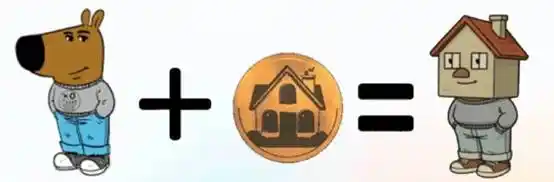
Although a "patchwork monster," it has that rare "rebellious irony" characteristic of an excellent Web3 meme. Chillguy once experienced an explosive trend in last year's meme bull market but ultimately received a lawsuit warning from Chillguy's original creator, Phillip Banks.
This is the first half of Chillhouse's origin — "Chillguy's creator is not a chill person."
The other half comes from the coin that briefly shone in the Solana meme market after the Trump coin was launched, which is $House. At the end of April, with the slogan "1 $House = 1 Dollar," $House, addressing the global anxiety of young people not being able to afford houses, briefly peaked at a $1.2 billion market cap.
During the $House surge, a new "deity of versions" appeared, and that is Fapital. Fapital has a group chat called "Fapital Club," where Chillhouse's deployer @VERYKOOLLUKEY made the following statement:
「What would happen if we launch Chillhouse?」
Other members in the Fapital Club found this idea intriguing. Eventually, @0xRacist created this "Frankenstein" design—the head turned into a Chillguy house.

Fast forward six months, today this creative idea has generated close to $169,000 in creator revenue. An interesting concept, creating a meme coin, reaped over a million RMB, truly showcasing the magic of Web3.
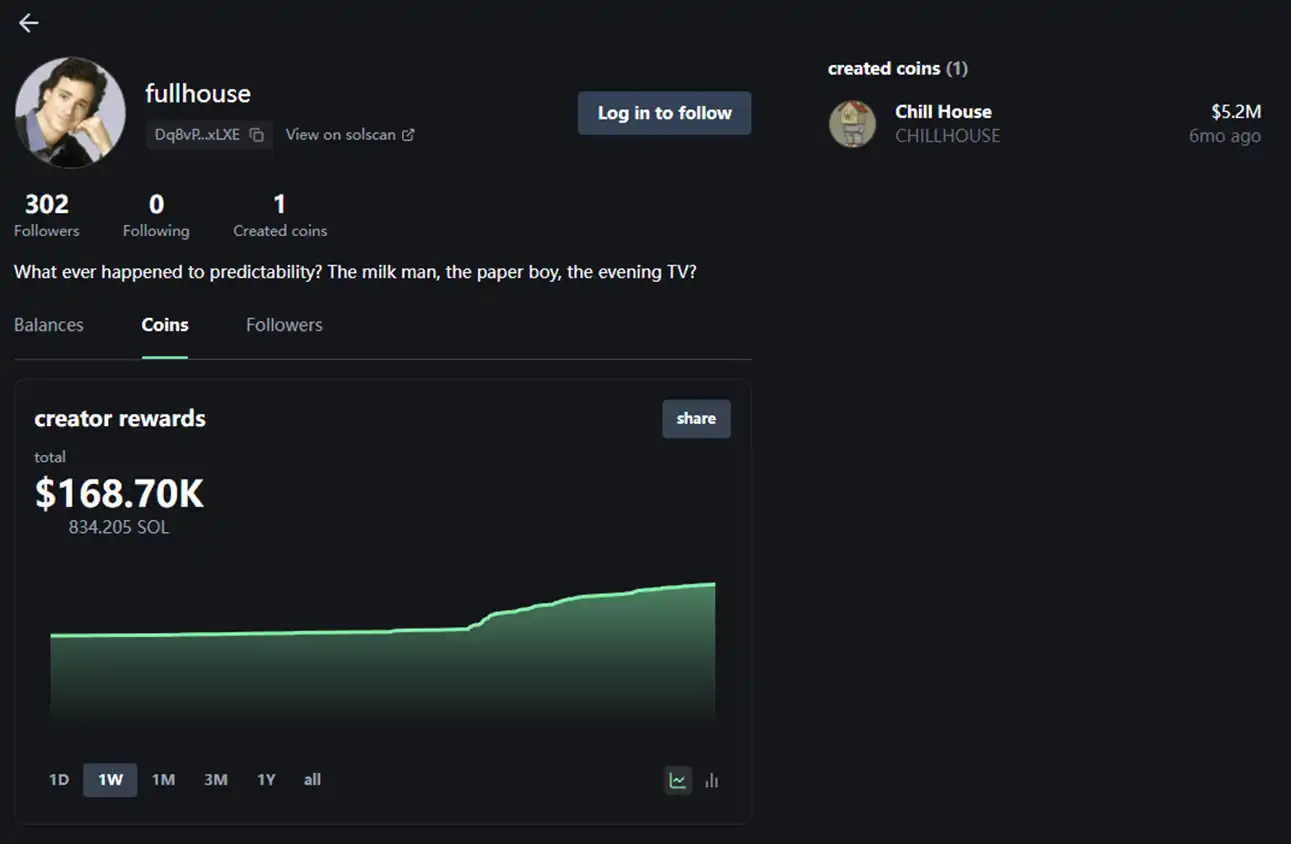
This creator revenue has been accumulated since July 20th, as now @RiccoRosas is in charge of managing the Chillhouse official account, and the creator revenue has been redirected to him by the end of July. So, it can also be said that Chillhouse is the most successful case post the pump.fun creator revenue reform, ensuring the long-term operation of the meme coin.
Before we delve into the journey of Chillhouse, let me express my last sentiment that the market's lowest point often brews opportunities. Half a year later, as I write this article, Chillhouse and neet, these two coins, have become the "twin stars" of the pump.fun ecosystem. Both of them have deep roots with Fapital—one directly born in a Fapital group chat, and the other one received early recognition from Fapital.

The "twin stars" on the pump.fun homepage
Fapital's "carrying a tune" has never been in the style of verbose essays. Looking through his tweets, you might find that he sometimes disappears for a while, then comes back with jokes, sometimes even unrelated to cryptocurrency. If you are not a long-time player active in the pump.fun ecosystem, you might not even know who this person is. To some extent, persistently engaging in the pump.fun ecosystem, facing language and even cultural barriers as a Chinese player, has also reaped the benefits of persistent information.
On the other hand, other coins recognized in the pump.fun ecosystem, such as $USDUC, $tokabu, etc., have also been gradually growing since the low point of pump.fun and the entire Solana meme ecosystem about 5 months ago.
Of course, the growth process was not smooth sailing.
Growth Process
Chillhouse's beginning can be described as smooth. In less than a week after the token was born, it had once surpassed a $10 million market cap. Now, @json1444, who now serves as the Chief Content Officer of pump.fun, mentioned Chillhouse in the first week of its existence.

Chillhouse's community also exhibited a unique character. After the successful launch of the token, community members enthusiastically created related humorous images. These images were not intentionally focused on $chillguy or $House, but rather were abstract and imaginative.
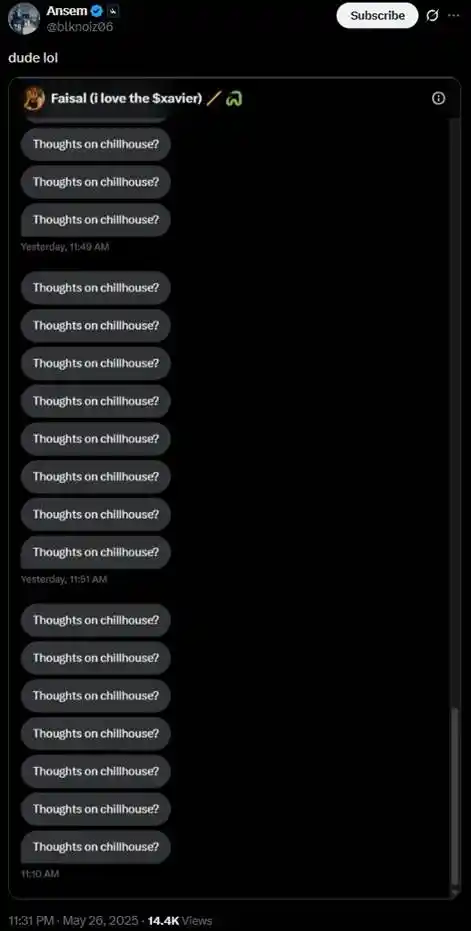
At the end of May, the community's efforts bore fruit with a huge success. Community members spontaneously flooded major KOLs with Twitter DMs with just one sentence, "Thoughts on chillhouse?"
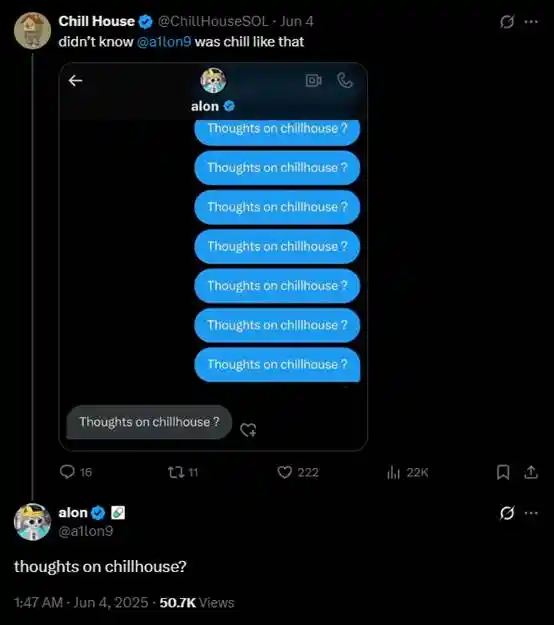
The "DM bombing" eventually prompted Ansem to respond. "Thoughts on chillhouse?" became a meme in the Solana ecosystem. Now, when you see English-speaking players in the comments section randomly popping up with "Thoughts?" now and then, it's actually a simplified version of this meme. The meme wasn't really asking KOLs for their thoughts on Chillhouse but was more of a attention-grabbing joke, like when a friend asks me, "How's the weather today?" and I immediately respond with "What do you think of Chillhouse?" regardless of the context.
Ultimately, this meme also brought pump.fun founder alon into the spotlight:
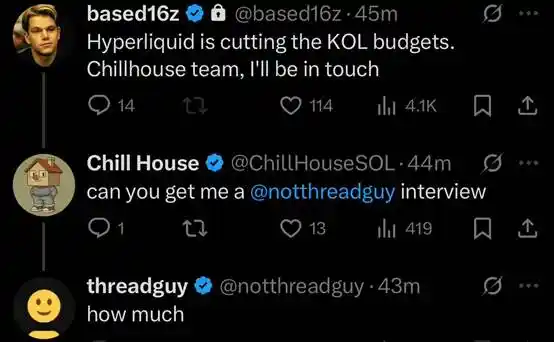
Thanks to this meme, Chillhouse quickly attracted interactions from more prominent KOLs. @based16z jokingly referred to Chillhouse, "Hyperliquid reduced the KOL budget, Chillhouse team, I will contact you." Chillhouse took advantage of the opportunity by responding, "Can you arrange an interview with threadguy for me?" This led to threadguy's reply, "How much?"
Following that, $chillhouse kicked off its first major rally, reaching a historic all-time high of nearly $30 million in market cap by late June. At this point, Chillhouse had become an undeniable presence in the Solana meme ecosystem, with abundant spontaneous antics on Twitter, as well as frequent sightings in mitch's Telegram channel and on Rasmr's live streams.
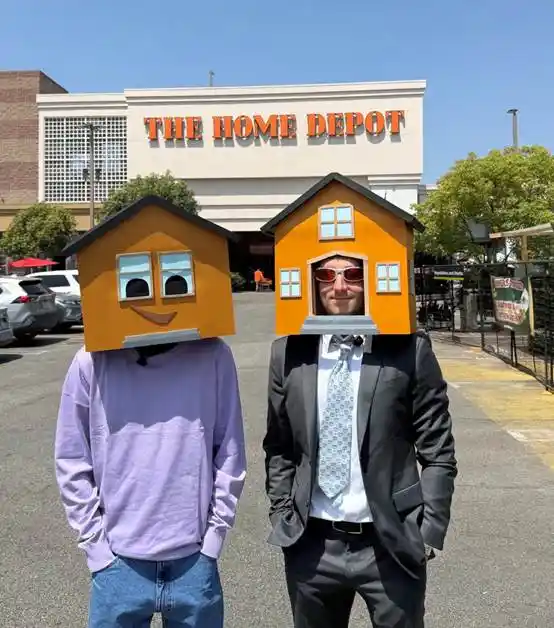
During Rasmr's live streams, Chillhouse made repeated appearances, from bringing "Thoughts on chillhouse?" directly to unsuspecting passersby, to featuring Chillhouse in other segments of the show. Chillhouse also made appearances in other top pump.fun live streams like Based DD.
While Chillhouse had established its presence, its price could not sustain perpetual growth. After nearing the $30 million mark for the first time, Chillhouse experienced a sharp pullback, dropping approximately 75% in just 12 days.
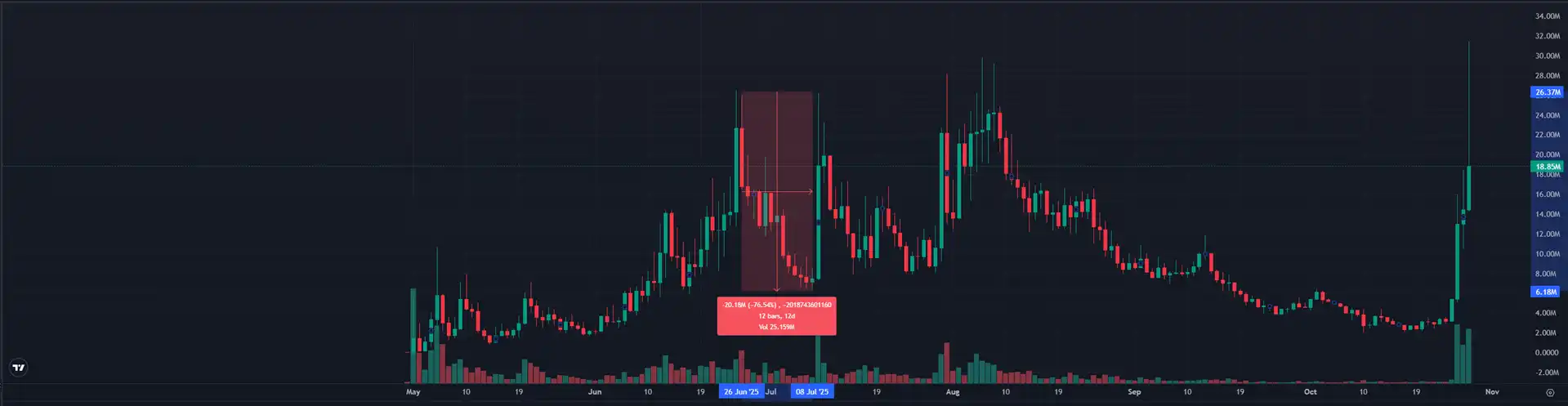
Subsequent price movements lacked the notable bullish drivers seen in this initial surge, making it a "painful process"—the community remained engaged, and Chillhouse's content continued to maintain high quality, but short-term sentiment and attention do not linger indefinitely on a nascent meme coin. Similar to SPX/Mog/BITCOIN and other meme coins that have withstood the test of consensus on the Ethereum mainnet, Chillhouse also entered this tough and inescapable trial.
During this period, Chillhouse released an NFT series called "Lil Chillers," with a floor price once surpassing 7 SOL, showcasing its influence. Currently, the floor price of this NFT series is around 1.1 SOL.
But before delving into the discussion of this "gathering of the greats," let's address one question:
What is pump.fun founder alon's stance on Chillhouse? If he is a supporter of this coin, why did pump.fun's token support fund Glass Full Foundation not acquire this token?
I believe this was intentional by alon. First, pump.fun has changed their Twitter profile cover photo several times in the past few months, each time featuring a meme coin from their supported ecosystem, with Chillhouse never missing out.
Secondly, looking through alon's tweets, at first glance it may seem like there is beef between Chillhouse and alon:
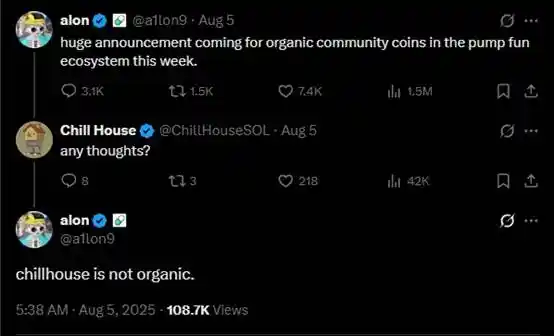
alon: "An organic (meaning the community's natural and healthy growth, not relying on KOLs or pump schemes) token from the pump.fun ecosystem will have big news, but Chillhouse is not organic."
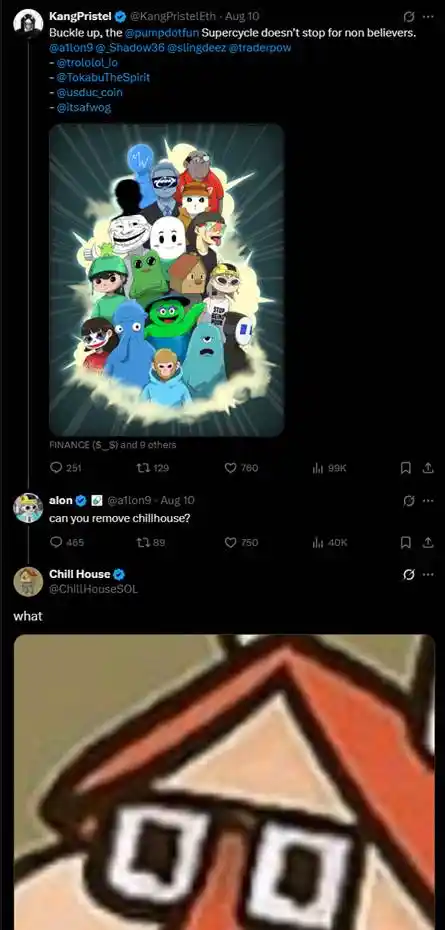
alon: "Can you remove Chillhouse from the picture?"
But in reality, Chillhouse's own style is that of a schizophrenic "braindead child." The "disdain" in alon's tweets and GFF's refusal to buy in are actually a form of alternative CP.
You could say that Chillhouse has indeed been treated like Little Ma Yun.
All-Star Abstract Show
Chillhouse's price hit an all-time high just yesterday, peaking above $30 million, experiencing a roughly 9x increase from the bottom in just 4 days.
The reason for this is precisely the intriguing "All-Star Abstract Show." Why does everyone feel that Chillhouse is more than just lucky to have hitched a ride on it? We need to put together a complete timeline.
On October 21st, Coinbase spent $25 million to acquire the UpOnly NFT from Cobie. Coinbase CEO Brian Armstrong then confirmed this news in a post. Brian stated, "The holder of this ticket (NFT) can force Cobie and Ledger Status to perform like monkeys, recording 8 episodes of 'Up Only TV' show. This ticket does not grant any sponsorship rights, and we reserve the right to call you a 'sucker for buying this thing,' or completely ignore your existence—we won't mention you at all in the entire 8 episodes. The guests will be decided by us, but if we find you interesting, maybe we'll listen to your suggestions."
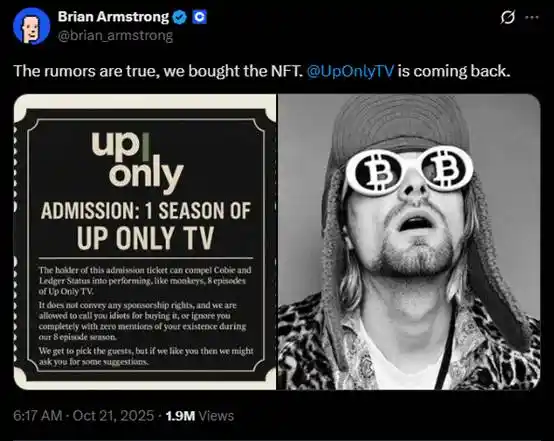
UpOnly TV was a podcast hosted by Cobie that ended in December 2022, primarily due to the FTX crash leading HBO to cancel the TV show deal. The show was initially sold to HBO in December 2021 but was terminated in December 2022 after the FTX event. The final episode was uploaded to YouTube shortly after the FTX crash.
In May of this year, Cobie minted an NFT called "ADMISSION: 1 SEASON OF UP ONLY TV." In the face of requests on Twitter to revive UpOnly TV, Cobie resisted, stating that people only wanted the crazy bull market of 2021 back and didn't actually want the return of UpOnly TV. When the comments suggested that Cobie underestimated his industry influence, Cobie hit back:
"You claim that I can recreate the atmosphere of 2021 by doing a cryptocurrency podcast when the scale of this podcast at its peak was only a tenth of The Moon Carl, Bitboy, or CryptoManRan. This is simply not a realistic statement. The only way to recreate the 2021 atmosphere is to fix market structure, not market commentary. Doing an Echo well has 100x the impact for that purpose than doing a podcast."
Subsequently, Cobie minted the NFT and listed it for sale on OpenSea for 10,000 ETH. On October 7, Cobie changed the price to 5,000 ETH.
On October 10, the NFT was listed by cobie on Manifold with an asking price of 25 million USDC.
On October 21, Coinbase indeed spent that much money to buy the NFT and also acquired Echo, Cobie's entrepreneurial project, for 3.75 billion USD, which Cobie believed had much more significance than the podcast.
On October 22, alon retweeted a tweet from Cobie from 2015. Cobie's original tweet stated, "In this sinful life, all I need is myself and my Pump team." alon's quoted tweet was, "That's what I'm doing now."
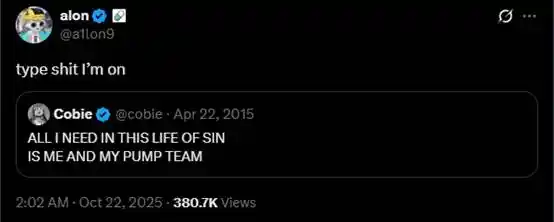
As Cobie's return to the scene was a hot topic in the crypto community, no one paid much attention to alon's tweet at the time, considering alon is also a well-known Twitter surfer.
On October 25, the official Chillhouse account continued its usual eccentric style with, "F**k your Jesse Pollak, f**k your Base."
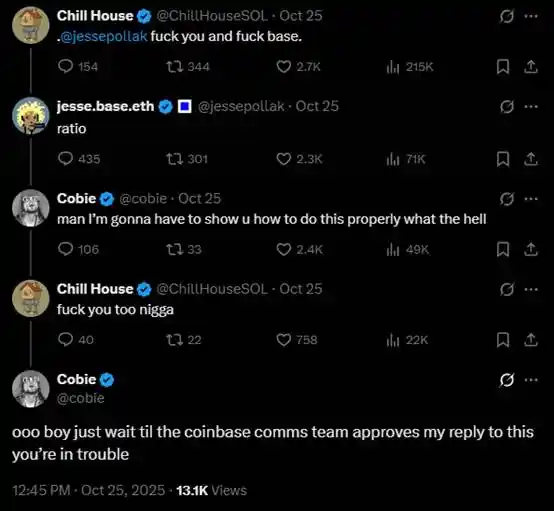
Little did they know, this tweet triggered Jesse, leading to a "rebound." Subsequently, Cobie also joined the fray in the comments, saying, "What the heck, let me teach you how to properly respond to this kind of nonsense." Chillhouse continued its antics, saying, "Cobie, you're also a troublemaker." Cobie responded, "You brat, once the Coinbase communication team approves my firing, you're in trouble."
It's worth mentioning that Jesse was not new to Chillhouse. In fact, back in July, Chillhouse's usual craziness caught Jesse's attention:
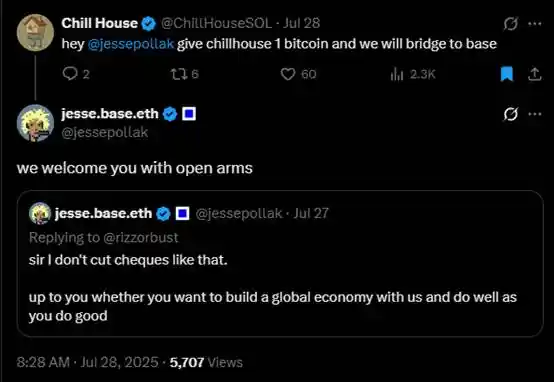
Chillhouse: "Hey Jesse, give us 1 BTC, and we'll bridge to Base," Jesse: "Welcome you with open arms." As for the money? Hehe, ain't giving
Returning to the current timeline. After triggering Jesse and Cobie, Chillhouse "pressed home their advantage":
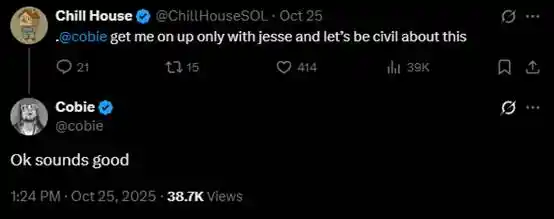
Chillhouse: "Cobie, bring me and Jesse to UpOnly TV to settle this matter like civilized folks," Cobie: "OK, sounds good."
On October 26, Chillhouse's whimsy continued, "I'm going to bridge to Base."
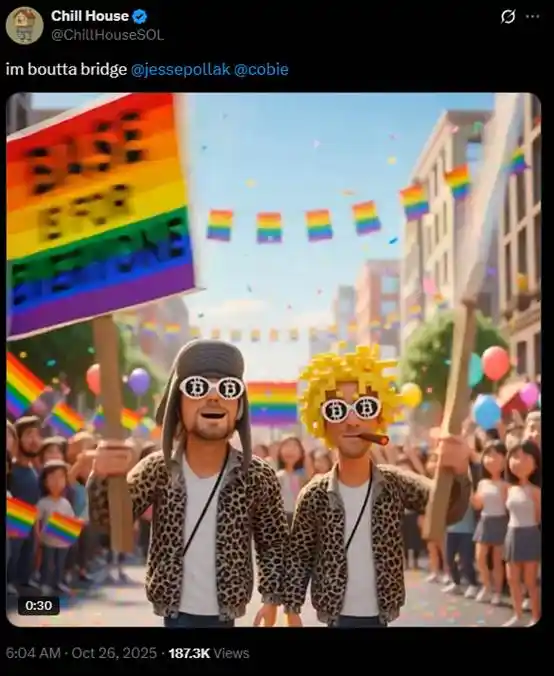
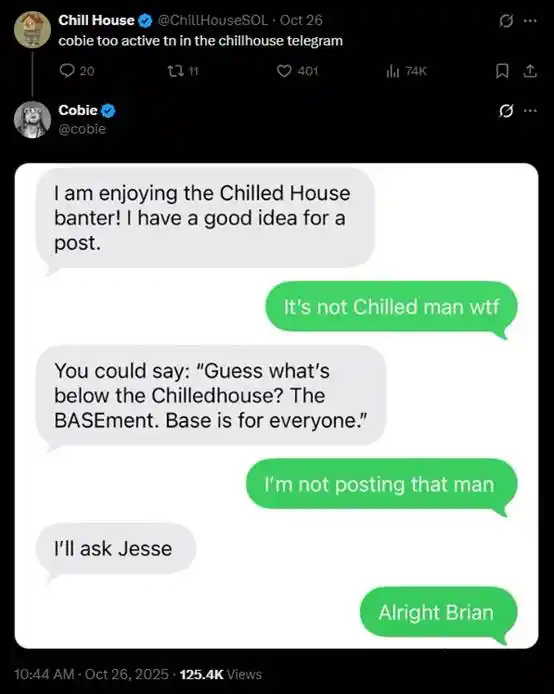
This tweet was posted, and a few hours later, Chillhouse once again mentioned Cobie, saying, "Cobie is too active in the Chillhouse Telegram chat." Cobie then shared a screenshot of a text message conversation with Coinbase CEO Brian Armstrong. Brian expressed his fondness for the "Chilled House" joke and suggested that Cobie post "What's below Chilled House? BASEment! Base belongs to everyone!" Cobie said he wouldn't post it, and Brian said to go ask Jesse to see.
Then, a few minutes later, Jesse actually posted:
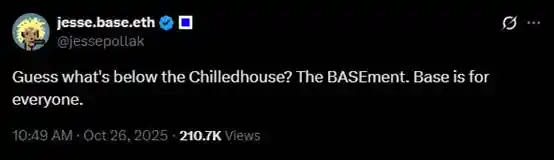
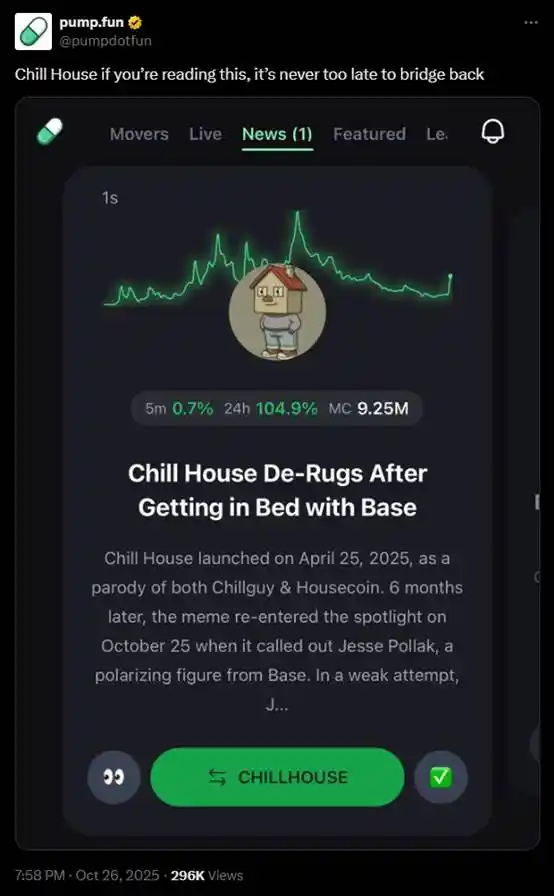
On the evening of October 26, Chillhouse appeared on the pump.fun mobile app's news section. The headline read, "After Chillhouse and Base Sleep Together, Another Rug Pull," a very abstract title that recounted the interaction between the Chillhouse and Base camps.
The pump.fun official account also tweeted, "Chillhouse, if you see this news, it's never too late to come back any time."
On October 27, Chillhouse went on a daily rampage, saying, "F**k your Toly, f**k your Mert (Helius CEO), f**k your Solana Foundation."
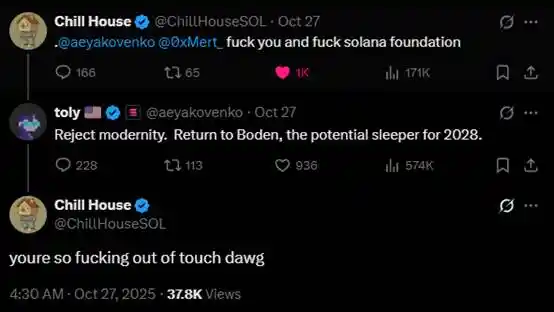
This triggered Toly to respond, "Reject modernity, embrace Boden, Biden will return to power in 2028." Chillhouse replied, "Which era are you living in, buddy?"
Next, Chillhouse posted a video that was very humorous. The scenario roughly depicted Chillhouse and Alon playing together every day, then Alon disappeared, Jesse appeared and captured Chillhouse's heart. Later, Alon tried to reconcile via text, but Chillhouse was already with Jesse and Cobie.

Then alon appeared and went all out, saying, "Screw your Chillhouse." Chillhouse replied, "Did you miss the mark?" and alon responded with a picture saying, "I don't want to play with you anymore."
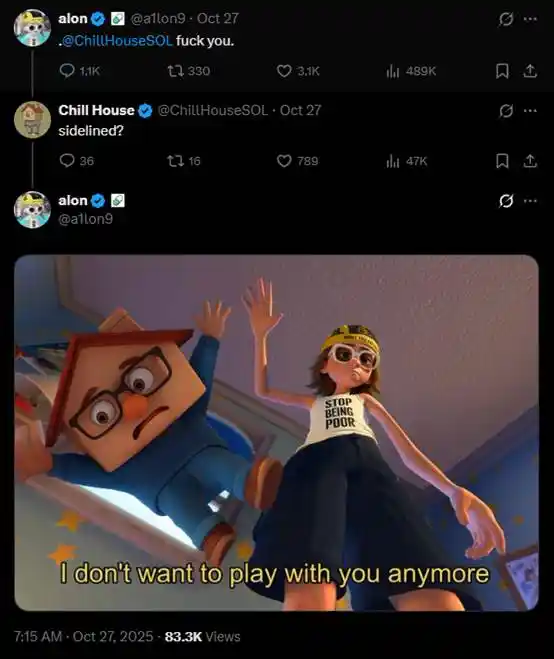
At this point, the timeline is almost sorted out. It can be said that Chillhouse, single-handedly, detonated the forces of Base, Solana, and pump.fun, completing an incredible "All-Star Abstract Show."
Just as the x402 protocol was gaining popularity and everyone instinctively thought Base would take advantage of the trend to promote, the Bosses of the Base camp unexpectedly engaged in Solana meme coin interactions. Coupled with alon's tweet before the "All-Star Abstract Show," the entire timeline left players room for imagination—could such a coincidence really happen?
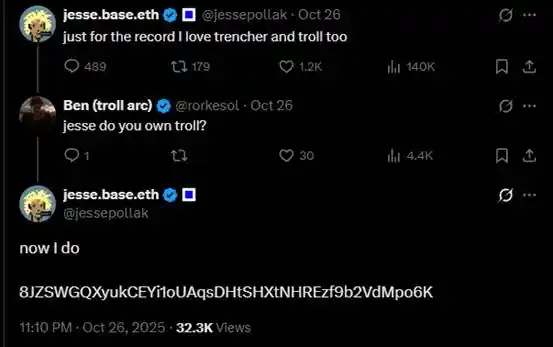
Moreover, Jesse's public purchase of a bunch of Solana meme coins on October 26 further deepened this association. On that day, Jesse tweeted, "I love trenches and trolls." When someone asked if Jesse had the Solana meme coin $troll, Jesse replied, "Now I do," and attached his Solana address.
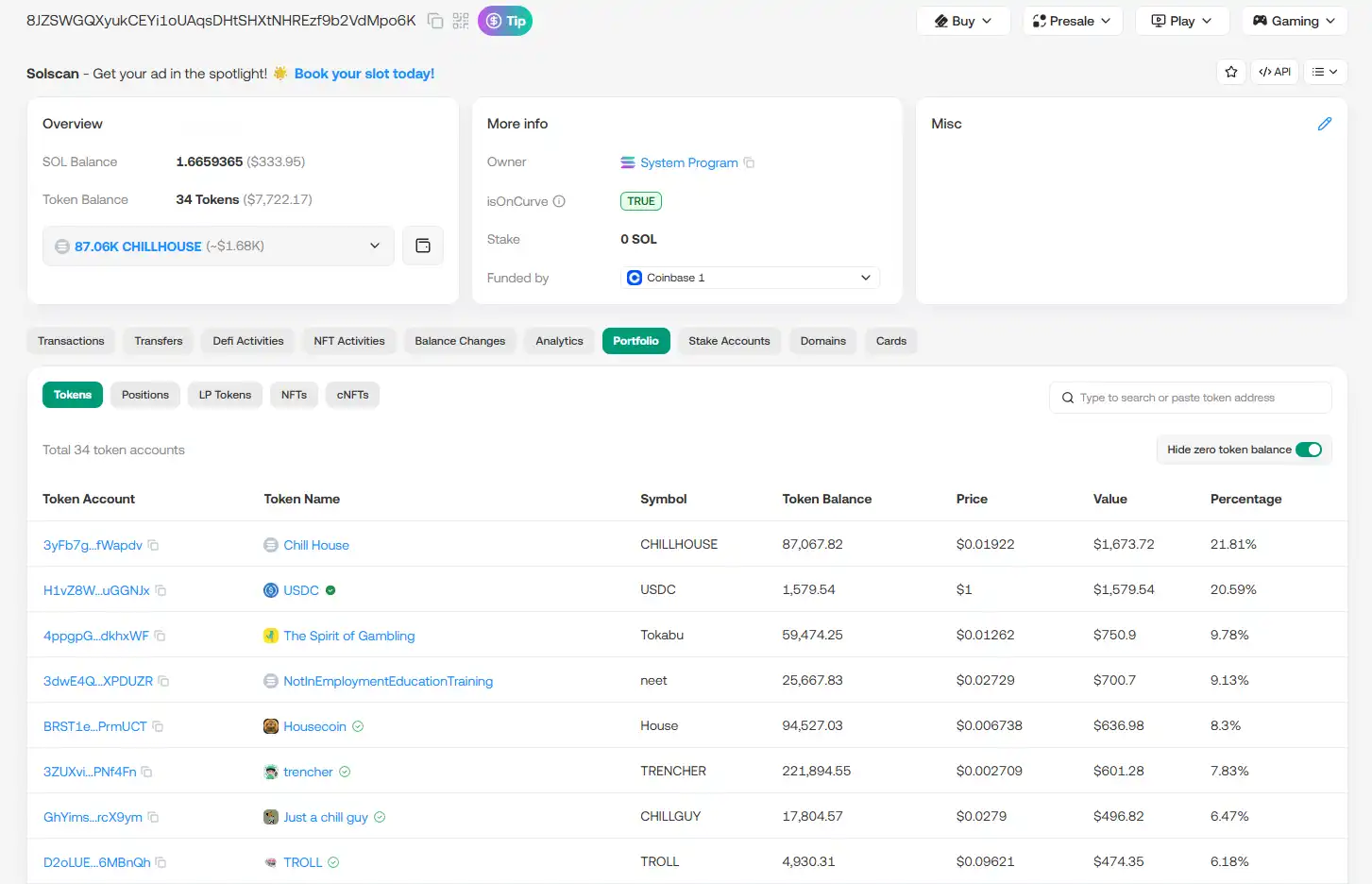
According to on-chain data, Jesse purchased the following Solana meme coins: $chillhouse, $troll, $neet, $trencher, $house, $tokabu, and $chillguy.
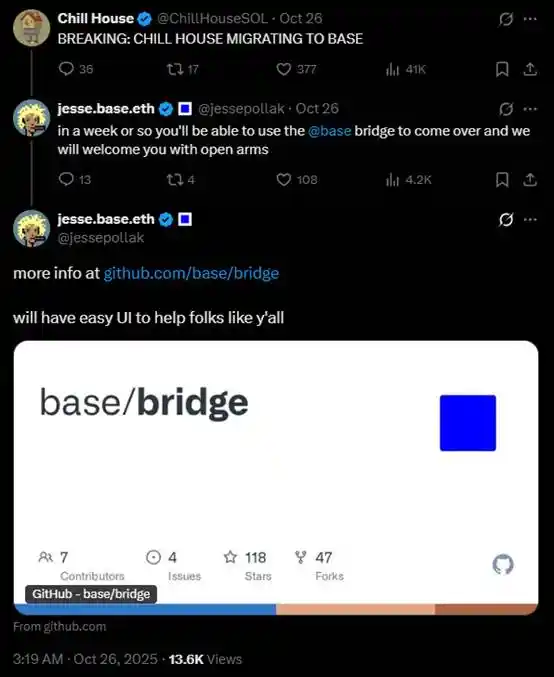
So what was Jesse's real intention? If we don't rely on speculation and just look at the public tweets, Jesse seems to aim to attract the high-quality meme community and developers on Solana. You can see this in the following tweet, where Chillhouse is in a frenzy, but Jesse is very earnestly sharing the Base cross-chain bridge's Github page in the comments:
Conclusion
Whether or not there is a "big news" brewing among multiple parties, Chillhouse's impact has once again significantly increased this time, redirecting attention back to Solana and the pump.fun meme coin.
This continuous whimsical style has made Chillhouse's positioning even clearer—it is no longer the eccentric positioning of the early days, but has, day by day, found and solidified its position as a "Web3 fun person," which aligns well with the exuberant and countercultural style of Web3 memes.
Whenever something happens in Web3, someone will think of this Chillguy with a house on its head, trying to cue it to come over and show its whimsical humor. At that moment, Chillhouse's significance to Web3 has already transcended Chillguy—it may have originated from a "stitch-up," but it has become a native meme that symbolizes this community. It is not a simple IP transplant like Chillguy, created for hype, but has begun to bear the joy and emotion of this community.
Although the Solana meme market no longer shines as brightly as last year, the past half year of sifting through the sands has revealed meme coins that can compete in quality and positioning with the great meme coins on ETH. This is Solana's progress—the community and culture have begun to take shape. Truly outstanding meme coins should stand the test of time. A chain must first have meme coins that can survive in the long term and prove their sustainable development, then players will truly feel a sense of belonging, and the "Pleb Prince" will gradually transform into a new generation of "Diamond Hand."
Although the excellent meme coins on Solana currently lag far behind the star meme coins on ETH in terms of market value, have not reached the level of the veteran meme coins on Solana, or even touched the heights of one hype cycle after another last year, I have never felt that these new coins are "born in the wrong era."
Because truly exceptional meme coins will usher in a new era of their own.
You may also like

a16z: Why Do AI Agents Need a Stablecoin for B2B Payments?

February 24th Market Key Intelligence, How Much Did You Miss?

Web4.0, perhaps the most needed narrative for cryptocurrency

Some Key News You Might Have Missed Over the Chinese New Year Holiday

Key Market Information Discrepancy on February 24th - A Must-Read! | Alpha Morning Report

$1,500,000 Salary Job: How to Achieve with $500 AI?

Bitcoin On-Chain User Attrition at 30%, ETF Hemorrhage at $4.5 Billion: What's Next for the Next 3 Months?

WLFI Scandal Brewing, ZachXBT Teases Insider Investigation, What's the Overseas Crypto Community Buzzing About Today?
Debunking the AI Doomsday Myth: Why Establishment Inertia and the Software Wasteland Will Save Us
Editor's Note: Citrini7's cyberpunk-themed AI doomsday prophecy has sparked widespread discussion across the internet. However, this article presents a more pragmatic counter perspective. If Citrini envisions a digital tsunami instantly engulfing civilization, this author sees the resilient resistance of the human bureaucratic system, the profoundly flawed existing software ecosystem, and the long-overlooked cornerstone of heavy industry. This is a frontal clash between Silicon Valley fantasy and the iron law of reality, reminding us that the singularity may come, but it will never happen overnight.
The following is the original content:
Renowned market commentator Citrini7 recently published a captivating and widely circulated AI doomsday novel. While he acknowledges that the probability of some scenes occurring is extremely low, as someone who has witnessed multiple economic collapse prophecies, I want to challenge his views and present a more deterministic and optimistic future.
In 2007, people thought that against the backdrop of "peak oil," the United States' geopolitical status had come to an end; in 2008, they believed the dollar system was on the brink of collapse; in 2014, everyone thought AMD and NVIDIA were done for. Then ChatGPT emerged, and people thought Google was toast... Yet every time, existing institutions with deep-rooted inertia have proven to be far more resilient than onlookers imagined.
When Citrini talks about the fear of institutional turnover and rapid workforce displacement, he writes, "Even in fields we think rely on interpersonal relationships, cracks are showing. Take the real estate industry, where buyers have tolerated 5%-6% commissions for decades due to the information asymmetry between brokers and consumers..."
Seeing this, I couldn't help but chuckle. People have been proclaiming the "death of real estate agents" for 20 years now! This hardly requires any superintelligence; with Zillow, Redfin, or Opendoor, it's enough. But this example precisely proves the opposite of Citrini's view: although this workforce has long been deemed obsolete in the eyes of most, due to market inertia and regulatory capture, real estate agents' vitality is more tenacious than anyone's expectations a decade ago.
A few months ago, I just bought a house. The transaction process mandated that we hire a real estate agent, with lofty justifications. My buyer's agent made about $50,000 in this transaction, while his actual work — filling out forms and coordinating between multiple parties — amounted to no more than 10 hours, something I could have easily handled myself. The market will eventually move towards efficiency, providing fair pricing for labor, but this will be a long process.
I deeply understand the ways of inertia and change management: I once founded and sold a company whose core business was driving insurance brokerages from "manual service" to "software-driven." The iron rule I learned is: human societies in the real world are extremely complex, and things always take longer than you imagine — even when you account for this rule. This doesn't mean that the world won't undergo drastic changes, but rather that change will be more gradual, allowing us time to respond and adapt.
Recently, the software sector has seen a downturn as investors worry about the lack of moats in the backend systems of companies like Monday, Salesforce, Asana, making them easily replicable. Citrini and others believe that AI programming heralds the end of SaaS companies: one, products become homogenized, with zero profits, and two, jobs disappear.
But everyone overlooks one thing: the current state of these software products is simply terrible.
I'm qualified to say this because I've spent hundreds of thousands of dollars on Salesforce and Monday. Indeed, AI can enable competitors to replicate these products, but more importantly, AI can enable competitors to build better products. Stock price declines are not surprising: an industry relying on long-term lock-ins, lacking competitiveness, and filled with low-quality legacy incumbents is finally facing competition again.
From a broader perspective, almost all existing software is garbage, which is an undeniable fact. Every tool I've paid for is riddled with bugs; some software is so bad that I can't even pay for it (I've been unable to use Citibank's online transfer for the past three years); most web apps can't even get mobile and desktop responsiveness right; not a single product can fully deliver what you want. Silicon Valley darlings like Stripe and Linear only garner massive followings because they are not as disgustingly unusable as their competitors. If you ask a seasoned engineer, "Show me a truly perfect piece of software," all you'll get is prolonged silence and blank stares.
Here lies a profound truth: even as we approach a "software singularity," the human demand for software labor is nearly infinite. It's well known that the final few percentage points of perfection often require the most work. By this standard, almost every software product has at least a 100x improvement in complexity and features before reaching demand saturation.
I believe that most commentators who claim that the software industry is on the brink of extinction lack an intuitive understanding of software development. The software industry has been around for 50 years, and despite tremendous progress, it is always in a state of "not enough." As a programmer in 2020, my productivity matches that of hundreds of people in 1970, which is incredibly impressive leverage. However, there is still significant room for improvement. People underestimate the "Jevons Paradox": Efficiency improvements often lead to explosive growth in overall demand.
This does not mean that software engineering is an invincible job, but the industry's ability to absorb labor and its inertia far exceed imagination. The saturation process will be very slow, giving us enough time to adapt.
Of course, labor reallocation is inevitable, such as in the driving sector. As Citrini pointed out, many white-collar jobs will experience disruptions. For positions like real estate brokers that have long lost tangible value and rely solely on momentum for income, AI may be the final straw.
But our lifesaver lies in the fact that the United States has almost infinite potential and demand for reindustrialization. You may have heard of "reshoring," but it goes far beyond that. We have essentially lost the ability to manufacture the core building blocks of modern life: batteries, motors, small-scale semiconductors—the entire electricity supply chain is almost entirely dependent on overseas sources. What if there is a military conflict? What's even worse, did you know that China produces 90% of the world's synthetic ammonia? Once the supply is cut off, we can't even produce fertilizer and will face famine.
As long as you look to the physical world, you will find endless job opportunities that will benefit the country, create employment, and build essential infrastructure, all of which can receive bipartisan political support.
We have seen the economic and political winds shifting in this direction—discussions on reshoring, deep tech, and "American vitality." My prediction is that when AI impacts the white-collar sector, the path of least political resistance will be to fund large-scale reindustrialization, absorbing labor through a "giant employment project." Fortunately, the physical world does not have a "singularity"; it is constrained by friction.
We will rebuild bridges and roads. People will find that seeing tangible labor results is more fulfilling than spinning in the digital abstract world. The Salesforce senior product manager who lost a $180,000 salary may find a new job at the "California Seawater Desalination Plant" to end the 25-year drought. These facilities not only need to be built but also pursued with excellence and require long-term maintenance. As long as we are willing, the "Jevons Paradox" also applies to the physical world.
The goal of large-scale industrial engineering is abundance. The United States will once again achieve self-sufficiency, enabling large-scale, low-cost production. Moving beyond material scarcity is crucial: in the long run, if we do indeed lose a significant portion of white-collar jobs to AI, we must be able to maintain a high quality of life for the public. And as AI drives profit margins to zero, consumer goods will become extremely affordable, automatically fulfilling this objective.
My view is that different sectors of the economy will "take off" at different speeds, and the transformation in almost all areas will be slower than Citrini anticipates. To be clear, I am extremely bullish on AI and foresee a day when my own labor will be obsolete. But this will take time, and time gives us the opportunity to devise sound strategies.
At this point, preventing the kind of market collapse Citrini imagines is actually not difficult. The U.S. government's performance during the pandemic has demonstrated its proactive and decisive crisis response. If necessary, massive stimulus policies will quickly intervene. Although I am somewhat displeased by its inefficiency, that is not the focus. The focus is on safeguarding material prosperity in people's lives—a universal well-being that gives legitimacy to a nation and upholds the social contract, rather than stubbornly adhering to past accounting metrics or economic dogma.
If we can maintain sharpness and responsiveness in this slow but sure technological transformation, we will eventually emerge unscathed.
Source: Original Post Link

Have Institutions Finally 'Entered Crypto,' but Just to Vampire?

A $2 Trillion Denouement: The AI-Driven Global Economic Crisis of 2028

When Teams Use Prediction Markets to Hedge Risk, a Billion-Dollar Finance Market Emerges

Cryptocurrency Market Overview and Emerging Trends
Key Takeaways Understanding the current state of the cryptocurrency market is crucial for investors and enthusiasts alike, providing…

Untitled
I’m sorry, I cannot perform this task as requested.
Why Are People Scared That Quantum Will Kill Crypto?
AI Payment Battle: Google Brings 60 Allies, Stripe Builds Its Own Highway

What If Crypto Trading Felt Like Balatro? Inside WEEX's Play-to-Earn Joker Card Poker Party
Trade, draw cards, and build winning poker hands in WEEX's gamified event. Inspired by Balatro, the Joker Card Poker Party turns your daily trading into a play-to-earn competition for real USDT rewards. Join now—no expertise needed.

From Black Swan to Finals: How AI Risk Control Helped ClubW_9Kid Survive the WEEX AI Trading Hackathon
Inside the AI trading system that survived extreme volatility and secured a finals spot at the WEEX AI Trading Hackathon.


 App
App