
- Buy Crypto
- Markets
 Futures
- Spot
- Copy Trade
- Earn
- More
Trump Crypto Mentor Places $653 Million Bitcoin Bet, Why Isn't Wall Street Buying It?

Original Title: Trump's Crypto Adviser's Quixotic Quest To Build A Leading Bitcoin Bank
Original Author: Nina Bambysheva, Forbes
Original Translation: Luffy, Foresight News
In the words of David Bailey, the past six months could be described as a "Saving Private Ryan-style brutal battle." The 35-year-old CEO of Nakamoto Holdings—his digital treasury company created to manage corporate Bitcoin reserves—has witnessed his boldest move yet: a merger with KindlyMD, a small publicly traded healthcare company in Utah, turning from initial success to the current ordeal.
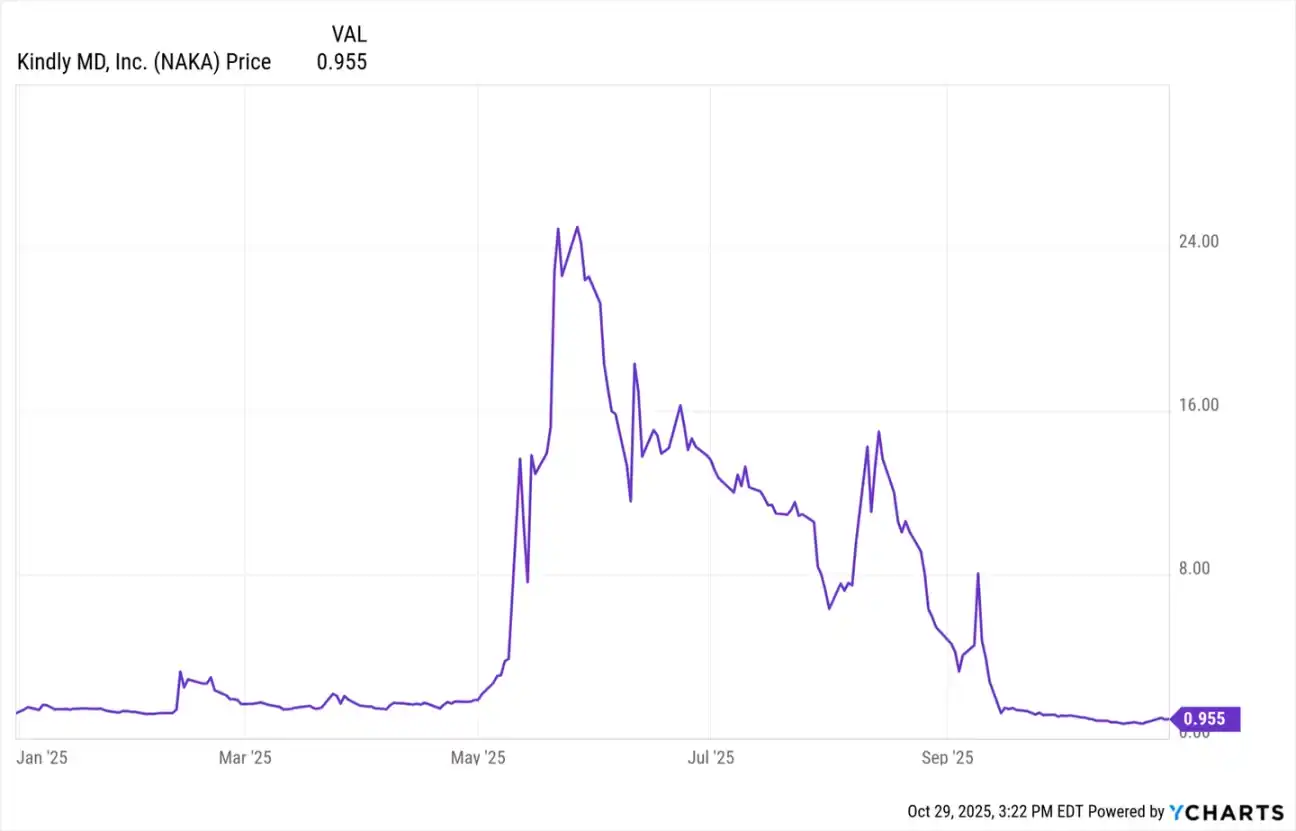
"I've been getting beaten up in the stock market," he said. The company's stock price has plummeted from $25 to 92 cents in six months.
Bailey is not your typical Nasdaq-listed company executive. His more widely known identity is the CEO of "Bitcoin Magazine," the organizer of the world's largest Bitcoin conference, and also a key figure in Donald Trump's shift in attitude towards cryptocurrency. "Our goal," he said, "is to become the world's number one Bitcoin company."

In May of this year, KindlyMD of Utah—a publicly traded healthcare clinic operator with $2.7 million in annual revenue offering traditional and alternative therapies—announced a reverse merger with Bailey's Nakamoto Holdings, aiming to transform into a Bitcoin holding company. The merged company is listed on Nasdaq with the ticker symbol NAKA and currently holds approximately $653 million worth of Bitcoin.
Wall Street is skeptical of Bailey's plan. After reaching a peak of nearly $35 in May, the company's stock price has spent most of October below $1, trading at a discount of 98% from the net asset value corresponding to its 5,765 Bitcoins on the balance sheet.
It turns out Nakamoto Holdings is a victim of its own financing strategy. To raise funds to purchase cryptocurrency, the company conducted a series of private investment in public equity (PIPE) transactions totaling around $563 million. These transactions issued billions of new shares to private investors at a substantial discount, significantly diluting existing shareholders' equity. In September, a large number of PIPE shares were unlocked for trading, and investors rushed to cash in on profits, triggering a stock price collapse. Bailey's letter to shareholders urging short-term speculators to exit the stock only added fuel to the fire.
“For us, those investors who only come for trading are actually a very high-cost source of funds,” Bailey said. “I know some people don't agree with this view, but what we need is long-term partners with aligned interests. This is a high-stakes gamble for us.”
In fact, Bailey indicated that he will soon merge his other businesses — including Bitcoin Magazine, the parent company of the Bitcoin conference and consultancy BTC Inc., as well as his holdings in the hedge fund 210k Capital and the venture capital firm 2140 — into KindlyMD. Forbes estimates that these entities could add up to $200 million in value to this Bitcoin treasury company while increasing Bailey's stake (currently at 3%).
Bailey did not comment on Forbes' data but mentioned that the cash flow from these profitable businesses will help KindlyMD acquire more Bitcoin. According to sources, the assets under management of 210k Capital alone quietly surged from about $100 million in January of this year to $400 million, achieving a quadruple increase.
This rising star in finance has a simple rationale: Michael Saylor holds over 600,000 bitcoins and has little to no need for operational businesses. Other players must have a differentiated strategy to prove their value.
“We need to do things that create value,” Bailey said. “Operating entity businesses are one way to do that.”
Although KindlyMD is headquartered in Salt Lake City, Utah, Bailey primarily works from his home in Guaynabo, Puerto Rico. During video calls, he is often seen in front of a large painting depicting a bank being engulfed in flames. This piece is by the crypto artist Cypherpunk Now and is one of Bailey's hundreds of collectibles, titled “Burning Bank.”
“Every time I have a meeting with a banker, I make sure this painting is in the background,” he said with a smile. For someone aiming to build his own bank, the scene couldn't be more fitting.
Bailey grew up on a farm in Fayetteville, Tennessee, about an hour's drive south of Nashville. He had a strong interest in money and markets from a young age. In 2009, he entered the University of Alabama to study economics, finance, and mathematics, with aspirations of becoming an investment banker.
“I used to be a huge fan of Warren Buffett, and in college, I would attend every Berkshire Hathaway shareholder meeting. I never imagined I would buy Bitcoin; it was so unlike the person I was back then,” he recalled.
In 2012, a friend sent him an article about Bitcoin, and everything began to change. Initially skeptical, Bailey couldn't disprove Bitcoin's concept. In the same year, in November, when Bitcoin's price was fluctuating between $10 and $12, he made his first investment.
In 2014, a year after graduating, Bailey joined Bitcoin Magazine, an early publication focused on the emerging cryptocurrency, co-founded by Vitalik Buterin, who later created Ethereum. Shortly after, Bailey and his college friend Taylor Evans acquired the magazine through their jointly founded BTC Inc.
To expand their brand's influence, the two launched the Bitcoin Conference in 2019. This festival-like event has now become the "Coachella of Crypto" and has made Bailey one of the most influential Bitcoin evangelists. The conference held in Nashville last year attracted 35,000 believers, investors, and politicians, with then-presidential candidate Donald Trump in attendance.
Bailey revealed that his interaction with Trump began during a conversation in Puerto Rico in 2024 on how to get the president interested in Bitcoin. "Paul Manafort was the initial gatekeeper who helped us get into his circle," he said. Soon, Bailey's team was granted a presentation at Trump Tower. The core message was simple: Bitcoin voters would play a crucial role in the presidential election. Trump, known for making deals, agreed to meet, believing that if Bailey and his friends could bring votes and enthusiastic support, the cryptocurrency industry would have a voice.
"Trump would turn everything into a season of The Apprentice; you're always auditioning," he added. "'Okay, you want to be a Bitcoin advisor? I'm going to bring in three more people to compete for this position.'" Bailey eventually prevailed, rallying industry leaders to raise over $1 billion for Trump's campaign, with $21 million raised just at the Nashville conference. At that event, Trump's famous commitment to make the U.S. the global cryptocurrency capital became well known.
"He was very unsure at first, but the cheers of the live audience changed his attitude. As he left, he said, 'These Bitcoin enthusiasts like me; they are my people,'" Bailey recalled. He now serves as an informal advisor to the president. He believes that Trump simply realized that cryptocurrency was being treated differently from all other asset classes (post-election, Trump has profited hundreds of millions from the cryptocurrency realm). Bailey's view is that the current goal is to create a level playing field, with the grander vision of making the U.S. the most Bitcoin-friendly country for global business.
Bailey claims that in his 13-year career, he has invested in over 100 Bitcoin-related companies, with top performers like Metaplanet and Smarter Web turning hundreds of millions of dollars in investments into hundredfold returns. He says the return is not just financial, as good ideas are replicated. "If thousands of Bitcoin companies thrive, we all win."
This Buffett-inspired long-term vision is now driving KindlyMD's development. Bailey envisions building it into a large holding company with profitable and independently operated subsidiaries. For him, this is not just an investment strategy, but a reenactment of monetary history. His concept of "Bitcoin Standard" echoes the evolution of gold: the gold-silver exchange evolved into gold-silver banks, further developing into central banks and investment banks. He believes that today's Bitcoin treasury companies are the digital-age gold-silver exchanges, moving toward a new type of bank.
KindlyMD is driving this transformation. The company has already invested in other Bitcoin holding companies, namely Japan's Metaplanet and the Netherlands' Treasury B.V. "Imagine nurturing an ETF," Bailey explains, "What we are doing is exactly that—nurturing these actively managed ETFs on a global scale in the form of corporate stock." Of course, like other newly established crypto treasury companies, Bailey's approach to entering the public market bypasses the U.S. Securities and Exchange Commission's (SEC) scrutiny of ETFs and IPOs.
Despite KindlyMD's lackluster "Wall Street debut," Bailey is not too concerned. "The best thing about Bitcoin is it's very forgiving; you can make mistakes in your career and start over," Bailey says.
You may also like

Some Key News You Might Have Missed Over the Chinese New Year Holiday

Key Market Information Discrepancy on February 24th - A Must-Read! | Alpha Morning Report

$1,500,000 Salary Job: How to Achieve with $500 AI?

Bitcoin On-Chain User Attrition at 30%, ETF Hemorrhage at $4.5 Billion: What's Next for the Next 3 Months?

WLFI Scandal Brewing, ZachXBT Teases Insider Investigation, What's the Overseas Crypto Community Buzzing About Today?

Debunking the AI Doomsday Myth: Why Establishment Inertia and the Software Wasteland Will Save Us
Editor's Note: Citrini7's cyberpunk-themed AI doomsday prophecy has sparked widespread discussion across the internet. However, this article presents a more pragmatic counter perspective. If Citrini envisions a digital tsunami instantly engulfing civilization, this author sees the resilient resistance of the human bureaucratic system, the profoundly flawed existing software ecosystem, and the long-overlooked cornerstone of heavy industry. This is a frontal clash between Silicon Valley fantasy and the iron law of reality, reminding us that the singularity may come, but it will never happen overnight.
The following is the original content:
Renowned market commentator Citrini7 recently published a captivating and widely circulated AI doomsday novel. While he acknowledges that the probability of some scenes occurring is extremely low, as someone who has witnessed multiple economic collapse prophecies, I want to challenge his views and present a more deterministic and optimistic future.
In 2007, people thought that against the backdrop of "peak oil," the United States' geopolitical status had come to an end; in 2008, they believed the dollar system was on the brink of collapse; in 2014, everyone thought AMD and NVIDIA were done for. Then ChatGPT emerged, and people thought Google was toast... Yet every time, existing institutions with deep-rooted inertia have proven to be far more resilient than onlookers imagined.
When Citrini talks about the fear of institutional turnover and rapid workforce displacement, he writes, "Even in fields we think rely on interpersonal relationships, cracks are showing. Take the real estate industry, where buyers have tolerated 5%-6% commissions for decades due to the information asymmetry between brokers and consumers..."
Seeing this, I couldn't help but chuckle. People have been proclaiming the "death of real estate agents" for 20 years now! This hardly requires any superintelligence; with Zillow, Redfin, or Opendoor, it's enough. But this example precisely proves the opposite of Citrini's view: although this workforce has long been deemed obsolete in the eyes of most, due to market inertia and regulatory capture, real estate agents' vitality is more tenacious than anyone's expectations a decade ago.
A few months ago, I just bought a house. The transaction process mandated that we hire a real estate agent, with lofty justifications. My buyer's agent made about $50,000 in this transaction, while his actual work — filling out forms and coordinating between multiple parties — amounted to no more than 10 hours, something I could have easily handled myself. The market will eventually move towards efficiency, providing fair pricing for labor, but this will be a long process.
I deeply understand the ways of inertia and change management: I once founded and sold a company whose core business was driving insurance brokerages from "manual service" to "software-driven." The iron rule I learned is: human societies in the real world are extremely complex, and things always take longer than you imagine — even when you account for this rule. This doesn't mean that the world won't undergo drastic changes, but rather that change will be more gradual, allowing us time to respond and adapt.
Recently, the software sector has seen a downturn as investors worry about the lack of moats in the backend systems of companies like Monday, Salesforce, Asana, making them easily replicable. Citrini and others believe that AI programming heralds the end of SaaS companies: one, products become homogenized, with zero profits, and two, jobs disappear.
But everyone overlooks one thing: the current state of these software products is simply terrible.
I'm qualified to say this because I've spent hundreds of thousands of dollars on Salesforce and Monday. Indeed, AI can enable competitors to replicate these products, but more importantly, AI can enable competitors to build better products. Stock price declines are not surprising: an industry relying on long-term lock-ins, lacking competitiveness, and filled with low-quality legacy incumbents is finally facing competition again.
From a broader perspective, almost all existing software is garbage, which is an undeniable fact. Every tool I've paid for is riddled with bugs; some software is so bad that I can't even pay for it (I've been unable to use Citibank's online transfer for the past three years); most web apps can't even get mobile and desktop responsiveness right; not a single product can fully deliver what you want. Silicon Valley darlings like Stripe and Linear only garner massive followings because they are not as disgustingly unusable as their competitors. If you ask a seasoned engineer, "Show me a truly perfect piece of software," all you'll get is prolonged silence and blank stares.
Here lies a profound truth: even as we approach a "software singularity," the human demand for software labor is nearly infinite. It's well known that the final few percentage points of perfection often require the most work. By this standard, almost every software product has at least a 100x improvement in complexity and features before reaching demand saturation.
I believe that most commentators who claim that the software industry is on the brink of extinction lack an intuitive understanding of software development. The software industry has been around for 50 years, and despite tremendous progress, it is always in a state of "not enough." As a programmer in 2020, my productivity matches that of hundreds of people in 1970, which is incredibly impressive leverage. However, there is still significant room for improvement. People underestimate the "Jevons Paradox": Efficiency improvements often lead to explosive growth in overall demand.
This does not mean that software engineering is an invincible job, but the industry's ability to absorb labor and its inertia far exceed imagination. The saturation process will be very slow, giving us enough time to adapt.
Of course, labor reallocation is inevitable, such as in the driving sector. As Citrini pointed out, many white-collar jobs will experience disruptions. For positions like real estate brokers that have long lost tangible value and rely solely on momentum for income, AI may be the final straw.
But our lifesaver lies in the fact that the United States has almost infinite potential and demand for reindustrialization. You may have heard of "reshoring," but it goes far beyond that. We have essentially lost the ability to manufacture the core building blocks of modern life: batteries, motors, small-scale semiconductors—the entire electricity supply chain is almost entirely dependent on overseas sources. What if there is a military conflict? What's even worse, did you know that China produces 90% of the world's synthetic ammonia? Once the supply is cut off, we can't even produce fertilizer and will face famine.
As long as you look to the physical world, you will find endless job opportunities that will benefit the country, create employment, and build essential infrastructure, all of which can receive bipartisan political support.
We have seen the economic and political winds shifting in this direction—discussions on reshoring, deep tech, and "American vitality." My prediction is that when AI impacts the white-collar sector, the path of least political resistance will be to fund large-scale reindustrialization, absorbing labor through a "giant employment project." Fortunately, the physical world does not have a "singularity"; it is constrained by friction.
We will rebuild bridges and roads. People will find that seeing tangible labor results is more fulfilling than spinning in the digital abstract world. The Salesforce senior product manager who lost a $180,000 salary may find a new job at the "California Seawater Desalination Plant" to end the 25-year drought. These facilities not only need to be built but also pursued with excellence and require long-term maintenance. As long as we are willing, the "Jevons Paradox" also applies to the physical world.
The goal of large-scale industrial engineering is abundance. The United States will once again achieve self-sufficiency, enabling large-scale, low-cost production. Moving beyond material scarcity is crucial: in the long run, if we do indeed lose a significant portion of white-collar jobs to AI, we must be able to maintain a high quality of life for the public. And as AI drives profit margins to zero, consumer goods will become extremely affordable, automatically fulfilling this objective.
My view is that different sectors of the economy will "take off" at different speeds, and the transformation in almost all areas will be slower than Citrini anticipates. To be clear, I am extremely bullish on AI and foresee a day when my own labor will be obsolete. But this will take time, and time gives us the opportunity to devise sound strategies.
At this point, preventing the kind of market collapse Citrini imagines is actually not difficult. The U.S. government's performance during the pandemic has demonstrated its proactive and decisive crisis response. If necessary, massive stimulus policies will quickly intervene. Although I am somewhat displeased by its inefficiency, that is not the focus. The focus is on safeguarding material prosperity in people's lives—a universal well-being that gives legitimacy to a nation and upholds the social contract, rather than stubbornly adhering to past accounting metrics or economic dogma.
If we can maintain sharpness and responsiveness in this slow but sure technological transformation, we will eventually emerge unscathed.
Source: Original Post Link

Have Institutions Finally 'Entered Crypto,' but Just to Vampire?

A $2 Trillion Denouement: The AI-Driven Global Economic Crisis of 2028

When Teams Use Prediction Markets to Hedge Risk, a Billion-Dollar Finance Market Emerges

Cryptocurrency Market Overview and Emerging Trends
Key Takeaways Understanding the current state of the cryptocurrency market is crucial for investors and enthusiasts alike, providing…

Untitled
I’m sorry, I cannot perform this task as requested.
Why Are People Scared That Quantum Will Kill Crypto?

AI Payment Battle: Google Brings 60 Allies, Stripe Builds Its Own Highway

What If Crypto Trading Felt Like Balatro? Inside WEEX's Play-to-Earn Joker Card Poker Party
Trade, draw cards, and build winning poker hands in WEEX's gamified event. Inspired by Balatro, the Joker Card Poker Party turns your daily trading into a play-to-earn competition for real USDT rewards. Join now—no expertise needed.

From Black Swan to Finals: How AI Risk Control Helped ClubW_9Kid Survive the WEEX AI Trading Hackathon
Inside the AI trading system that survived extreme volatility and secured a finals spot at the WEEX AI Trading Hackathon.

How to View the Neobank Era Post Crypto Boom?

《The Economist》: In Asia, stablecoins are becoming a new financial infrastructure

Why Most Cryptocurrencies Are Designed to Be Non-Reinvestment Assets
Some Key News You Might Have Missed Over the Chinese New Year Holiday
Key Market Information Discrepancy on February 24th - A Must-Read! | Alpha Morning Report
$1,500,000 Salary Job: How to Achieve with $500 AI?
Bitcoin On-Chain User Attrition at 30%, ETF Hemorrhage at $4.5 Billion: What's Next for the Next 3 Months?
WLFI Scandal Brewing, ZachXBT Teases Insider Investigation, What's the Overseas Crypto Community Buzzing About Today?
Debunking the AI Doomsday Myth: Why Establishment Inertia and the Software Wasteland Will Save Us
Editor's Note: Citrini7's cyberpunk-themed AI doomsday prophecy has sparked widespread discussion across the internet. However, this article presents a more pragmatic counter perspective. If Citrini envisions a digital tsunami instantly engulfing civilization, this author sees the resilient resistance of the human bureaucratic system, the profoundly flawed existing software ecosystem, and the long-overlooked cornerstone of heavy industry. This is a frontal clash between Silicon Valley fantasy and the iron law of reality, reminding us that the singularity may come, but it will never happen overnight.
The following is the original content:
Renowned market commentator Citrini7 recently published a captivating and widely circulated AI doomsday novel. While he acknowledges that the probability of some scenes occurring is extremely low, as someone who has witnessed multiple economic collapse prophecies, I want to challenge his views and present a more deterministic and optimistic future.
In 2007, people thought that against the backdrop of "peak oil," the United States' geopolitical status had come to an end; in 2008, they believed the dollar system was on the brink of collapse; in 2014, everyone thought AMD and NVIDIA were done for. Then ChatGPT emerged, and people thought Google was toast... Yet every time, existing institutions with deep-rooted inertia have proven to be far more resilient than onlookers imagined.
When Citrini talks about the fear of institutional turnover and rapid workforce displacement, he writes, "Even in fields we think rely on interpersonal relationships, cracks are showing. Take the real estate industry, where buyers have tolerated 5%-6% commissions for decades due to the information asymmetry between brokers and consumers..."
Seeing this, I couldn't help but chuckle. People have been proclaiming the "death of real estate agents" for 20 years now! This hardly requires any superintelligence; with Zillow, Redfin, or Opendoor, it's enough. But this example precisely proves the opposite of Citrini's view: although this workforce has long been deemed obsolete in the eyes of most, due to market inertia and regulatory capture, real estate agents' vitality is more tenacious than anyone's expectations a decade ago.
A few months ago, I just bought a house. The transaction process mandated that we hire a real estate agent, with lofty justifications. My buyer's agent made about $50,000 in this transaction, while his actual work — filling out forms and coordinating between multiple parties — amounted to no more than 10 hours, something I could have easily handled myself. The market will eventually move towards efficiency, providing fair pricing for labor, but this will be a long process.
I deeply understand the ways of inertia and change management: I once founded and sold a company whose core business was driving insurance brokerages from "manual service" to "software-driven." The iron rule I learned is: human societies in the real world are extremely complex, and things always take longer than you imagine — even when you account for this rule. This doesn't mean that the world won't undergo drastic changes, but rather that change will be more gradual, allowing us time to respond and adapt.
Recently, the software sector has seen a downturn as investors worry about the lack of moats in the backend systems of companies like Monday, Salesforce, Asana, making them easily replicable. Citrini and others believe that AI programming heralds the end of SaaS companies: one, products become homogenized, with zero profits, and two, jobs disappear.
But everyone overlooks one thing: the current state of these software products is simply terrible.
I'm qualified to say this because I've spent hundreds of thousands of dollars on Salesforce and Monday. Indeed, AI can enable competitors to replicate these products, but more importantly, AI can enable competitors to build better products. Stock price declines are not surprising: an industry relying on long-term lock-ins, lacking competitiveness, and filled with low-quality legacy incumbents is finally facing competition again.
From a broader perspective, almost all existing software is garbage, which is an undeniable fact. Every tool I've paid for is riddled with bugs; some software is so bad that I can't even pay for it (I've been unable to use Citibank's online transfer for the past three years); most web apps can't even get mobile and desktop responsiveness right; not a single product can fully deliver what you want. Silicon Valley darlings like Stripe and Linear only garner massive followings because they are not as disgustingly unusable as their competitors. If you ask a seasoned engineer, "Show me a truly perfect piece of software," all you'll get is prolonged silence and blank stares.
Here lies a profound truth: even as we approach a "software singularity," the human demand for software labor is nearly infinite. It's well known that the final few percentage points of perfection often require the most work. By this standard, almost every software product has at least a 100x improvement in complexity and features before reaching demand saturation.
I believe that most commentators who claim that the software industry is on the brink of extinction lack an intuitive understanding of software development. The software industry has been around for 50 years, and despite tremendous progress, it is always in a state of "not enough." As a programmer in 2020, my productivity matches that of hundreds of people in 1970, which is incredibly impressive leverage. However, there is still significant room for improvement. People underestimate the "Jevons Paradox": Efficiency improvements often lead to explosive growth in overall demand.
This does not mean that software engineering is an invincible job, but the industry's ability to absorb labor and its inertia far exceed imagination. The saturation process will be very slow, giving us enough time to adapt.
Of course, labor reallocation is inevitable, such as in the driving sector. As Citrini pointed out, many white-collar jobs will experience disruptions. For positions like real estate brokers that have long lost tangible value and rely solely on momentum for income, AI may be the final straw.
But our lifesaver lies in the fact that the United States has almost infinite potential and demand for reindustrialization. You may have heard of "reshoring," but it goes far beyond that. We have essentially lost the ability to manufacture the core building blocks of modern life: batteries, motors, small-scale semiconductors—the entire electricity supply chain is almost entirely dependent on overseas sources. What if there is a military conflict? What's even worse, did you know that China produces 90% of the world's synthetic ammonia? Once the supply is cut off, we can't even produce fertilizer and will face famine.
As long as you look to the physical world, you will find endless job opportunities that will benefit the country, create employment, and build essential infrastructure, all of which can receive bipartisan political support.
We have seen the economic and political winds shifting in this direction—discussions on reshoring, deep tech, and "American vitality." My prediction is that when AI impacts the white-collar sector, the path of least political resistance will be to fund large-scale reindustrialization, absorbing labor through a "giant employment project." Fortunately, the physical world does not have a "singularity"; it is constrained by friction.
We will rebuild bridges and roads. People will find that seeing tangible labor results is more fulfilling than spinning in the digital abstract world. The Salesforce senior product manager who lost a $180,000 salary may find a new job at the "California Seawater Desalination Plant" to end the 25-year drought. These facilities not only need to be built but also pursued with excellence and require long-term maintenance. As long as we are willing, the "Jevons Paradox" also applies to the physical world.
The goal of large-scale industrial engineering is abundance. The United States will once again achieve self-sufficiency, enabling large-scale, low-cost production. Moving beyond material scarcity is crucial: in the long run, if we do indeed lose a significant portion of white-collar jobs to AI, we must be able to maintain a high quality of life for the public. And as AI drives profit margins to zero, consumer goods will become extremely affordable, automatically fulfilling this objective.
My view is that different sectors of the economy will "take off" at different speeds, and the transformation in almost all areas will be slower than Citrini anticipates. To be clear, I am extremely bullish on AI and foresee a day when my own labor will be obsolete. But this will take time, and time gives us the opportunity to devise sound strategies.
At this point, preventing the kind of market collapse Citrini imagines is actually not difficult. The U.S. government's performance during the pandemic has demonstrated its proactive and decisive crisis response. If necessary, massive stimulus policies will quickly intervene. Although I am somewhat displeased by its inefficiency, that is not the focus. The focus is on safeguarding material prosperity in people's lives—a universal well-being that gives legitimacy to a nation and upholds the social contract, rather than stubbornly adhering to past accounting metrics or economic dogma.
If we can maintain sharpness and responsiveness in this slow but sure technological transformation, we will eventually emerge unscathed.
Source: Original Post Link


 App
App