
- Buy Crypto
- Markets
- Futures
- Spot
- Copy Trade
 Earn
Earn- More
With a $1 billion valuation, why couldn't Farcaster pull off a "decentralized" Twitter?

Original Article Title: "A 10 Billion Valuation and Five Years of Exploration, Why Did It 'Throw in the Towel'?"
Original Article Author: Bootly, via Bitpush News
After five years of establishment, raising approximately $180 million in total funding, and once reaching a valuation close to $10 billion, Farcaster has officially admitted that the path of Web3 social has not panned out.
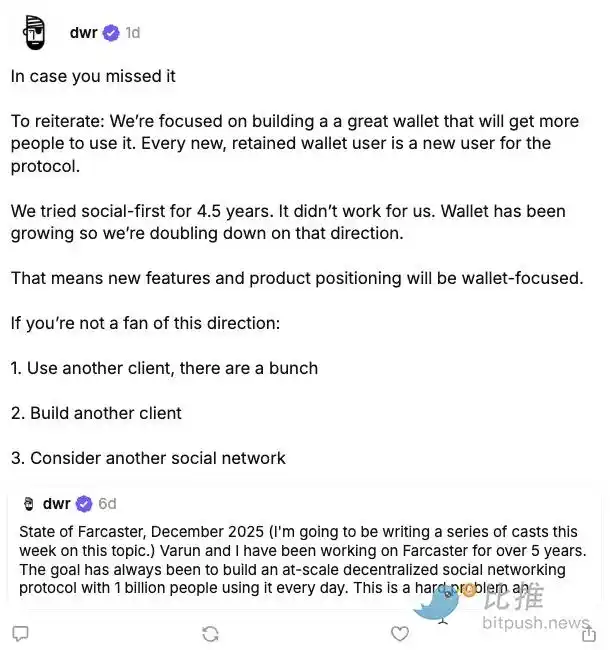
Recently, Farcaster co-founder Dan Romero posted consecutively on the platform, announcing that the team will abandon the "social-first" product strategy and instead fully focus on the wallet direction. In his statement, this was not seen as a proactive upgrade but rather a choice made after a long period of attempts, compelled by reality.
"We tried for 4.5 years to put social first, but it didn't work."
This assessment not only signifies Farcaster's transformation but also once again shines a spotlight on the structural challenges of Web3 social.
The Gap Between Ideal and Reality: Why Farcaster Couldn't Become "Decentralized Twitter"
Farcaster emerged in 2020, amidst the rising narrative of Web3. It attempted to address three core issues of Web2 social platforms:
· Platform Monopoly and Censorship
· User Data Not Owned by Oneself
· Creators Unable to Monetize Directly
Its design concept was quite idealistic:
· Protocol Layer Decentralization
· Clients Can Freely Build
· Social Relationships On-Chain and Migratable
Among the many "decentralized social" projects, Farcaster was once seen as the product closest to Product-Market Fit (PMF). Especially after the 2023 Warpcast, numerous Key Opinion Leaders (KOLs) joined Crypto Twitter, making it seem like the prototype of the next-generation social network.
However, problems soon surfaced.
According to Farcaster Monthly Active Users (MAU) data on Dune Analytics, Farcaster's user growth trajectory revealed a very clear but not optimistic pattern:
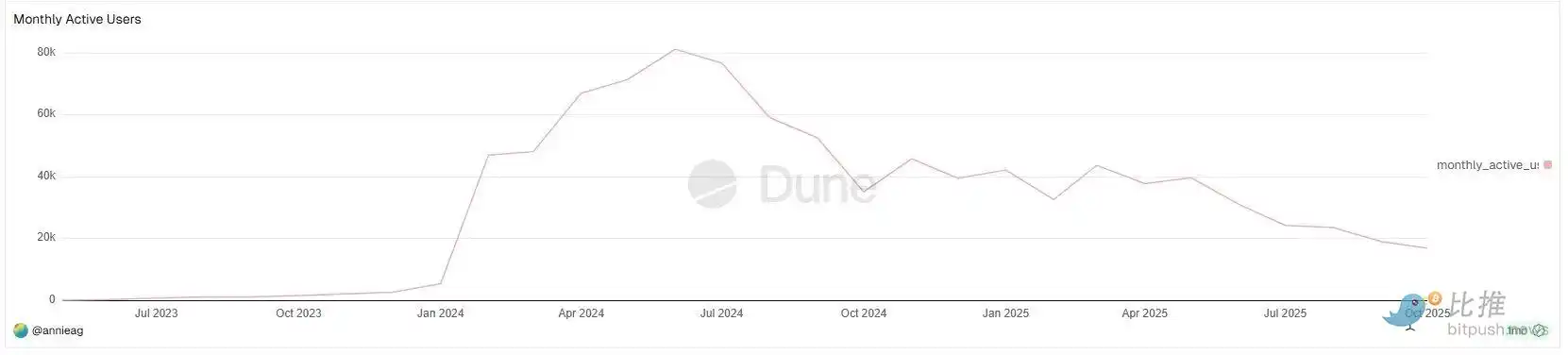
Throughout most of 2023, Farcaster's monthly active users (MAU) were almost negligible;
The true inflection point in growth occurred in early 2024, with MAU rapidly rising from low thousands to approximately 40,000–50,000 in a short period of time, peaking at nearly 80,000 MAU in mid-2024.
This was the only truly significant scaling window for Farcaster since its inception. Particularly noteworthy is that this growth did not occur during a bear market, but rather during a phase of high Base ecosystem activity and intense SocialFi narratives.
However, this window did not last long.
Starting in the latter half of 2024, MAU data showed a noticeable decline, presenting a fluctuating downward trend over the following year:
· MAU rebounded multiple times, but the peaks trended lower
· By the second half of 2025, MAU had dropped to less than 20,000
In reality, Farcaster's growth has always been unable to "break the circle," with its user base highly homogeneous:
· Crypto industry professionals
· VCs
· Builders
· Crypto-native users
For the average user:
· The registration threshold is high
· Social content is heavily "in-group"
· The user experience is not superior to X/Instagram
This has led Farcaster to consistently fail to generate true network effects.
DeFi KOL Ignas on X (@DeFiIgnas) bluntly stated that Farcaster "simply acknowledged what everyone had been feeling for a long time":
The network effect intensity of X (formerly Twitter) is almost impossible to be positively breached.
This is not an issue of crypto narratives but a structural barrier of social products. From a product perspective, the social aspect of Farcaster's issues is quite typical:
· User growth has always been locked within the crypto-native crowd
· Content is highly self-referential, making overflow difficult
· Creator Monetization and User Retention Did Not Form a Positive Feedback Loop
This is also why Ignas succinctly summarized Farcaster's new strategy in one sentence:
"It's easier to add social to a wallet than to add a wallet to a social product."
This assessment fundamentally acknowledges that "social is not Web3's primary need."
"Bubbles Are Comfortable, but Numbers Are Harsh"
If MAU data answers "How is Farcaster doing," another question is: How big is this market itself?
Crypto creator Wiimee provided a set of impactful comparative data on X.

Following an "accidental breakout from the crypto content circle," Wiimee created content for the general audience for four consecutive days. The analysis data showed that within approximately 100 hours, he gained 2.7 million impressions, more than double the total views of all his crypto content in a year.
He remarked: "Crypto Twitter is a bubble, and it's small. Speaking to the general public for four days is more impactful than speaking to insiders for four years."
This is not a direct critique of Farcaster but reveals a more underlying issue: crypto social is inherently a highly self-referential ecosystem with weak external outreach capabilities. When content, relationships, and followers are all limited to the same group of native users, even the most sophisticated protocol design struggles to break through the market's size limit.
Thus, the challenge Farcaster faces is not "the product is not good enough" but rather "there are not enough people in the space."
Wallet, Unexpectedly Achieving PMF
What truly altered Farcaster's internal judgment was not a reflection on social but an unexpected validation of the wallet.
Earlier in 2024, Farcaster introduced a built-in wallet in the app, originally intended as a supplement to the social experience. However, from the usage data, the wallet's growth rate, usage frequency, and retention performance were notably different from the social module.
Dan Romero emphasized in a public response: "Every new wallet user and retained user is a new user for the protocol."
This sentence itself has revealed the core logic of the roadmap adjustment. The wallet is not facing "expressiveness," but the real, rigid on-chain operational needs: transfer, transaction, signature, and interaction with new applications.
In October, Farcaster acquired the AI Agent-driven token issuance tool Clanker and gradually integrated it into the wallet system. This move was also seen as the team's clear commitment to the "wallet-first" path.
From a business perspective, this direction has obvious advantages:
· Higher frequency of use
· Clearer monetization path
· Closer integration with on-chain ecosystem
In contrast, social features are more like icing on the cake rather than the growth-driving engine.
Although the wallet strategy is data-driven, community controversy has followed.
Several long-time users have made it clear that they are not against the wallet itself but feel uncomfortable with the accompanying cultural shift: from "users" being redefined as "traders," from "co-builders" being labeled as the "old guard."
This exposes a practical issue: when the product direction changes, community emotions are often harder to migrate than the roadmap. Farcaster's protocol layer remains decentralized, but the decision-making power regarding product direction still lies largely with the team. This tension is amplified during the transition.
Romero later admitted communication issues but also made it clear that the team has made a choice.

This is not arrogance but a common reality check for a late-stage startup project. In this sense, Farcaster has not abandoned the social ideal but has let go of the fantasy of scaling it.
Perhaps as an observer said, "First make users stay for the tool, then there is room for social interaction."
Farcaster's choice may not be the most romantic, but it may be the closest to reality, diving deep into integrating native financial tools (wallet, transaction, issuance), which is the practical path to transforming into sustainable business value.
You may also like

Penguin Token Sells Off Amid Market Fluctuations
Key Takeaways A significant PENGUIN token holder has started liquidating their holdings, resulting in $40,000 worth of tokens…

Insider Whale Acquires Additional 22,000 ETH
Key Takeaways The “1011 Insider Whale” has added another 22,000 ETH to their holdings. The ETH purchase is…

OWL Tokens Transferred in Potential Sell-off Alert
Key Takeaways $2.1 million in OWL tokens were moved from a team’s wallet, raising concerns about a possible…

Global Risks Influence Bitcoin Fluctuations: QCP Asia’s Insight
Key Takeaways Persistent macroeconomic uncertainties cause global markets to retreat into risk-off mode. Japanese bond yields surge to…

Dormant Ethereum Whale Transfers 50,000 ETH to Gemini, Market Reacts
Key Takeaways A significant dormant Ethereum whale transferred 50,000 ETH, valued at approximately $145 million, to the Gemini…

Whale Leverages a 2x Long Position on 3,436 ETH
Key Takeaways A crypto whale utilized 2x leverage to go long on 3,436 ETH with an average entry…

Avantis Token Experiences Surge as It Faces Key Resistance
Key Takeaways Avantis token (AVNT) recorded a single-day surge exceeding 27%, outperforming other tokens in its sector such…

Enso’s Recent Liquidation Sparks Market Volatility
Key Takeaways Enso experienced a dramatic $11.67 million in liquidations, with a significant 70.7% involving short positions, indicating…

Aperture Finance Faces $17 Million Loss in Blockchain Security Breach
Key Takeaways Aperture Finance suffered a substantial security breach, resulting in the loss of approximately $17 million across…

PENGUIN Token Skyrockets Fueled by White House Post
Key Takeaways The Nietzschean Penguin (PENGUIN) token has experienced a significant price surge following a social media post…

Crypto Traders Shift from PENGUIN to GHOST
Key Takeaways After significant gains, PENGUIN investors are reallocating their funds to newer cryptocurrencies such as GHOST. On-chain…

Justin Sun Boosts River Token with $8 Million Investment
Key Takeaways Justin Sun has invested $8 million into River Protocol, significantly impacting the token’s performance. Following the…

DODO Experiences Significant 24-Hour Growth Due to Strategic Developments
Key Takeaways DODO’s price has seen a 25.46% increase, reaching $0.02 within the last 24 hours. A strategic…

U.S. Government Shutdown Threat Impacts Bitcoin and Crypto Markets
Key Takeaways The risk of a U.S. government shutdown has surged, with predicted odds now approaching 80% as…

Tezos’ Tallinn Upgrade Now Live, Reduces Block Times to 6 Seconds
Key Takeaways The Tallinn protocol update is Tezos’ 20th major upgrade since its inception, optimizing multiple aspects of…

Crypto Users Face Threat from Massive 149 Million Credential Infostealer Data Breach
Key Takeaways: A massive data breach involving 149 million records was discovered, posing rising risks for crypto users.…

Crypto Takeaways from Davos: When Politics and Finances Collide
Key Takeaways Trump’s Geopolitical Crypto Push: U.S. President Trump emphasized the urgency of crypto regulation as a geopolitical…
South Korea’s Coinone Considers Stake Sale Amid Rising Coinbase Interest
Key Takeaways Coinone, a regulated cryptocurrency exchange in South Korea, is contemplating a significant stake sale as consolidation…
Penguin Token Sells Off Amid Market Fluctuations
Key Takeaways A significant PENGUIN token holder has started liquidating their holdings, resulting in $40,000 worth of tokens…
Insider Whale Acquires Additional 22,000 ETH
Key Takeaways The “1011 Insider Whale” has added another 22,000 ETH to their holdings. The ETH purchase is…
OWL Tokens Transferred in Potential Sell-off Alert
Key Takeaways $2.1 million in OWL tokens were moved from a team’s wallet, raising concerns about a possible…
Global Risks Influence Bitcoin Fluctuations: QCP Asia’s Insight
Key Takeaways Persistent macroeconomic uncertainties cause global markets to retreat into risk-off mode. Japanese bond yields surge to…
Dormant Ethereum Whale Transfers 50,000 ETH to Gemini, Market Reacts
Key Takeaways A significant dormant Ethereum whale transferred 50,000 ETH, valued at approximately $145 million, to the Gemini…
Whale Leverages a 2x Long Position on 3,436 ETH
Key Takeaways A crypto whale utilized 2x leverage to go long on 3,436 ETH with an average entry…


 App
App